

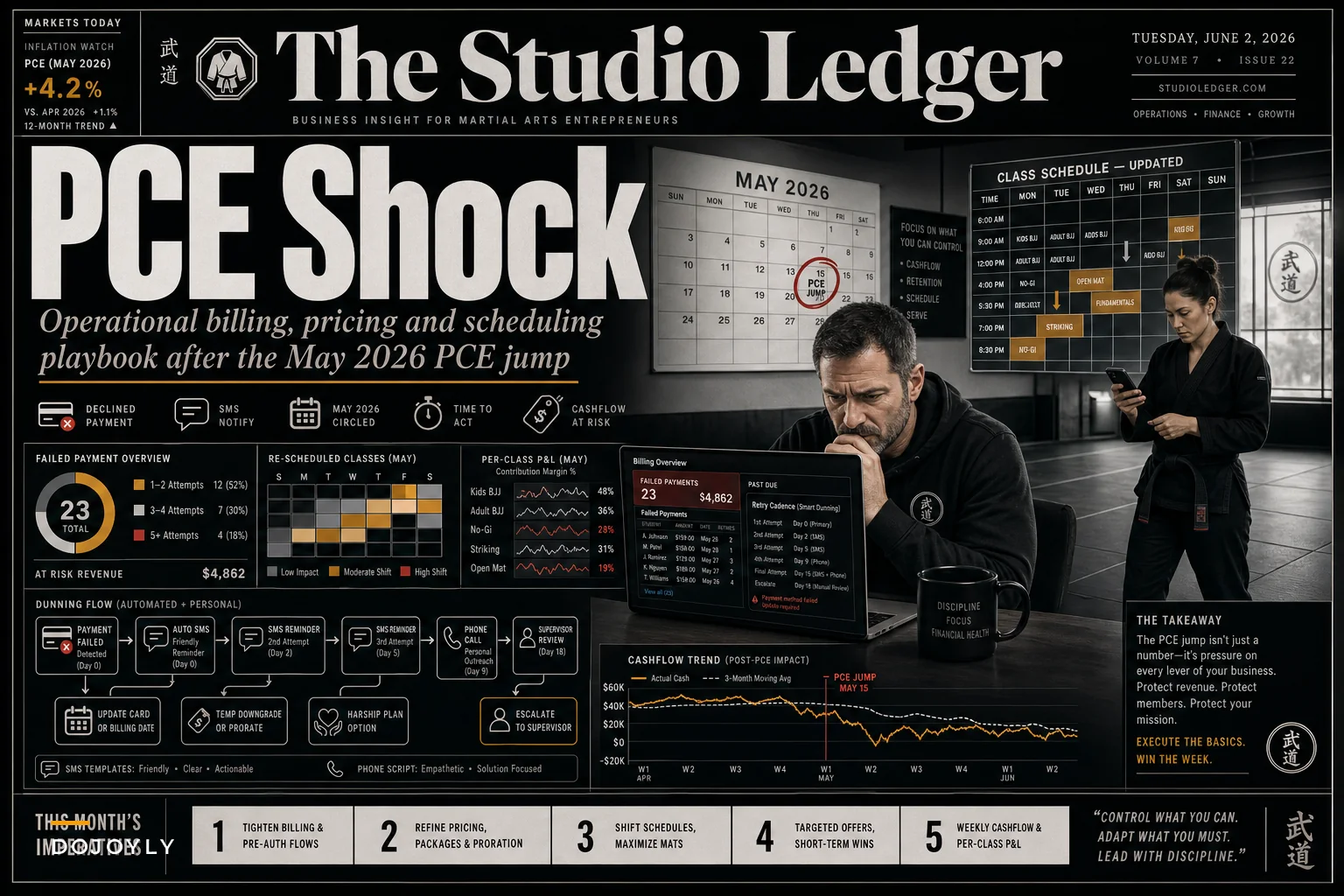

The May PCE numbers hit harder than most people were expecting. The Bureau of Economic Analysis reported a 4.1% year-over-year jump in headline inflation, with core PCE landing at 3.4% — well above what economists had forecast. For martial arts studio owners still navigating post-pandemic recovery, this isn't just background noise. It's a real operational problem that needs real billing and pricing responses, now.
I spent last week talking with studio owners across the midwest and heard the same story repeated back to me. Insurance premiums up 18-22%. Utilities climbing month over month. Equipment suppliers adding fuel surcharges that didn't exist six months ago. And the same families who signed up for unlimited memberships in January are now asking about dropping to twice-weekly plans or putting accounts on hold "just for summer."
The old playbook — raise prices, tighten collections, hope the economy cools — doesn't work when your members are getting squeezed as hard as you are. What studios actually need right now is a serious rethink of how billing, pricing, and scheduling work together. Not to survive the next quarter, but to protect both revenue and retention through what looks like a rough stretch ahead.
The billing crisis hiding in your membership base
Most studios run what I'd call "set and forget" billing — monthly autopay at a fixed rate, minimal communication, reactive problem-solving when cards decline. During stable times, it's fine. During inflationary spikes, it falls apart fast.
Pull your failed payment reports from the last 90 days. If you're running traditional billing, you'll probably see failures climbing steadily since March. Not the usual expired cards or bank errors — these are insufficient funds failures, hitting predictable patterns around the 15th and 30th when other bills come due.
A Brazilian Jiu-Jitsu academy in Ohio shared their numbers with me: failed payments jumped from 8% in February to 14% in May. Each failure triggers a cascade. The automated retry fails again. The member gets embarrassed. They stop showing up to class. By the time someone reaches out personally, they've already mentally written off the membership.
The fix isn't more aggressive collections. It's building flexibility into your billing structure before members hit their breaking point. Smart studios are letting members choose their billing date — 1st, 10th, 20th, or 25th — based on their actual paycheck schedule. Sounds simple, but the operational complexity shoots up immediately. You need clear tracking of who gets billed when, prorated calculations for mid-month switches, and careful cash flow management when billing gets spread across the month.
Offer billing-date choices aligned to common payroll days (1st, 10th, 20th, 25th) to cut failed payments without forcing collections.
You also need systems that surface who has moved billing dates recently and that automate the prorations so staff aren't manually calculating mid-month switches.
Dynamic pricing without destroying your brand
Raising prices during economic stress usually accelerates churn. But keeping prices flat while costs rise guarantees margin collapse. The answer isn't choosing one or the other — it's building pricing structures that respond to both your cost reality and your members' actual circumstances.
Simplify class bookings and attendance tracking.
Dojoyly helps you schedule, confirm, and manage every class effortlessly.
- Unified class & student management
- Automated member notifications
- Instructor scheduling & availability
No credit card required
Start with real segmentation. Your longtime members who've been training three-plus years can probably absorb a modest increase if you communicate it properly. The family that enrolled their two kids last month while dad's on reduced hours? They need options, not a rate hike.
Legacy Protection Tiers:
-
3+ years
Current rate locked through 2026
-
1–3 years
3% increase cap
-
Under 1 year
Market rate adjustment up to 7%
-
New enrollments
Full market rate
Where studios mess this up is implementing the tiers without the operational backbone to support them. You need systematic tracking of enrollment dates, automated tier assignments, clear communication for each group, and exception handling for hardship cases that doesn't rely on whoever happens to be at the front desk making judgment calls in the moment.
That administrative load used to be genuinely prohibitive. AI-powered billing platforms can now handle the complexity while maintaining clear audit trails — and preventing the confusion that kills member trust.
Scheduling as a retention tool, not just a calendar
When budgets tighten, attendance drops before memberships cancel. Members start doing the cost-per-class math in their heads, feel guilty about "wasting" money, then cancel to "take a break" that becomes permanent.
The scheduling fix most studios miss: create value through flexibility instead of fighting for attendance. A Muay Thai gym in Michigan restructured their entire schedule around this idea. Instead of fixed class times that members either make or miss, they implemented rolling 90-minute training blocks with open drop-in windows.
That required rethinking instructor assignments. Rather than one instructor per class, they built in overlapping coverage with clear handoff protocols. The Tuesday 5:30–7:00pm block might have Instructor A from 5:30–6:30 and Instructor B from 6:00–7:00, with a 30-minute overlap where both are present. Members get flexibility, instructors get predictable schedules, the studio maintains quality control.
The numbers shifted noticeably. Under the old model, they averaged around 68% monthly attendance. After switching to flexible blocks, that climbed to 79%. More importantly, 90-day retention went from 81% to 87%.
Prepayment incentives that actually work
Prepayment discounts seem obvious when cash flow tightens. Offer 15% off for six months upfront, get immediate cash, problem solved. Except that's not usually how it plays out.
The studios that successfully use prepayment don't position it as a discount — they position it as inflation protection. The pitch that actually converts: "Lock in today's rate for the next 12 months while prices are rising everywhere else."
The more interesting operational move is partial prepayment. Instead of requiring full upfront payment, offer members the option to prepay just the difference between their current rate and the new one. If someone's paying $140/month and rates are moving to $155, they can prepay $180 ($15 × 12 months) to lock their current rate for a year.
This requires billing logic sophisticated enough to track prepayment credits, apply them correctly each month, and handle edge cases like suspensions or transfers. Most billing systems can't do this natively — you end up with spreadsheet chaos, manual adjustments, and member-facing errors that erode trust.
The instructor cost equation nobody's discussing
CNBC's coverage noted that wage growth continues lagging inflation, putting real pressure on workers across industries. For martial arts studios, this creates a genuine bind: instructors need raises to keep up with inflation, but revenue per student isn't growing fast enough to cover it.
The knee-jerk reaction is to cut instructor hours or pack more students into classes. Both erode the quality that justifies your pricing in the first place. The smarter move is transitioning to performance-based compensation that actually aligns everyone's incentives.
Instead of flat hourly rates, consider a base-plus-bonus structure:
-
Base rate
70% of current hourly
-
Attendance bonus
$2 per student above minimum threshold
-
Retention bonus
$50 per student who hits the 6-month milestone
-
Upgrade bonus
$30 per student who moves from basic to unlimited
A karate dojo in Indiana made this switch in March. Instructor costs dropped around 8% initially as everyone adjusted. By May, costs were back to baseline — but revenue per class had increased 14% because instructors were actively working to improve attendance and retention.
The operational challenge is tracking these metrics accurately and transparently. Instructors need to trust the numbers, which means clear dashboards, regular audits, and fast correction of any errors. Manual tracking breaks down here. You need systems that calculate bonuses automatically from actual attendance data and membership records.
Failed payment workflows that preserve relationships
Every failed payment is a retention problem in waiting. During inflationary periods, these usually aren't members trying to avoid paying — they're good people having temporary cash flow issues who will quietly disappear rather than have an awkward money conversation.
The traditional dunning sequence (retry, retry, email, suspend) accelerates churn during economic stress. You need workflows that protect revenue without making members feel humiliated. One approach that works well segments failed payments by member history:
First-time failure (good standing member):
-
Immediate SMS
"Hi [name], your payment didn't process. No worries — we'll try again in 3 days. Reply HELP if you need to discuss options."
-
No service interruption for 7 days
-
Personal call on day 5 if not resolved
Repeated failure pattern:
-
Immediate SMS with options
"Hi [name], we noticed some payment issues. Would switching your billing date help? Reply with 1st, 10th, 20th, or 25th to update."
-
Automatic offer for temporary downgrade
-
Clear path back to full membership
Chronic issues:
-
Proactive reach-out about scholarship or hardship programs
-
Work-trade options (cleaning, admin help)
-
Extended suspension rather than outright cancellation
Here's a simple flowchart of that workflow.
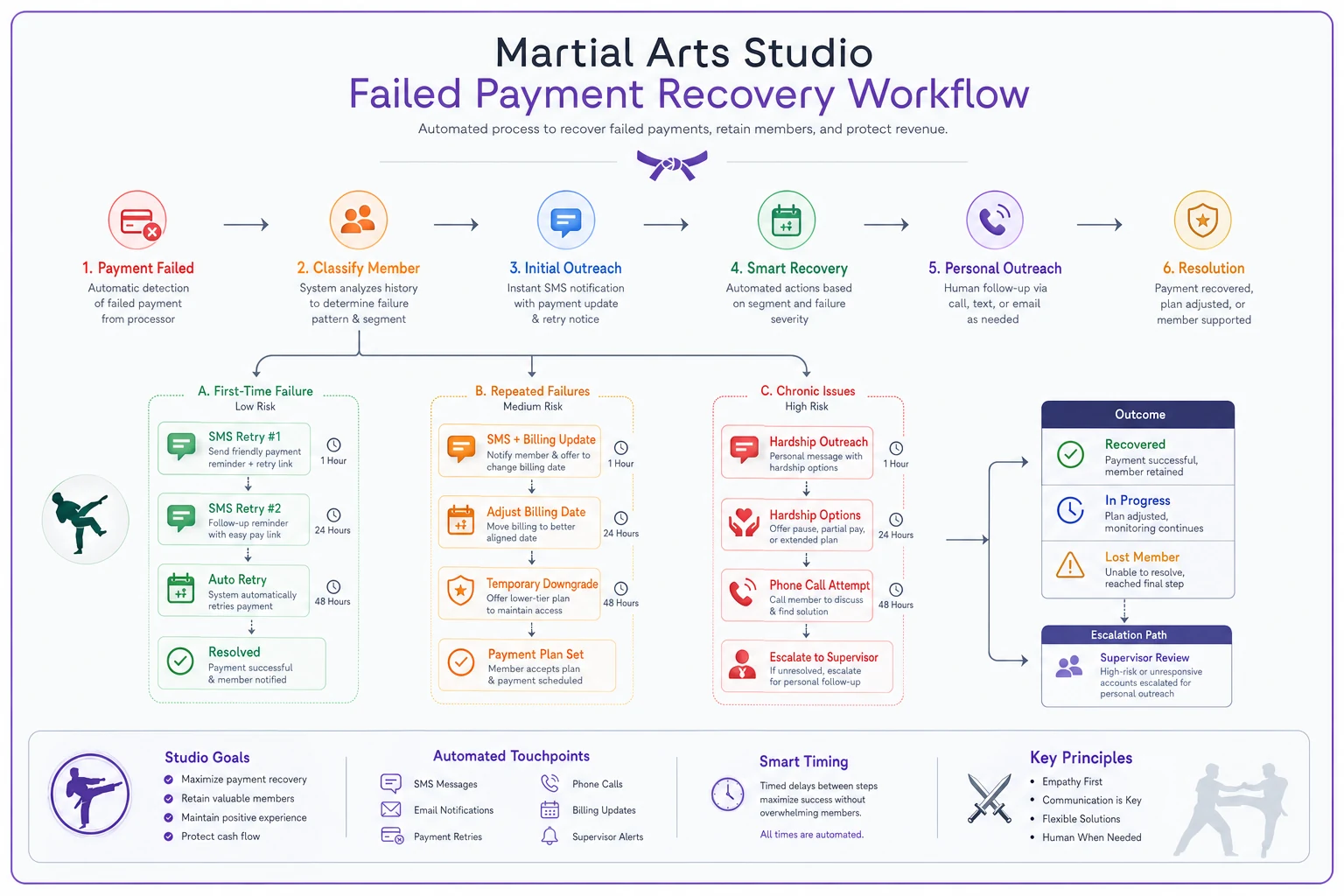
Automating this preserves relationships and reduces churn.
Package restructuring for inflation reality
The traditional good/better/best membership tiers don't map well onto how families actually make decisions during inflation. They're not weighing premium versus basic — they're weighing "keep the membership" versus "drop martial arts entirely."
Restructuring packages around commitment flexibility rather than just access levels tends to work better:
Flex Plans:
-
8 classes/month that rollover (vs. unlimited that doesn't)
-
Choose any 2 months per year to pause without losing your rate
-
Family cap at 2.5x the individual rate regardless of family size
-
Quarterly rate reviews with 30-day notice
Stability Plans:
-
Traditional unlimited access
-
Rate locked for 18 months
-
No pause options
-
Premium pricing for the certainty
Managing rollovers, pauses, and family calculations without creating front desk chaos requires clear system rules — maximum rollover balances, pause request deadlines, family member tracking that doesn't require someone manually updating a spreadsheet every week.
Communication sequences that prevent surprises
Price increases during inflation are expected. Surprise price increases trigger immediate cancellations. The difference between those two outcomes is entirely in how you communicate.
A timeline that works:
-
60 days out
General email about rising costs affecting all businesses, appreciation for member loyalty, commitment to maintaining quality
-
45 days out
Specific announcement of pricing changes with a real explanation of what's driving costs (insurance up X%, utilities up Y%, equipment costs up Z%)
-
30 days out
Individual emails with each member's specific impact and their options — grandfather rate, prepayment, package changes
-
15 days out
Text reminders about upcoming changes and available options
-
Day of change
Confirmation email showing the new rate and next billing date
The key is giving members control at each stage. Executing this cleanly requires email segmentation, tracking of who's received what communication, and handling of edge cases like members who join mid-sequence.
Seasonal adjustments that match cash flow reality
Summer has always been slow for martial arts studios, but inflation amplifies the seasonal pattern. Families cutting discretionary spending start with summer activities, planning to "restart in fall" — and often never do.
| Season | Actions |
|---|---|
| Summer (June–August) | 20% reduction in monthly rates Relaxed attendance requirements Extended freeze options Focus on retention over revenue |
| Fall (September–November) | Peak pricing with heavy promotion New student incentives Referral bonuses doubled Revenue recovery focus |
| Winter (December–February) | Moderate pricing with flexibility Heavy focus on prepayment for next year Corporate and family packages Cash flow stabilization |
| Spring (March–May) | Testing ground for next year's pricing Tournament and testing fee optimization Equipment sales push Margin improvement focus |
Studios using this seasonal model report roughly 15–20% better annual retention because members don't feel forced to maintain peak payments during low-usage months.
The competitive landscape shift
Inflation doesn't hit all studios equally. The large-volume school down the street with 300-plus students and multiple revenue streams can absorb cost increases longer than your 80-student program. That creates temporary competitive disadvantages that become permanent if you don't respond.
Map your local competition:
-
Who's raised prices already?
-
Who's offering aggressive discounts?
-
Who's added new services or packages?
-
Who's quietly reduced schedule or quality?
If everyone else raises prices 10% and you hold flat, you're signaling either superior efficiency or impending quality cuts. Neither message helps long-term.
The better response is differentiating through service, not price. Better communication, more flexible scheduling, superior instructor development, stronger member experience. These improvements cost less than sustained margin compression — but they require real operational execution, not just good intentions.
Technology as a force multiplier
Manual billing and scheduling management might have worked when you had 50 students and stable economics. Managing multiple price points, billing dates, package types, and communication sequences while responding to a shifting economic environment is a different problem.
The studios holding up best through this period aren't necessarily the biggest or best-funded. They're the ones with operational systems that adapt quickly. When a member needs to switch billing dates, it happens automatically. When someone qualifies for a loyalty discount, it applies without manual intervention. When a payment fails, the right workflow triggers based on that member's history — not based on who happens to be working the front desk.
AI-powered platforms handle that complexity while keeping the personal touch members expect. They spot patterns in member behavior, flag problems before they escalate, and execute your policies consistently regardless of staff turnover or scheduling gaps. The studio owner spending 15 hours a week on billing reconciliation doesn't have capacity left to optimize pricing strategy or develop instructors.
Protecting your studio's future
The May PCE numbers aren't an anomaly. They're part of a broader economic recalibration that will shape the next 18 to 24 months for martial arts studios. Studios that respond with rigid, traditional approaches will lose members to economic pressure and to competitors who offer more flexibility. Studios that build adaptive operational systems can actually strengthen their market position during turbulent periods.
Start with billing flexibility — payment date options, thoughtful failed payment workflows, hardship accommodations that preserve member dignity. Layer in pricing changes that acknowledge both your cost reality and your members' constraints. Restructure packages around flexibility. And build the operational infrastructure that lets you execute all of this without drowning in administrative work.
The studios that come out of this inflationary period in better shape won't be the ones that raised prices the most or cut costs the deepest. They'll be the ones that built billing, pricing, and scheduling operations flexible enough to serve members through economic volatility while protecting their own margins. The question isn't whether you need to adapt — it's whether you do it now with a real plan, or six months from now when members are already gone.
Your next 90 days matter more than you probably realize.
Ready to elevate your dojo operations?
Join 500+ martial arts studios using Dojoyly to save time, reduce scheduling conflicts, and improve member engagement.