


You know that stomach drop when your phone buzzes at an ungodly hour. Your head BJJ instructor just texted—their kid woke up with a fever. Class starts in 90 minutes. You've got seventeen students signed up, three testing for blue belt today, and your backup instructor is competing out of state.
What happens next usually determines whether you lose students that day.
Most martial arts studios handle substitute instructors like they're improvising their first sparring session. Someone frantically scrolls through contacts, fires off desperate texts to anyone who might be free, then either cancels class or throws an unprepared instructor into a room full of students expecting their regular sensei.
Students don't leave because of occasional substitutes—they understand emergencies happen. They bail when the substitute shows up clueless, teaches completely different material than what they've been drilling, or the class gets axed with a "sorry guys" text fifteen minutes before warmups.
The real problem isn't the absence. It's the chaos that follows.
Why coverage requests turn into desperate scrambles
Your typical martial arts instructor calls out roughly once every six weeks. Four instructors on your schedule? You're dealing with coverage every other week.
Yet most studios still treat each incident like it's never happened before.
The panic follows a predictable script. Owner gets the text—best case a few hours early, often that morning. They mentally run through who might be available (never written down anywhere). They send individual texts, waiting for responses while watching the clock.
Nobody updates students. Nobody briefs the substitute. Nobody checks if this instructor has bailed three times this month.
The substitute shows up knowing "teach the 10 AM karate kids." They have no clue the class spent last week drilling kata. They don't know Tommy has a tournament Saturday and needs form practice. They don't know Sarah just returned from two weeks off and needs catch-up.
So they default to whatever they usually teach. The curriculum flow breaks. Students get confused bouncing between teaching styles. Parents notice the disorganization immediately.
That belt test scheduled for today? Postponed indefinitely because the substitute doesn't even know who was testing.
The substitute bench that exists only in theory
Every studio owner claims they have backup instructors ready. They'll mention three senior students who "help sometimes" or that black belt who "used to teach" before switching to evening classes.
Simplify class bookings and attendance tracking.
Dojoyly helps you schedule, confirm, and manage every class effortlessly.
- Unified class & student management
- Automated member notifications
- Instructor scheduling & availability
No credit card required
When you need someone at 7 AM Tuesday, that roster vanishes.
Availability changes constantly. The college student who covered mornings last semester now has early statistics. The retired instructor who was always free just took a consulting gig.
Nobody tracks these shifts systematically, so you're working with stale information every emergency.
The rotation gets even worse. Without clear policies, the same reliable instructor covers 80% of absences because they never say no. They burn out fast. Meanwhile, other qualified people never get asked because you forgot they mentioned Tuesday availability.
Or instructors start dodging requests because saying yes once means becoming the permanent substitute.
Then there's payment confusion. Some places pay regular hourly rates. Others offer flat coverage fees. Some don't pay at all if the substitute is earning teaching hours for certification. Nobody knows until they're negotiating at 7:15 AM.
The person agreeing to help feels either underpaid or uncertain about compensation. Great motivation for next time.
Building coverage that actually functions
Smooth operations start with realistic preparation before anyone gets sick. Begin with your actual roster—not the fantasy version where everyone's perpetually available.
Build a simple availability grid. Not some complex app—just a spreadsheet tracking who's certified for which programs (kids, adults, beginners, competition team), their typical open windows (Monday mornings, evening classes, weekends), contact preferences, last coverage date, and pay rate.
Update monthly. Set a recurring reminder for the first Monday: text your substitute list asking about availability changes. Most won't respond, meaning no changes. The ones who do save you from calling unavailable people.
Track coverage in the same sheet. When someone fills in, mark it. When you need coverage, start with qualified people who haven't helped recently.
This prevents both burnout and favoritism. One studio realized they'd asked the same instructor fourteen times while three others hadn't been contacted once—they had no idea until they started tracking.
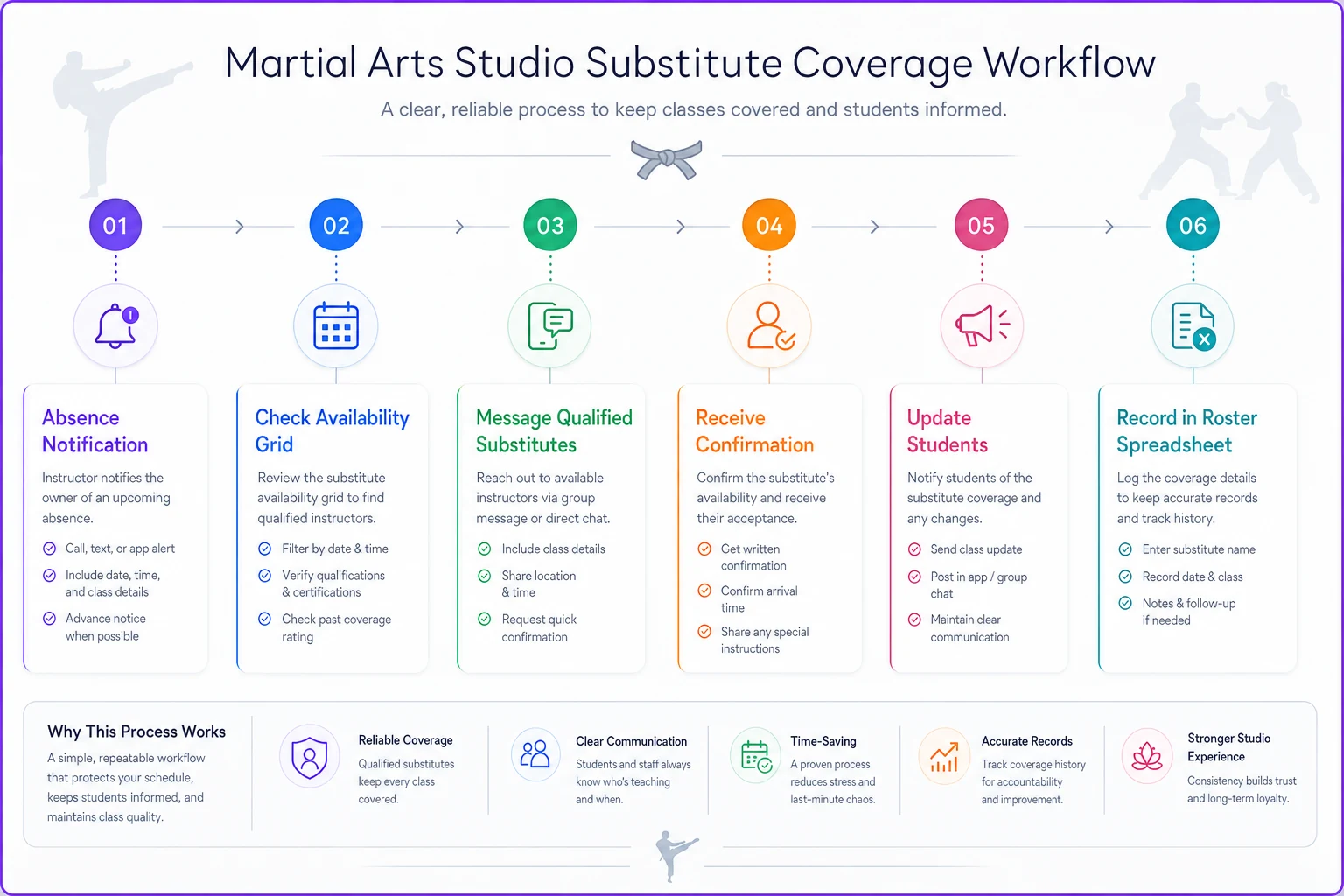
Use this simple workflow when coverage is needed.
This prevents both burnout and favoritism. One studio realized they'd asked the same instructor fourteen times while three others hadn't been contacted once—they had no idea until they started tracking.
Messages that skip the panic
When that early morning text arrives, templates save sanity. Not corporate nonsense, but actual messages you customize in seconds.
Substitute request: "Hey [Name], need coverage for [Day] [Time] [Program]. Regular instructor sick. Can you take it? Class working on [specific technique]. [Number] students. Pays $[rate]. Let me know by [time]."
Student update (with substitute): "Quick heads up—[Regular Instructor] out sick today, [Substitute Name] covering. We'll continue [specific focus]. See you at [time]!"
Student update (canceling): "Need to cancel today's [time] class due to instructor illness. Account credited for session. [Regular Instructor] back [day]. Saturday workshop on [topic] still has openings if you want extra training."
Post-class follow-up: "Thanks for covering. Students worked on [topic]. Quick notes: [2-3 points about progress/issues]. Payment processed for $[amount]."
Information packets that prevent blind teaching
The biggest substitute disaster? Throwing experienced instructors into classes blind. Even seasoned teachers struggle without context.
Keep a "substitute folder" for each program. Not a massive manual—practical quick-reference.
-
current focus (techniques or forms the class has been drilling recently)
-
roster with relevant notes ("Tommy testing for yellow belt next week," "Sarah returning from injury, no contact drills")
-
backup lesson structure (reliable 60-minute plan that works anytime)
-
program basics (your terminology, belt standards, class rules)
Kids format: warmup game, technique review, drill stations, cool-down. Adults: warmup, fundamental technique, partner drills, controlled sparring, stretching.
This isn't about perfect documentation. It's giving qualified instructors enough context to maintain continuity. Update the current focus weekly—two minutes every Monday. Everything else stays mostly static.
One BJJ school kept this as a Google Doc accessible from phones. Substitutes reviewed it in the parking lot and walked in prepared.
Students couldn't tell their regular professor was out until someone asked about his sick kid.
Money talk before the emergency
Financial discussions at 7 AM go badly. Set substitute pay policies when everyone's calm and nobody needs emergency help.
Clearest approach: standard rates by class type, not individual negotiation.
| Class Type | Rate |
|---|---|
| Kids classes | $35-45 hourly |
| Adult basics | $40-50 |
| Advanced/competition | $50-65 |
| Emergency coverage (under 2 hours notice) | Adds $15 |
Post these where instructors see them. Include them in instructor agreements. When you need coverage, everyone knows the deal upfront.
For instructors earning certification hours, clarify training versus paid work. "Shadow teaching" for certification? Training, unpaid. Solo instruction responsibility? Work, standard rate.
The distinction matters legally and for relationships.
Scheduling that prevents scrambles
Best substitute situation is one you rarely need. Not because instructors never get sick, but because you built operational buffers.
Overlap instructor schedules when possible. Kids program runs 4-6 PM? Schedule two instructors 4-5 PM. One leads, one assists. Lead calls out? Assistant takes over and you only need coverage for the helper role—much easier.
Costs more in payroll but prevents headaches and maintains quality.
Partner with nearby studios. Not as competition but operational allies. The taekwondo place two miles over has similar coverage challenges. Create mutual aid agreements—you cover them, they cover you. Their instructors won't know your exact curriculum, but they can run solid fundamentals when needed.
Consider "floating instructor" positions. Someone whose job includes availability for coverage. They handle equipment, private lessons, curriculum development normally, but keep flexible schedules specifically for substitution.
Expensive? Less than losing students from constant cancellations.
For critical programs like competition teams, always have two instructors current on the curriculum. They don't both teach every session, but both stay updated on team progress. When one's out, transition stays smooth.
Monthly checkups that prevent crisis
Set monthly reminders to review your substitute system. Twenty minutes prevents most coverage disasters.
Check availability—send those "any changes?" texts. Review last month's absences for patterns. Someone calling out frequently? Tuesday mornings consistently problematic? Same substitutes overused?
Set a recurring calendar reminder for the first Monday of each month to check substitute availability.
Update lesson plan summaries with current curriculum. Verify compensation records are clean and everyone got paid. Check that notification templates have correct times and programs.
This isn't about complex management systems. It's twenty minutes monthly so you're not scrambling when that inevitable 6:47 AM text arrives.
Digital tools that reduce manual work
The mechanical coverage pieces—tracking availability, sending notifications, recording who covered what—consume hours better spent teaching. Operational software helps studios scale beyond manual owner management.
Modern scheduling platforms maintain substitute rosters digitally, track availability patterns, automatically notify qualified substitutes using rotation rules, and send student updates without individual typing. When instructors mark unavailable in the system, it updates everywhere instantly.
No more calling people on vacation.
Some platforms use AI automation to match substitutes to absences—considering certification, recent coverage, even teaching compatibility. The same systems track compensation automatically, preparing payroll without spreadsheet updates.
The real value isn't the technology itself. It's freeing mental bandwidth from repetitive tasks so you focus on training substitutes, maintaining curriculum quality, and building relationships that actually keep studios running.
Making coverage routine instead of crisis
When you treat substitute coverage as normal operations instead of emergency response, that 6:47 AM text becomes minor inconvenience rather than crisis. Check roster, message next available qualified instructor, update students, return to coffee.
Substitutes show up prepared, knowing exactly what students have been practicing. They maintain curriculum continuity while adding their teaching style—students actually enjoy variety when it's organized. Parents see professional operations handling real-life situations smoothly.
Most importantly, regular instructors can take sick days without guilt. They know the studio has solid coverage systems. No panicked texts asking "can you come in anyway?" They recover properly and return ready to teach, instead of pushing through illness and burning out.
The operational difference shows in retention. Students stay because consistency continues even when specific instructors can't be there. Parents trust their kids' training won't get disrupted by normal life events.
Your studio builds a reliability reputation that matters more than any marketing.
The substitute instructor policy isn't about perfect attendance—it's preparing for reality. Instructors will get sick, have emergencies, need personal time. Studios that thrive treat coverage as standard procedure, not recurring crisis.
Build your roster, create templates, maintain lesson plans, clarify compensation before needing them. Twenty minutes of monthly maintenance pays off every time someone texts before 7 AM.
Students keep training, instructors feel supported, and you handle whatever comes up without chaos. How you manage unexpected absences tells students more about your professionalism than all the perfect classes when everything goes according to plan.
Students keep training, instructors feel supported, and you handle whatever comes up without chaos. How you manage unexpected absences tells students more about your professionalism than all the perfect classes when everything goes according to plan.
Ready to elevate your dojo operations?
Join 500+ martial arts studios using Dojoyly to save time, reduce scheduling conflicts, and improve member engagement.