



A family walks into your dojo on the 17th of the month. They're excited, kid's ready to start, credit card in hand. Your front desk freezes for a second. The billing software shows $149 for the monthly membership, but they're starting halfway through November. Do they pay full price? Half? What about December? And wait, didn't you promise them a sibling discount during the tour last week?
This scenario plays out in martial arts studios everywhere. The inconsistent handling costs studios thousands in lost revenue every year. Not from major billing failures, but from small mistakes, inconsistent policies, and manual calculations that go wrong.
The hidden cost of billing confusion
Most studio owners think their billing problems are about late payments or failed transactions. The real profit leak happens much earlier - in those awkward moments when staff aren't sure what to charge, when discount policies get applied inconsistently, or when proration calculations happen differently depending on who's working the desk.
Studios lose $400-700 monthly just from inconsistent proration and discount application. That's not students skipping payments. That's charging some families $74.50 for a half-month while charging others $149 for the same situation. Or applying a 10% sibling discount to one family's second child but forgetting it for another. Or worse, applying discounts that were supposed to expire after three months but nobody tracked them.
The problem compounds with operational chaos. Staff spending 15 minutes calculating what should be a 30-second transaction. Parents getting different answers about pricing depending on which instructor they ask. The owner getting pulled into billing disputes that shouldn't exist.
Why martial arts billing gets complicated fast
Unlike a gym membership where everyone pays the same monthly rate, martial arts studios deal with layers of complexity that traditional billing systems weren't built for.
Simplify class bookings and attendance tracking.
Dojoyly helps you schedule, confirm, and manage every class effortlessly.
- Unified class & student management
- Automated member notifications
- Instructor scheduling & availability
No credit card required
Your typical month includes new students starting on random dates, families with multiple kids at different belt levels, promotional rates from that Facebook campaign you ran, military discounts you honor, the special rate you gave to the family that referred three other students, and temporary holds for injuries or travel.
Each scenario requires specific handling, clear policies, and consistent application. What usually happens though: instructors make gut decisions, front desk staff use different calculation methods, owners create exceptions that never get documented, and the bookkeeper discovers the mess months later when numbers don't add up.
Building proration policies that actually work
Most studios lose money on proration without realizing it.
The cleanest approach for mid-month starts uses a daily rate calculation. Take your monthly rate, divide by the number of days in that month, multiply by days remaining. Simple enough, except November has 30 days and December has 31, so the daily rate changes. And what counts as the "start date" - when they sign up, attend their first class, or when the payment processes?
A policy framework that eliminates confusion: Start dates 1st-7th: Charge full month Start dates 8th-20th: Prorate based on calendar days remaining Start dates 21st-31st: Prorate current month + full next month upfront
Use this quick visual of the decision flow to help train staff on the 1st/8th/21st rules.
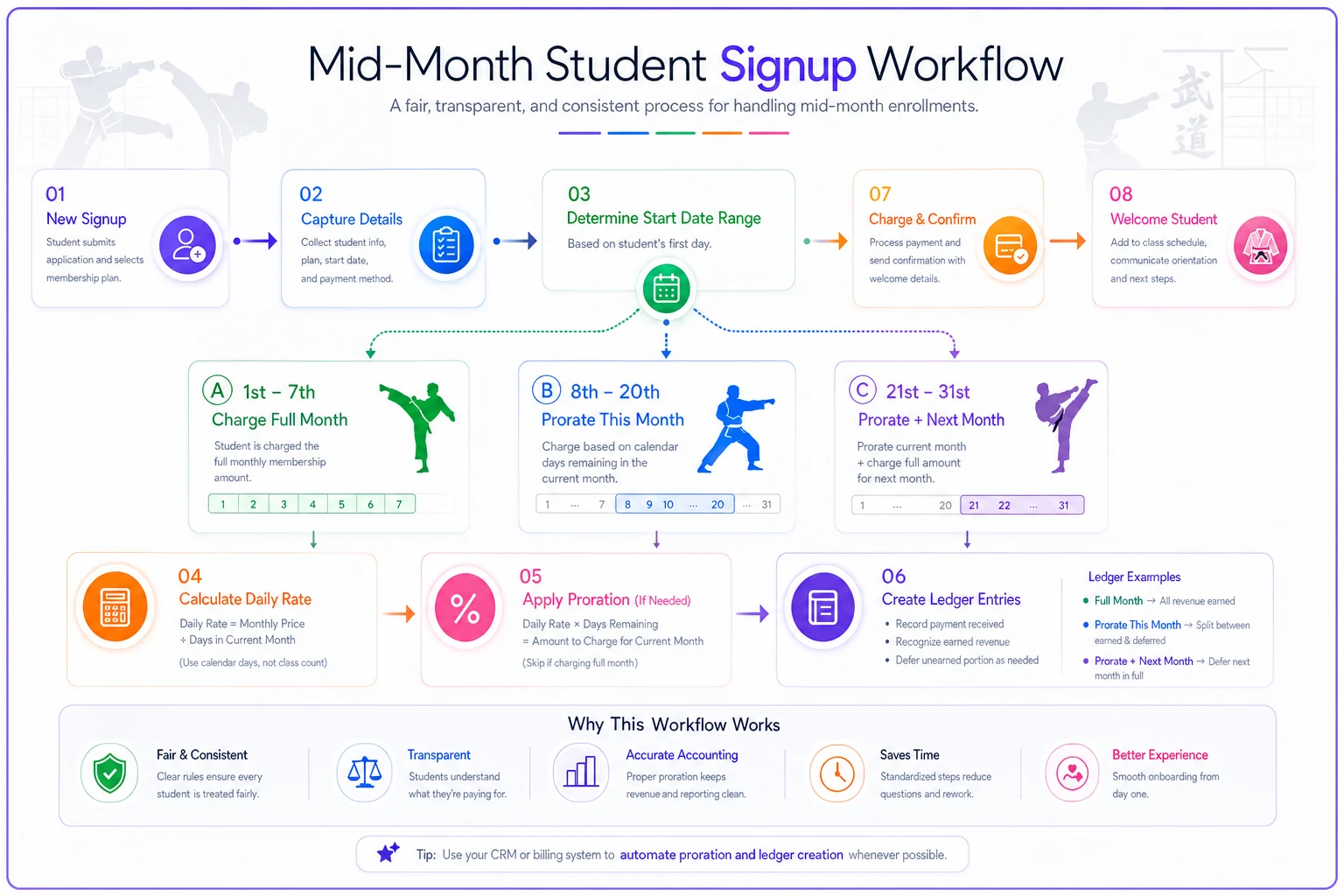
This handles most situations cleanly. The 1st-7th full charge makes sense because they're getting nearly the full month of classes. The 21st-31st double charge ensures you're not processing tiny amounts and reduces the chance they'll quit before really starting.
Sample ledger entries that prevent discrepancies
Your bookkeeping needs to track prorated amounts separately from regular tuition. Otherwise, your monthly revenue reports become meaningless and you can't spot trends or issues.
How a mid-month November signup should flow through your books:
-
November 17th signup (14 days remaining)
-
- Regular monthly rate
$149
-
- Daily rate
$149 ÷ 30 = $4.97
-
- Prorated charge
$4.97 × 14 = $69.58
-
- December prepayment
$149
Ledger entries:
Nov 17 - Debit: Accounts Receivable $218.58 Nov 17 - Credit: Deferred Revenue (Dec) $149.00 Nov 17 - Credit: Tuition Revenue (Nov) $69.58 Dec 1 - Debit: Deferred Revenue $149.00 Dec 1 - Credit: Tuition Revenue $149.00
Notice how December's payment sits in deferred revenue until December actually starts. This prevents your November revenue from looking artificially inflated and keeps monthly financials accurate.
Discount policies that protect your margins
Discounts destroy profitability when they're not tracked properly. That 10% sibling discount sounds small until you realize it's been running for two years on a family that was supposed to get it for just the first three months.
| Discount Type | Amount | Limit |
|---|---|---|
| Sibling discount | 10% off second child, 15% off third+ child | Per family |
| Military/First responder | 10% off per student | Valid ID required |
| Annual prepay | 8% off total | Paid in full only |
| Referral credit | $25 account credit per successful referral | No stacking |
But here's the critical part - discounts don't stack. A military family with three kids gets either the military discount or the sibling discount, not both. Annual prepay supersedes monthly discounts. This prevents families from paying 40% less than your standard rate through accumulated discounts.
Track every discount with an expiration date or review trigger. Even "permanent" discounts should flag for annual review. Some studios still honor founder's rates from 2018 while families pay $89 monthly and new students pay $149.
Sample policy language for your team
Your front desk needs exact language, not general guidelines. Print this, laminate it, keep it at the desk:
For mid-month starts: "Since you're starting on the [DATE], your first month is prorated to $[AMOUNT] for the remaining classes in [MONTH]. Starting [NEXT MONTH], you'll be on our regular monthly rate of $[RATE]. Today's total is $[PRORATE + NEXT MONTH] which covers you through the end of [NEXT MONTH]."
For discount requests: "We offer a 10% sibling discount for your second child and 15% for additional children. This applies to the lower-priced program if your children are in different classes. The discount continues as long as both children are actively enrolled."
For "I was told" situations: "Let me verify that discount in our system. All special rates require manager approval and documentation. If we offered you a specific rate, it will be noted in your account. One moment while I check."
This language prevents awkward negotiations and inconsistent promises that erode your pricing structure.
Common billing cycle examples
Your desk will face these scenarios this month:
Scenario 1: Family with two kids starting November 15th
-
Calculate base monthly rates
Kid 1 at $149, Kid 2 at $134.10 (with sibling discount)
-
Apply November proration (16 days)
$75.95 + $68.35 = $144.30
-
Add December prepayment
$283.10
-
Total charge today
$427.40
Scenario 2: Adult student with military discount starting November 22nd
-
Apply military discount to regular rate
$169 becomes $152.10
-
Calculate November proration (9 days)
$45.63
-
Add December prepayment
$152.10
-
Total charge today
$197.73
Scenario 3: Returning student (quit 6 months ago) starting November 3rd
-
Check previous rate
$129 (from 2023)
-
Apply current pricing
$149 (no grandfather pricing)
-
No proration needed (started in first week)
-
Total charge today
$149
Each scenario has a clear calculation path that any staff member can follow.
Bookkeeping exports that catch revenue leaks
Your billing software probably generates reports, but are you looking at the right data? Most studios run a basic monthly revenue report and call it done. That won't catch the slow leaks.
Export and review these reports monthly:
Discount Aging Report: Shows every active discount, when it started, and its current monthly impact. Look for discounts over 6 months old and families with multiple stacked discounts.
Proration Variance Report: Compares prorated amounts charged versus what should have been charged based on start date. A 10% variance means your staff needs retraining on the calculation method.
Write-off Tracking: Every adjustment, credit, or write-off with the reason code and authorizing staff member. More than 2% of monthly revenue in adjustments signals a process problem.
Revenue Per Student Trends: Not just total revenue, but average revenue per active student monthly. This number dropping means discounts are creeping up or you're not raising rates appropriately.
Set a monthly reminder for the 5th of each month.
Pull the reports, spend 20 minutes looking for patterns, and address issues immediately.
When automation prevents billing chaos
The manual calculation and tracking of billing variations is where studios fall apart. Staff make math errors, forget to apply discounts, or apply them incorrectly. Policies get bent during busy periods. Documentation disappears.
AI-powered operational software changes this completely. Instead of your front desk calculating proration manually, the system automatically determines the correct amount based on start date and your configured policies. When a family qualifies for a sibling discount, it applies automatically and sets the appropriate expiration or review date.
The real value isn't just accurate calculations - it's the consistency. Every family gets treated the same way. Every discount gets tracked. Every proration follows the same formula. The AI agents handle the complexity behind the scenes while your staff focuses on welcoming new students.
Modern billing platforms with AI automation also catch the edge cases humans miss. They flag when a family has conflicting discounts, alert you when promotional rates are about to expire, and prevent the accidental stacking of discounts that shouldn't combine. They maintain a complete audit trail, so six months from now when a parent questions a charge, you have the exact calculation and policy that was applied.
Protecting your revenue starts with clarity
Studios that clean up their billing policies typically see an immediate 5-8% revenue increase without adding a single new student. That's just from charging correctly and consistently for the students they already have.
Start by documenting your current policies, even if they're inconsistent. Train your entire team on the same calculation methods. Create written scripts for common billing scenarios. Track every discount and review them quarterly.
The martial arts business is challenging enough without losing money to preventable billing confusion. Your policies don't need to be complex - they need to be clear, documented, and consistently applied. Stop the bleeding from a thousand tiny billing cuts. Your bottom line will thank you.
Ready to elevate your dojo operations?
Join 500+ martial arts studios using Dojoyly to save time, reduce scheduling conflicts, and improve member engagement.