


No-shows hurt differently in martial arts than other businesses. When someone skips their Tuesday evening BJJ fundamentals class, you're not just losing that hour of revenue—you're watching an entire belt progression slow down, seeing momentum die, and dealing with the ripple effect that hits partner drills, sparring rotations, and eventually retention rates.
A perfectly good Muay Thai program in Austin crumbled this exact way last year. The owner had 22 registered for his Saturday morning intermediate class. Consistently, only 14 showed up. Those empty spots meant beginners on the waitlist couldn't move up, experienced students had fewer sparring partners, and the energy in the room felt deflated every single week. By month three, even the regulars started showing up less because "class feels dead lately."
Most studios accept this as normal. They'll tell you 30-40% no-show rates are just part of running martial arts classes. After building operational systems for dozens of studios, that acceptance keeps studios stuck at break-even when they could be profitable.
Why martial arts no-shows compound differently
Your typical fitness class can absorb a few no-shows. Zumba still works with 12 people instead of 15. But martial arts breaks down operationally when attendance becomes unpredictable.
Take a standard kids' karate class with belt testing prep. You've structured the month assuming consistent attendance—week one introduces forms, week two refines technique, week three adds speed, week four polishes for testing. When Tommy shows up to weeks one and four but misses the middle sessions, now you're running two different curricula in the same class. Your instructor splits attention, other students get less feedback, and Tommy's parents wonder why he's not ready for his yellow belt test.
Adult programs face different but equally damaging patterns. Brazilian Jiu-Jitsu relies heavily on consistent training partners. When your Tuesday/Thursday crew becomes unpredictable, students lose drilling consistency. That purple belt who was helping newer students develop their guard game stops showing up because "I never know who'll be there." The social fabric that keeps martial arts students training for years instead of months starts unraveling.
The financial bleeding gets worse. A 16-student evening class with four no-shows isn't just losing $60 in drop-in revenue. You're paying an instructor for a class that's operating at 75% capacity, your per-student overhead jumps by 25%, and those four waitlisted students who wanted that slot are now looking at your competitor's schedule.
The waitlist allocation logic that actually fills classes
Most studios handle waitlists wrong. They either don't have one (leaving money on the table) or they treat it like a simple queue (first come, first served). Neither approach reduces no-shows effectively.
Simplify class bookings and attendance tracking.
Dojoyly helps you schedule, confirm, and manage every class effortlessly.
- Unified class & student management
- Automated member notifications
- Instructor scheduling & availability
No credit card required
What works better: tiered waitlist priority based on attendance reliability.
Start tracking show-up rates for every student. Not complicated—just a simple percentage of attended versus registered classes over the last 60 days. Students with 90%+ attendance get automatic priority on waitlists. Those hovering around 70% go to tier two. Below that, tier three.
When someone cancels their spot in tomorrow's BJJ fundamentals class, your system checks the waitlist and offers it to the highest-tier student first. They get 2 hours to confirm. No response? Move to the next person in that tier. Only after exhausting tier one do you move to tier two.
This creates a beautiful operational feedback loop. Students quickly learn that consistent attendance gives them access to popular class times. The guy who only shows up when he feels like it stops getting those prime Saturday morning slots. Your actual class attendance starts climbing because the people filling spots are the ones who actually show up.
One kickboxing studio in Phoenix implemented exactly this system and watched their Thursday evening class go from averaging 18 attendees (with 24 registered) to consistently hitting 23-24 actual bodies on the mat. Same registration numbers, completely different operational reality.
The waitlist is just one piece though. The real gains come from coordinating it with your reminder system.
Multi-channel reminder timing that gets people to actually show up
Studios mess up reminders in three ways: sending them at the wrong time, using the wrong channel, or making them too easy to ignore. You need to fix all three to reduce martial arts class no-shows effectively.
The 48-24-2 Framework
Forget the single day-before reminder. That's amateur hour and it shows in your attendance rates.
48 hours out: Send the first touch via email. This isn't a reminder—it's a prep message. "Thursday's gi class will focus on guard passing. Bring your A-game and a water bottle." Make it about anticipation, not obligation.
24 hours out: SMS hits different. Short, action-oriented. "Tomorrow 6pm BJJ confirmed. Reply N to cancel and open your spot." That last part matters—you're making them think about someone else wanting their slot.
2 hours out: Push notification through your studio app (if you have one) or a final SMS. "Class starting in 2 hours. Jeremy's teaching tonight." Personal touches like instructor names increase show rates by roughly 8-12% based on patterns across multiple schools.
Not everyone responds to the same communication channel. Track what actually works:
| Student Segment | Primary Channel | Secondary Channel | Success Rate |
|---|---|---|---|
| Under 25 | Push notification | SMS | 78% response |
| 25-40 busy professionals | SMS | 82% response | |
| 40+ parents | SMS | 71% response | |
| Competition team | WhatsApp group | SMS | 91% response |
Default reminders to each student's historically most responsive channel to improve confirmations.
Many studios blast the same message through every channel simultaneously. That's how you train people to ignore you. Space them out, vary the message slightly, and track which channels actually drive confirmations versus just opens.
Building incentive mechanics that reward consistency without breaking the bank
Points, discounts, and free gear—most studios try these and wonder why they don't move the needle on attendance. The problem isn't incentives themselves, it's how they're structured.
Traditional approach: Show up 10 times, get a free month. Sounds good until you realize it rewards quantity over consistency. The student who binges 10 classes in two weeks then vanishes for a month gets the same reward as someone steadily attending twice weekly.
The Streak-Based Model
Instead, tie rewards to attendance streaks with recovery windows. Here's a framework that's worked across multiple studios:
-
2 weeks perfect attendance (all registered classes attended)
Unlock priority booking for next month
-
4 weeks at 85%+ attendance
15% discount on gear or private lesson
-
8 weeks at 85%+ attendance
Free seminar or workshop entry
-
12 weeks at 90%+ attendance
Custom patch, rashguard, or gear with "Dedicated Student" recognition
Key detail: Allow one "grace skip" per month that doesn't break the streak if they cancel 4+ hours in advance. Life happens, and rigid systems create resentment instead of motivation.
The Social Proof Layer
Add a public element without being obnoxious. A simple "Consistency Board" in your studio showing current streak leaders works better than you'd think. Not names and shaming for missing class—just celebrating those who show up consistently.
One Taekwondo school posts a monthly "Iron Will Award" on social media for the student with the best attendance. Cost: $0. Impact: Their overall no-show rate dropped from 35% to 22% in four months. Students started treating class slots as commitments, not suggestions.
Anti-Incentives That Actually Work
Sometimes the stick works better than the carrot. But you have to be strategic about it.
-
Cancel within 2 hours of class
Lose priority booking for one week
-
No-show without cancellation
Drop one tier in waitlist priority
-
Three no-shows in a month
Require confirmation 24 hours before each class for the next month
These create enough friction to change behavior without feeling punitive enough to drive students away.
Measuring what actually matters (and killing what doesn't work)
Most studios track the wrong metrics or worse, track nothing at all. "Feels like fewer no-shows lately" isn't data you can build on.
The Core Four Metrics
-
Registration-to-Attendance Rate
(Actual attendees / Registered students) × 100
-
Waitlist Conversion Rate
(Waitlist students who attended / Total waitlist offers) × 100
-
Cancellation Window
Average hours between cancellation and class time
-
Streak Participation
Percentage of active students maintaining 80%+ attendance
That third metric—cancellation window—tells you if your reminder system is working. If people are canceling 30 minutes before class, your 2-hour reminder is too late. If they're canceling 18 hours out, your 24-hour reminder might be triggering uncommitted students to bail.
The 6-Week Experiment Cycle
Don't run changes for three months hoping they work. Use 6-week cycles:
Weeks 1-2: Baseline measurement with current system
Weeks 3-4: Implement one change (just one—don't muddy the data)
Weeks 5-6: Measure impact and decide to keep, kill, or modify
A San Diego MMA gym tested SMS reminders at different times using this cycle. They discovered 3 hours before class had 12% better attendance than 2 hours, completely opposite to what they expected. Their demographic (mostly military and first responders) needed more lead time to arrange schedules.
Red Flags to Kill Immediately
-
Attendance dropping after implementing "streak rewards" (might be too complex)
-
Waitlist students accepting spots but not showing (your tiers might be off)
-
Increased complaints about communication (you're over-messaging)
-
Competition team attendance dropping (they need different handling than casual students)
When something isn't working by week 4 of your cycle, kill it. Don't wait for week 6.
The operational damage from a bad policy compounds faster in martial arts than other businesses because of the community dynamics.
A real workflow in action
This played out at a mid-sized BJJ and Muay Thai gym in Denver. They had roughly 240 active students, 8 instructors, and were hemorrhaging money despite being "full" on paper.
Their Tuesday/Thursday evening BJJ classes showed 32 registered students but averaged 21 actually showing up. The owner was paying for a second instructor to handle 32 students, but with only 21 attending, that second salary was pure waste. Multiply that across 12 classes per week and they were bleeding roughly $3,400 monthly in unnecessary instructor costs.
The workflow they implemented:
Week 1: Audit and Setup
-
Pulled three months of attendance data
-
Identified their worst no-show patterns (Tuesday evenings and Saturday mornings)
-
Set up basic tracking in a spreadsheet (nothing fancy)
Week 2-3: Waitlist Tiers
-
Categorized all students into three attendance tiers
-
Created a simple priority system for their booking software
-
Trained front desk on the new process
Week 4-5: Reminder Sequence
-
Launched the 48-24-2 reminder framework
-
Different messages for each touchpoint
-
Tracked response rates to find optimal timing
Week 6-7: Soft Incentives
-
Introduced the streak system with that one grace skip per month
-
Posted a simple consistency board near the changing rooms
-
Started highlighting consistent students on Instagram
Week 8: Measurement and Adjustment
-
Tuesday evening classes now averaging 28 students (from 21)
-
Waitlist conversion jumped from 30% to 75%
-
Reduced second instructor to assistant role, saving $800/month
The biggest surprise? Their kids' program, which they hadn't even focused on, saw attendance improve by 15% just from the reminder system. Parents appreciated the structure and started treating classes more seriously.
By month three, they were saving $2,400 monthly in instructor costs, had added 18 new students from improved waitlist management, and their retention rate climbed because classes had better energy with consistent attendance.
Visualizing the workflow helps teams follow it consistently.
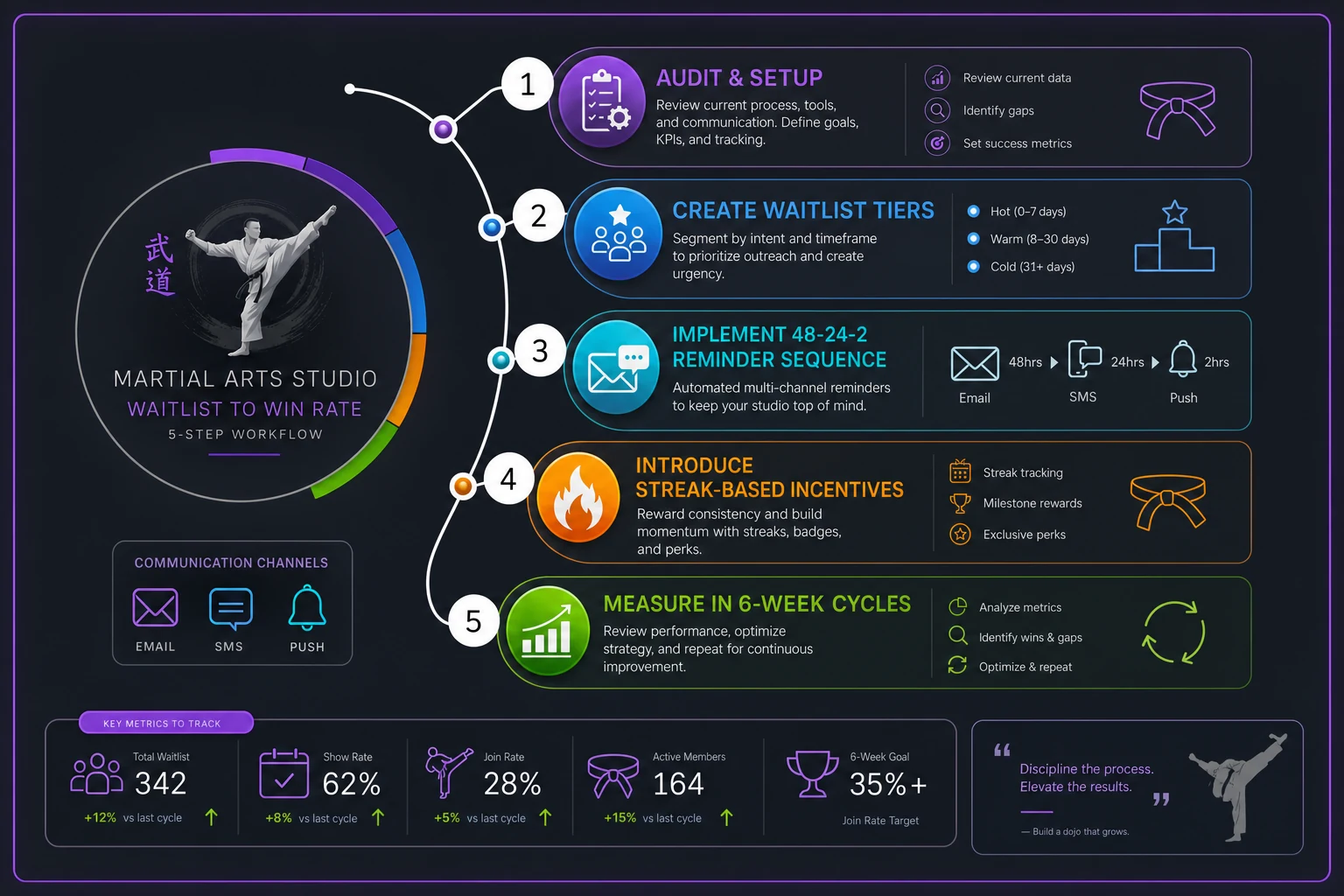
A simple diagram like this keeps everyone aligned on the sequence and responsibilities.
The automation advantage most studios miss
This entire workflow breaks if you're trying to manage it manually. Studios attempt spreadsheet gymnastics to track attendance tiers, send individual reminder texts, and update waitlist priorities by hand. They last about two weeks before giving up.
The operations get complex fast. You're tracking attendance percentages for 200+ students, sending 600+ reminders per week across multiple channels, managing waitlist priorities that change daily, and trying to measure results while actually running classes. That's not sustainable with sticky notes and Google Sheets.
AI-powered operational software changes this completely. Instead of your front desk person spending two hours every morning sending reminders and updating waitlists, an automated system handles it in seconds. The software tracks attendance patterns, identifies which students need which type of reminder, sends them at optimal times, and automatically adjusts waitlist priorities based on real behavior.
It spots patterns humans miss. Like that group of students who always no-show when a specific instructor teaches, or the correlation between weather patterns and attendance rates for your morning classes. The automated system running in the background can adjust reminder timing when rain is forecast, or send different messages when they detect a student's attendance dropping below their normal pattern.
One studio discovered through their automated tracking that students who received reminders mentioning their training partners showed up 18% more often than generic reminders. "Mark confirmed for tonight's roll" hits different than "Class reminder: 6pm BJJ." The system learned this and adapted without anyone programming it specifically.
The real value isn't just efficiency—it's consistency. The workflow runs perfectly whether your manager is sick, your front desk is new, or it's the busy season. No dropped balls, no forgotten reminders, no manual errors that irritate students and create more no-shows.
Making this work in your studio's reality
Every studio thinks they're unique, and in some ways they are. Your competition team might need different handling than the suburban Taekwondo school down the street. But the core operational principles to reduce martial arts class no-shows stay consistent.
Start with one problem class. Pick your worst no-show offender and run the full workflow on just that one. Get the kinks out, see what your students respond to, then expand. Trying to revolutionize your entire schedule at once is a recipe for chaos and angry students.
Consider your demographic carefully. A studio serving primarily shift workers needs different reminder timing than one full of 9-to-5 office workers. Test everything, assume nothing.
Don't overcomplicate the incentives. Studios create point systems so complex they needed a manual to explain them. If you can't describe your streak reward in one sentence, it's too complicated. Simple, clear, consistent beats clever every time.
Watch for cultural resistance. Some old-school instructors hate the idea of "coddling" students with reminders and rewards. Bring them data—show them how consistent attendance improves student progression, belt testing success rates, and ultimately retention. Frame it as respecting the art by ensuring students actually show up to learn it.
Treat this as an operational system, not a one-time fix. Markets change, student populations evolve, and what works today might not work in six months. The studios successfully keeping no-show rates below 15% are the ones constantly testing, measuring, and refining their approach.
Your mat time is too valuable to waste on empty spots and dead energy. Fix the no-show problem and watch how it transforms not just your attendance numbers, but the entire culture of your studio. Students train harder when they're surrounded by committed partners. Instructors teach better when they have engaged, consistent classes. And your business operates profitably when you're not paying for phantom students who never show up.
The workflow is clear. The tools exist. The only question is whether you'll keep accepting 30% no-shows as "just how it is" or actually fix the problem. Studios who tackle this head-on are the ones building sustainable, profitable businesses while others scrape by wondering why their "full" classes feel so empty.
Ready to elevate your dojo operations?
Join 500+ martial arts studios using Dojoyly to save time, reduce scheduling conflicts, and improve member engagement.