


Failed payments in martial arts studios follow an annoyingly predictable pattern. A card expires in February, the March charge bounces, your processor sends one generic email that lands in spam, then nothing. By April, the parent assumes their kid is still training while you're out two months of revenue and stuck having an awkward conversation at pickup.
Most studios discover these failures weeks later during manual account reviews. Meanwhile, that family has been attending classes, using resources, and creating a collections nightmare that gets harder to resolve each passing day.
The disconnect is brutal. The parent paying isn't the person receiving the service. The student showing up for class has no idea mom's card expired. The instructor teaching doesn't know there's a payment issue.
The hidden math of payment failures destroying studio margins
Payment failures hit martial arts studios differently than other businesses. When a gym membership fails, the member just can't scan in. When a martial arts payment fails, the student keeps showing up for classes, belt tests, and tournaments while the balance grows.
Running $149 monthly memberships with 200 students, you'll see credit card expiration rates around 3% monthly, plus another 2% for insufficient funds or changed account numbers. That's 10 students with failed payments each month.
The damage compounds fast. Unlike a declined transaction at checkout, these are recurring charges that fail silently. Without immediate intervention, roughly 30% of these turn into permanent losses. Another 40% take 2-3 months to recover, requiring multiple awkward conversations and manual follow-ups.
Do the math: 10 failures monthly, 3 never recover ($447 gone), 4 take multiple months (creating $596 in delayed revenue), and only 3 resolve quickly. You're looking at over $1,000 in immediate impact, plus the administrative burden of chasing payments instead of running classes.
Why martial arts payment recovery requires different tactics
Generic payment retry logic fails spectacularly here. Standard payment processors retry the same failed card 3-4 times over two weeks. But retrying an expired card doesn't magically update the expiration date. Retrying insufficient funds at 2am doesn't add money to the account. These blanket retry attempts just create more decline fees without solving the underlying problem.
Simplify class bookings and attendance tracking.
Dojoyly helps you schedule, confirm, and manage every class effortlessly.
- Unified class & student management
- Automated member notifications
- Instructor scheduling & availability
No credit card required
Each failure type needs its own recovery approach. An expired card needs proactive communication before the expiration date. Insufficient funds need strategic retry timing. Changed account numbers need immediate parent notification.
The relationship dynamics complicate everything. Parents appreciate heads-up communication, but they hate feeling harassed. Students keep training while payment issues drag on. Staff get caught in the middle, trying to maintain relationships while protecting revenue.
Pre-authorization checks that catch problems before they cost you money
The smartest studios prevent failures instead of chasing them. Two weeks before any stored card expires, you should already be communicating with parents. Not a generic "update your payment" email, but specific messaging that acknowledges their situation.
"Hi Sarah, we noticed your card ending in 4782 expires this month. Jake's been making great progress toward his brown belt—to ensure there's no interruption in his training, please update your payment method before February 28th."
This pre-expiration outreach typically prevents 60-70% of expiration-related failures.
Running a $1 pre-authorization 24 hours before the actual charge date catches insufficient funds and allows parents to transfer money or update their payment method. One studio in Colorado started doing this and cut their NSF failures by half—parents would get the bank notification and immediately transfer funds before the real charge hit.
Use a $0.01 or $1 pre-authorization 24 hours before the charge date to trigger bank notifications and reduce NSF failures.
These preventive measures feel helpful rather than pushy. Parents get useful reminders during their normal financial planning, not emergency collection calls.
A retry schedule that actually matches how parents manage money
Most payment failures aren't permanent—they're timing issues. The account that has insufficient funds on the 1st might be flush on the 3rd after payday. The parent who missed your email on Tuesday might see your text on Thursday.
Here's a visual workflow for the retry timeline:
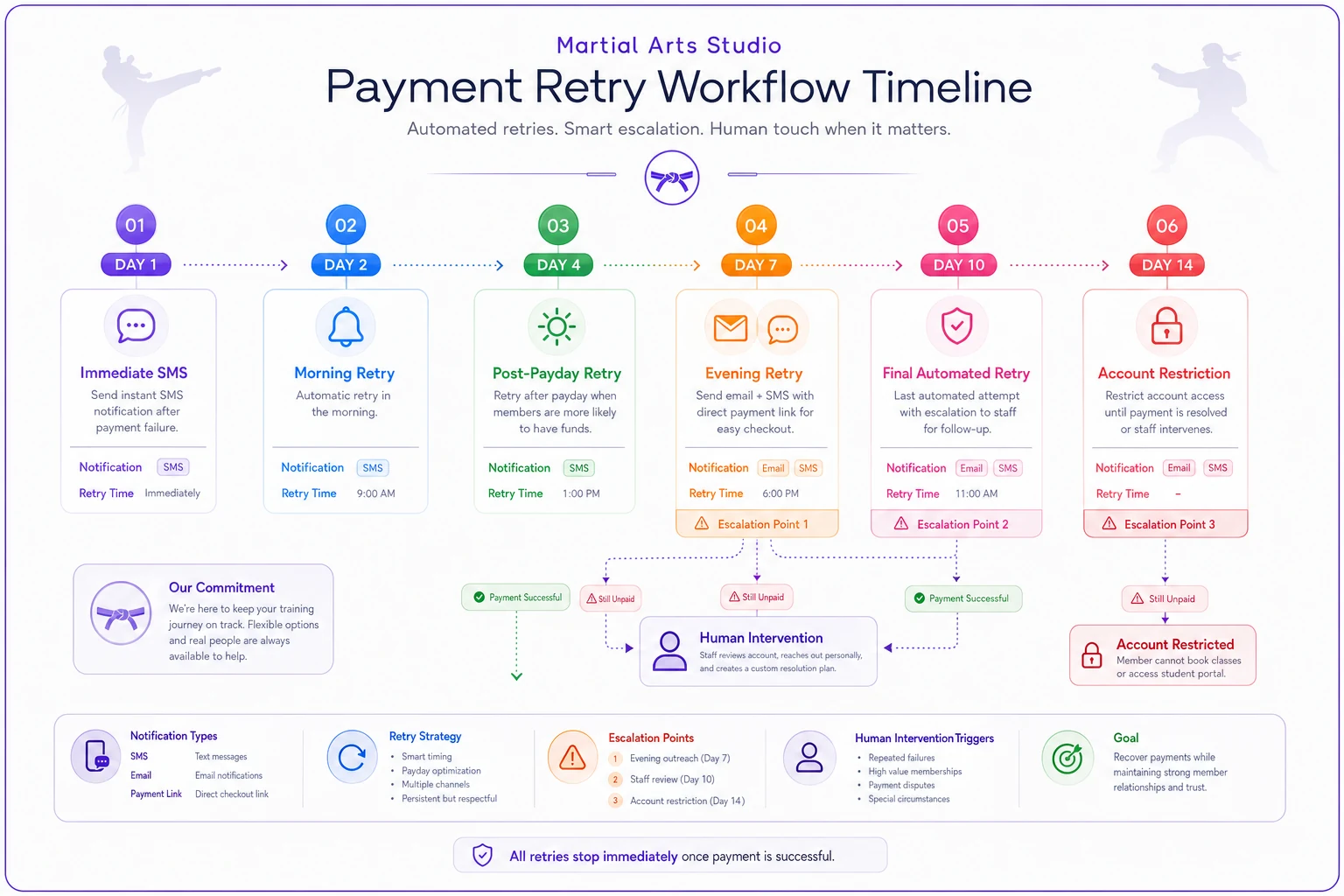
Day 1 (Failure): Immediate SMS notification to the parent. Not an email they'll miss, but a text they'll see. "Your martial arts payment didn't process. Reply RETRY to try again or CALL to speak with us."
Day 2: Morning retry at 9am. Many parents handle financial tasks during their morning routine after dropping kids at school.
Day 4: Retry after typical payday cycles. If the initial charge was on the 1st, retry on the 5th when direct deposits have cleared.
Day 7: Evening retry at 7pm with simultaneous email and SMS. Include a direct payment link that works on mobile. "We haven't been able to process Jake's monthly training fee. Click here to update your payment: [link]"
Day 10: Final automated retry with escalation warning. "Jake's account will be restricted next week if payment isn't received. Please contact us immediately to avoid interruption in training."
Day 14: Account restriction with in-person notification protocol. The student can attend their current week's classes but can't register for testing, tournaments, or the following week until resolved.
This schedule aligns with human behavior, not arbitrary retry rules. You're trying when people have money, when they're paying attention, and with increasing urgency that matches the actual consequences.
Communication scripts that preserve relationships while collecting payment
The language you use during payment recovery makes the difference between a resolved payment and a lost family. Too aggressive, and parents get offended. Too passive, and they ignore you.
Initial SMS (Day 1): "Hi [Parent], your payment for [Student]'s martial arts didn't go through today. This happens sometimes with card updates. Reply RETRY to try again or CALL if you need help. Thanks!"
First Email (Day 4): "Subject: Quick payment update needed for [Student] Hi [Parent], We haven't been able to process this month's payment for [Student]'s training. They're doing great in class—just had an awesome sparring session yesterday! Could you update your payment info when you have a moment? Here's a direct link: [payment link] If there's anything we need to discuss about the membership, just let me know. Thanks, [Instructor Name]"
Escalation Email (Day 10): "Subject: Action needed to continue [Student]'s training [Parent], We still haven't been able to collect [Student]'s monthly training fee. I know things get busy, but we need to resolve this by [date] to avoid interrupting their progress toward [next belt/goal]. [Student] has been working hard on their forms—I'd hate to see them miss next week's preparation for testing. Please use this link to update payment: [link] Or call me directly at [phone] if we need to work something out. [Instructor Name]"
This creates urgency through the student's goals, not threats. Parents respond better when it's about their child's progress rather than your business needs.
The critical handoff between automated recovery and human intervention
Automation handles the routine failures efficiently, but some situations require human judgment. The family that's been training for 3 years and suddenly has payment issues might be facing financial hardship. The new student whose payment fails in month two might be having second thoughts.
-
Any student training over 2 years with sudden payment failure
-
Second consecutive month of failure
-
Parent responds to automated message with concerns
-
High-value accounts (families with multiple students, competition team members)
-
Payment failure combined with decreased attendance
When staff intervenes, they need context. Not just "payment failed," but the full picture: how long they've trained, recent attendance, belt level, upcoming tests or tournaments, previous payment history. This context shapes the conversation from collection call to retention discussion.
One dojo in Texas saved a longtime family by noticing their payment failure coincided with decreased attendance. A quick call revealed the dad lost his job. They arranged a temporary reduced rate and volunteer exchange program. Six months later, the family was back to full payment and became their biggest referrals source.
Tracking recovery rates to optimize your dunning workflow
Most studios have no idea how effective their payment recovery actually is. They know some payments fail and some eventually get collected, but the specific patterns remain invisible.
Monitor these key recovery indicators:
| Recovery Metric | Expected Rate | Notes |
|---|---|---|
| Expired cards | 75-85% | With pre-expiration outreach |
| Insufficient funds | 60-70% | With proper retry timing |
| Closed accounts | 20-30% | Requires new payment method |
| Fraud blocks | 80-90% | With parent confirmation |
Recovery rate by intervention method:
-
SMS
highest immediate response (40-50% same-day resolution)
-
Email
moderate response (20-30% within 3 days)
-
Phone call
highest overall recovery (70%+) but labor-intensive
-
In-person
nearly 100% resolution but risks relationship damage
Time to recovery:
-
Day 1-3
45% of recoverable payments
-
Day 4-7
30% of recoverable payments
-
Day 8-14
20% of recoverable payments
-
Beyond 14 days
5% recovery rate drops dramatically
These patterns help you adjust your workflow. If SMS drives immediate recovery, invest in better text messaging. If day 4-7 shows the best recovery window, focus your efforts there rather than repeatedly hitting the same failed card on day 1.
When to write off losses versus when to keep pursuing
Not every failed payment is worth endless pursuit. The energy spent chasing $149 from a family that's clearly done could be better spent retaining three at-risk members.
Write-off indicators include:
-
No response to any communication after 30 days
-
Parent explicitly states financial inability to pay
-
Student hasn't attended in 3+ weeks
-
Previous payment recovery took multiple months
-
Family has pattern of payment issues
Continue pursuing when:
-
Student still actively attending
-
Family has long positive history
-
Parent is responsive but needs time/options
-
Competition team or leadership program members
-
Multiple family members training
The decision isn't just financial—it's strategic. A family struggling temporarily might become your strongest supporters later. A family that's checked out mentally won't re-engage regardless of collection efforts.
Sometimes the math is simple. A new student whose payment fails in month two and who hasn't attended in three weeks probably isn't worth extensive recovery efforts. A longtime student whose payment fails but who's still attending every class deserves more patience and creative solutions.
Building payment recovery into your operational workflow
Payment recovery can't be an afterthought that someone handles when they remember. It needs defined processes, clear ownership, and integration with your daily operations.
Start with pre-class payment checks. Before each session, instructors see a quick list: green (paid), yellow (payment processing), red (payment failed). This awareness prevents awkward situations and creates natural conversation opportunities. "Hey Jake, can you have mom check her email? We need to update something for next month."
Schedule weekly payment review meetings. Every Monday, review all failed payments from the previous week. Assign specific recovery actions to specific staff members. Track progress throughout the week.
Create recovery checkpoints during natural interaction points:
-
Belt testing registration requires current payment status
-
Tournament signups trigger payment verification
-
Equipment orders confirm account standing
-
Parent conferences include payment status review
These checkpoints catch issues before they compound. A parent excited about their child's upcoming belt test is much more motivated to resolve a payment issue than one who discovers it during an awkward phone call.
The most successful studios treat payment recovery like class scheduling or belt testing—a critical operational function that requires consistent attention and defined processes.
The compound effect of systematic payment recovery
Getting payment recovery right doesn't just save the individual transaction. A studio with 200 students losing 5% monthly to payment failures is bleeding $1,500 in immediate revenue. But the real damage compounds over time.
Those families with unresolved payment issues often quit entirely. They feel embarrassed about the debt, avoid the studio, and eventually disappear. What started as a $149 failed payment becomes a lost student worth $1,800 annually.
They don't refer friends. They don't write positive reviews. They might even share negative experiences about "that dojo that kept hassling us about payment." The reputation damage exceeds the financial loss.
Conversely, families where payment issues are handled professionally often become more committed. They appreciate the respectful communication, the flexible solutions, the focus on their child's progress rather than just collecting money. These recovered relationships frequently become your strongest advocates.
The studios with systematic recovery processes report 15-20% higher lifetime customer value. Not because they're better at collecting money, but because they're better at maintaining relationships during difficult moments.
Bringing it all together with smart operational software
Manual payment recovery is exhausting. Tracking expiration dates in spreadsheets, remembering to send follow-ups, coordinating retry attempts—it's a full-time job that nobody wants. This is where AI-powered operational platforms transform a painful process into an automated workflow.
Modern studio management software with AI automation handles the entire dunning process systematically. It tracks payment methods, monitors expiration dates, triggers pre-emptive communications, manages retry schedules, and escalates to staff when needed. The AI components learn from your recovery patterns, optimizing retry timing and communication methods based on what actually works for your specific studio.
But the real power isn't just automation—it's integration. When payment status connects to class attendance, belt progression, and family communication, you create a complete operational picture. The instructor knows before class. The parent gets reminded at optimal times. The admin sees trends and patterns.
Payment recovery stops being a collections problem and becomes part of your student retention system. The technology handles the routine work while your staff focuses on relationships and exceptions—exactly where human judgment matters most.
You can build similar systems manually, but most studios find that AI-assisted operational platforms handle the complexity better than spreadsheets and sticky notes. The software remembers what humans forget, follows up when humans get busy, and identifies patterns that humans miss.
Making payment recovery a competitive advantage
Failed payments don't have to drain your studio's revenue and energy. With the right combination of pre-emptive monitoring, strategic retry scheduling, relationship-focused communication, and systematic workflows, you can recover most failed payments while actually strengthening family relationships.
The studios thriving today aren't the ones hoping payment problems resolve themselves. They're the ones who built robust recovery processes that respect families while protecting revenue. They catch problems before they compound, communicate with empathy and urgency, and use every interaction to reinforce the value of training.
Whether you're managing this manually or leveraging operational software to automate the workflow, the principles remain the same: prevent what you can, respond quickly to what you can't prevent, and always remember that behind every failed payment is a family invested in their child's martial arts journey.
Ready to elevate your dojo operations?
Join 500+ martial arts studios using Dojoyly to save time, reduce scheduling conflicts, and improve member engagement.