


Three months ago, a studio owner in Tampa called me after losing twelve families in two weeks. His lead instructor had taken another job, and the replacement couldn't maintain the same energy or structure. Parents started complaining about inconsistent belt testing standards. Kids said class felt different. The owner thought he had a staffing problem. Actually, he had zero documentation, no standardized lesson plans, and instructors who each ran their own version of the curriculum.
This happens constantly in martial arts studios that grow past two instructors. You start teaching all classes yourself, then bring in help, and suddenly you're managing five different teaching styles, three interpretations of your belt requirements, and instructors who disappear without warning—leaving you scrambling to cover classes while maintaining quality.
Most studio owners miss this: instructor coordination isn't about finding better people. It's about building systems that make good instructors better and average instructors consistent. When you rely on individual talent instead of documented processes, you're always one resignation away from chaos.
Why martial arts studios specifically struggle with instructor standardization
Unlike fitness gyms where instructors can follow preset routines, martial arts instruction requires nuanced progression tracking, technique refinement across skill levels, and cultural elements that vary by discipline. A BJJ class flows differently than a taekwondo session. A kids' karate class needs different energy than adult Muay Thai.
Studios usually evolve through predictable stages. First, the owner teaches everything, knows every student, maintains perfect consistency. Then comes the first assistant instructor who mimics the owner's style, creates minor variations, though parents don't notice yet.
Eventually multiple instructors develop their own approaches. Belt testing becomes subjective. Advanced students notice inconsistencies. Either the studio implements real systems or quality deteriorates until reputation suffers.
The breaking point typically hits around 150-200 active students. Below that threshold, informal coordination works because instructors can communicate directly about individual students. Above it, the lack of systems creates visible gaps. Parents start requesting specific instructors. Students get conflicting feedback on technique. Belt promotions feel arbitrary.
Martial arts parents pay attention. They watch classes, compare notes, and notice when Tuesday's instructor contradicts Thursday's instructor about proper stance width. Unlike drop-off activities, martial arts studios operate under constant observation.
The hidden cost calculation most owners never make
Studios lose money to instructor inconsistency in ways that don't show up clearly in the books.
Simplify class bookings and attendance tracking.
Dojoyly helps you schedule, confirm, and manage every class effortlessly.
- Unified class & student management
- Automated member notifications
- Instructor scheduling & availability
No credit card required
Student confusion leads to slower progression, which delays belt testing. If students test every three months instead of every two months, that's fewer testing fees. For a 200-student studio charging $45 per test, delaying tests by one month costs roughly $3,000 per testing cycle.
Retention drops when parents perceive quality issues. Even a 3% increase in monthly churn devastates long-term revenue. At $130 average monthly tuition with 180 active students, that 3% represents $8,424 in lost annual revenue—not counting the acquisition cost to replace those students.
Substitute teaching becomes expensive when instructors can't cover each other's classes effectively. Owners end up teaching classes they should have delegated, missing opportunities to work on growth. If an owner spends 10 hours weekly covering classes at an opportunity cost of $75/hour, that's $39,000 annually in lost strategic work time.
The real damage happens through reputation. When students leave because "the classes aren't what they used to be," they tell other parents. In tight-knit suburban markets where most students come from word-of-mouth, inconsistent quality becomes a growth ceiling.
Building your instructor preparation framework
The foundation of consistent instruction starts with class preparation standards. Not lesson plans handed down from headquarters—actual, usable prep frameworks your instructors will follow.
Start with a simple class structure template that works across all skill levels.
| Class Phase | Duration | Purpose | Requirements |
|---|---|---|---|
| Warm-up | 10 minutes | Physical preparation | 3 standard routines to rotate |
| Technique instruction | 20 minutes | Core skill building | Monthly technique plan by belt level |
| Application drills | 15 minutes | Practice implementation | Partner and solo formats defined |
| Cool-down and recap | 5 minutes | Integration and preview | Standardized review format |
Keep the shared document editable and require instructors to log deviations immediately after class.
The template matters less than the adherence. Create a shared document where instructors log what they actually taught versus the plan. Gaps become visible immediately. When Tuesday's instructor skips side kicks and Thursday's instructor assumes students know them, you can intervene before students get frustrated.
For multi-level classes, build decision trees. "If more than 60% are yellow belts or higher, use advanced warm-up B. If majority white belts, stick with basic warm-up A." This removes on-the-spot judgment calls that create inconsistency.
Think of this as building muscle memory for your entire instructor team. The framework provides structure without restricting creativity.
Creating substitution playbooks that actually work
Every studio faces instructor absences. The difference between smooth coverage and chaos comes down to documentation.
Monday 4pm Kids Beginners:
-
Usual instructor
Sarah
-
Typical attendance
12-16 students
-
Energy level
High energy needed, parents watch closely
-
Standard warm-up
Animal movements
-
Current focus
Working toward yellow belt test in March
-
Specific students needing attention
Timothy (ADHD, needs regular refocusing), Emma (shy, requires encouragement)
-
Parent hot buttons
Start exactly on time, end 5 minutes early for pickup
Wednesday 7pm Adult Advanced:
-
Usual instructor
Marcus
-
Typical attendance
8-10 students
-
Energy level
Serious technical focus
-
Standard warm-up
Light sparring drills
-
Current focus
Competition prep for April tournament
-
Key students
Jordan (potential instructor candidate), Mike (returning from knee injury)
-
Important notes
This group expects detailed technique breakdowns
Substitutes reading these playbooks understand context beyond just curriculum. They know which classes tolerate variation and which demand strict consistency.
Include emergency contact protocols. "If fewer than 5 students show up, combine with the parallel intermediate class. If someone gets injured, call the owner first, then fill out incident form B."
The playbook should fit on two pages. Substitutes won't read novels during their drive to cover a class. Keep it practical and actionable.
Rotating lesson plans without losing progression
Static lesson plans fail because students progress at different rates. Rotating templates maintain variety while ensuring coverage.
Design a six-week rotation that cycles through core techniques:
-
Striking fundamentals
-
Defensive movements
-
Forms/kata
-
Partner drills
-
Sparring preparation
-
Review and assessment
Within each week, specify variations by belt level. White belts practice straight punches during striking week. Brown belts work combination flows. Same theme, different depth.
This rotation prevents the "we did kicks for three weeks straight" problem while ensuring students see each element regularly. Instructors can add personality within the framework without abandoning structure.
Track completion rates. If instructors consistently skip week 3 because they dislike teaching forms, you've identified a training need. If students show lower attendance during week 5, maybe sparring prep needs restructuring.
Build flexibility into the framework. "If testing is next week, replace regular rotation with test preparation format C." This prevents instructors from abandoning the system during critical periods.
The rotation should feel natural, not forced. Students shouldn't notice the pattern as much as they notice consistent, progressive training.
Performance metrics that connect to retention
Most studios track the wrong instructor metrics. Class attendance alone tells you nothing about instruction quality. Student progression and retention rates reveal what actually matters.
Meaningful instructor metrics include progression velocity—how quickly students under each instructor advance through belt levels. If Sarah's students average 4 months between tests while Marcus's students average 6 months, investigate the discrepancy.
Retention by instructor matters too. Track which instructor was teaching when students quit. Patterns emerge quickly. Maybe Tom's aggressive teaching style works great for competitive teenagers but drives away casual adult beginners.
Count specific instructor requests as a parent satisfaction indicator. When parents start asking to switch their child to different class times to avoid certain instructors, you have a problem.
During belt tests, track pass rates by primary instructor. If one instructor's students consistently struggle with specific techniques, their teaching method needs adjustment.
Create a simple dashboard showing these metrics monthly. Don't overwhelm instructors with data—highlight two or three key areas for improvement. Make the numbers tell a story about student success, not instructor failure.
Link these metrics to compensation. Not punitively, but as growth incentives. "Instructors whose students maintain 85% or higher six-month retention receive a $2/hour raise." This aligns instructor behavior with studio success.
Compensation structures that reward consistency
Traditional martial arts instructor pay—flat hourly rates regardless of performance—encourages minimal effort. Building outcome-based compensation drives quality without micromanagement.
Base pay covers standard instruction. Add performance bonuses for student progression milestones, retention achievements, class growth, substitute availability, and curriculum development.
Keep the structure simple. Complex formulas create confusion and resentment. "Base rate: $25/hour. Add $50 for each student who passes a belt test. Add $100 monthly if your classes maintain 90% retention."
Some studios successfully implement tiered instructor levels:
-
Assistant Instructor
$20-25/hour, follows established lesson plans
-
Lead Instructor
$25-35/hour, can modify curriculum within guidelines
-
Senior Instructor
$35-45/hour, develops new programs and trains other instructors
Progression between levels depends on demonstrated consistency, not just time served. This creates career paths while maintaining standards.
Avoid purely commission-based structures. They encourage instructors to pass students who aren't ready, degrading your reputation. Balance quality incentives with growth metrics.
The compensation should feel fair and motivating. Instructors need to understand exactly how they can increase their earnings through better performance.
The technology layer that makes coordination possible
Manual coordination breaks down as studios grow. Operational software transforms inconsistent instruction from a personality problem into a process problem.
[GRAPH: Instructor coordination workflow - from lesson planning through performance tracking to compensation adjustments]
Here's a quick visual of the workflow.
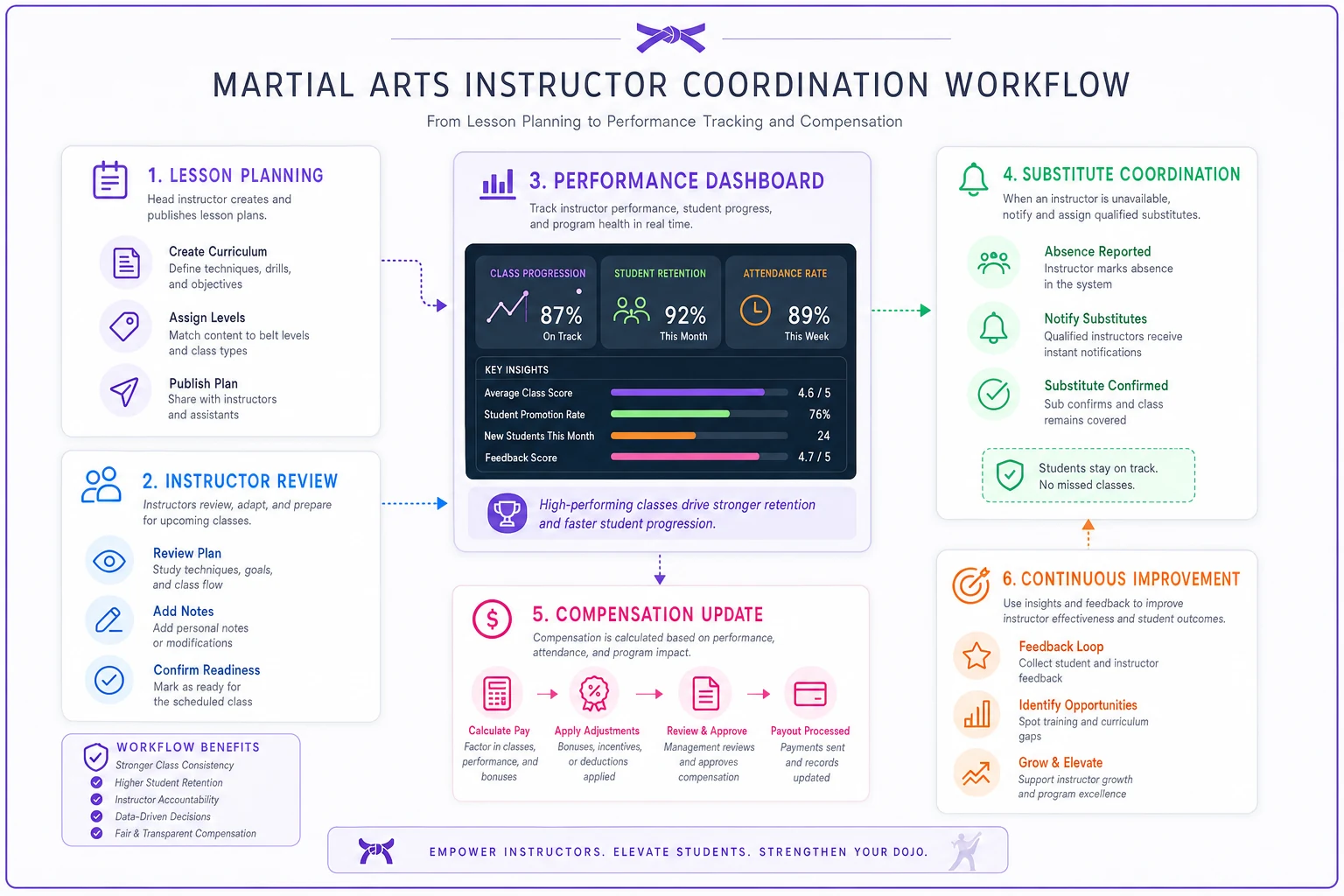
Digital lesson plan distribution ensures every instructor sees updates immediately. When you modify next week's curriculum, everyone knows instantly. No more "I didn't get the email" or "the binder wasn't updated."
Student progression tracking becomes centralized. Instead of instructors keeping mental notes about who needs work on what, the system maintains detailed records. Substitutes can review a student's history before class starts.
Automated scheduling handles instructor availability, preventing double-booking and ensuring coverage. When someone calls in sick, the system identifies qualified substitutes and sends notifications.
Performance dashboards give instructors real-time feedback. They see their retention rates, student progression metrics, and areas for improvement without waiting for quarterly reviews.
Parent communication standardizes through the platform. Updates about curriculum changes, belt testing schedules, and student progress maintain consistent messaging regardless of which instructor sends them.
AI-powered operational platforms can predict coverage gaps, identify students at risk of dropping out, and suggest curriculum adjustments based on progression patterns. The coordination problems that plague growing studios—miscommunication, inconsistent standards, scheduling chaos—become manageable when information centralizes properly.
This isn't about replacing instructor creativity with robotic standardization. It's about providing structure that allows good instructors to focus on teaching instead of administration.
Building your implementation timeline
Systematic instructor coordination doesn't happen overnight. Studios need a phased approach that doesn't disrupt current operations.
Month 1: Document current state. Have each instructor write down their typical class structure. Identify gaps and inconsistencies. Don't judge—just document.
Month 2: Create basic templates. Build simple class structure templates and share them. Ask for feedback before mandating adoption.
Month 3: Pilot with willing instructors. Find two or three instructors excited about standardization. Let them test templates and provide feedback.
Month 4: Refine and expand. Adjust templates based on pilot feedback. Begin rolling out to all instructors with training sessions.
Month 5: Implement metrics. Start tracking basic performance indicators. Share data with instructors without tying it to compensation yet.
Month 6: Connect compensation. Once instructors understand the metrics, begin incorporating performance bonuses.
Throughout this process, maintain open communication. Instructors who've developed their own style over years might resist standardization. Frame changes as professional development, not criticism of current methods.
Hold monthly instructor meetings to discuss what's working and what isn't. Let instructors contribute to playbook development. When they help create standards, they're more likely to follow them.
Common failure points to avoid
Studios typically stumble in predictable ways when implementing instructor coordination.
Over-documentation creates 50-page manuals nobody reads. Keep playbooks concise and actionable. Ignoring feedback means forcing systems that don't match reality. If instructors consistently skip certain elements, investigate why before mandating compliance.
Delayed metrics waste time. Start tracking immediately, even if imperfectly. Compensation confusion happens when you change pay structures without clear communication. Explain exactly how new systems benefit instructors.
Technology without training is expensive and useless. Buying software but not teaching instructors how to use it wastes money. Budget time for proper onboarding.
The biggest failure: treating coordination as a one-time project instead of an ongoing process. Standards need regular updates as your studio evolves.
Some owners get frustrated when instructors push back on new systems. Remember, change is uncomfortable even when it's beneficial. Give the process time to work.
When standardization goes too far
Some studios overcorrect, creating rigid systems that strip away instructor personality. Students don't want robots—they want consistent, quality instruction from engaging teachers.
Maintain flexibility within structure. If an instructor's unique warm-up routine gets kids excited while still preparing them properly, keep it. If their explanation method differs from the standard but students learn faster, adapt the standard.
Watch for signs of over-standardization. Instructors seem disengaged or robotic. Classes feel identical regardless of instructor. Student energy drops. Instructor turnover increases.
The goal isn't military precision. It's predictable quality that lets instructor personality shine through structured frameworks.
You want parents to trust any instructor at your studio while still appreciating individual teaching styles.
Measuring success beyond the numbers
Effective instructor coordination shows up in ways metrics don't always capture:
Parents stop requesting specific instructors because they trust consistency across the board. Substitutes volunteer to cover classes because they feel prepared. Senior students begin assisting because they understand the curriculum structure.
The owner's phone stops ringing with complaints about different instructors teaching conflicting techniques. Belt tests become celebrations instead of stress because everyone knows the standards. New instructors onboard quickly because systems exist to support them.
Studios with strong coordination systems report something interesting: instructors start collaborating spontaneously. They share drill ideas, discuss challenging students, and solve problems together because they're working from the same foundation.
Long-term, these studios build reputations for quality that transcend individual instructors. Parents recommend the studio, not just "Sarah's Thursday class." This institutional strength becomes a competitive moat in crowded markets.
Building sustainable growth through systematic instruction
Studios that implement proper instructor coordination don't just run smoother operations—they deliver on the promise of martial arts training: consistent, progressive skill development that builds confidence and character. When instruction quality becomes predictable, student outcomes become predictable.
These systems require effort to implement. But the alternative—hoping good instructors never leave, that substitutes figure it out, that parents don't notice inconsistencies—isn't a strategy. It's gambling with your studio's reputation and financial future.
Strong studios aren't built on exceptional individuals. They're built on systems that make ordinary instructors deliver exceptional experiences, consistently.
The studios that survive and thrive past the owner-operator stage all share this characteristic: they've systematized quality without destroying personality. They've created frameworks that support both instructor development and student success. Most importantly, they've recognized that coordination isn't about control—it's about creating conditions where everyone can succeed.
These systems require effort to implement. But the alternative—hoping good instructors never leave, that substitutes figure it out, that parents don't notice inconsistencies—isn't a strategy. It's gambling with your studio's reputation and financial future.
The studios that survive and thrive past the owner-operator stage all share this characteristic: they've systematized quality without destroying personality. They've created frameworks that support both instructor development and student success. Most importantly, they've recognized that coordination isn't about control—it's about creating conditions where everyone can succeed.
Ready to elevate your dojo operations?
Join 500+ martial arts studios using Dojoyly to save time, reduce scheduling conflicts, and improve member engagement.