



Three weeks ago, a BJJ studio owner in Denver showed me his whiteboard. Names, belt colors, payment dates, and arrows connecting everything in what looked more like a conspiracy theory than a business system. "This is how we track student progress," he said.
His trial conversion rate? About 35%. Student retention past six months? Maybe half. The kicker — he had no clue why students were leaving. The data lived in his head, his instructor's notebook, and that chaotic whiteboard.
Most martial arts studios operate with disconnected systems that create massive blind spots. Curriculum sits in one place, billing in another, student communication scattered across text messages and verbal reminders. When a student drops off, nobody notices until the credit card declines or they've been missing for three weeks.
The studios thriving in competitive markets aren't necessarily better at teaching techniques. They're better at operationalizing student success.
Students don't randomly quit — they leave at predictable moments
Trial week dropoff happens when nobody follows up after day two. The excitement wears off, they feel sore, maybe intimidated by the regular class atmosphere. Without a structured touchpoint on day three or four, they convince themselves they'll "come back next week" and never do.
The 30-day danger zone hits when initial motivation fades but habits haven't formed yet. Students start skipping classes. Nobody notices because attendance tracking is manual and sporadic. By the time someone realizes they haven't shown up in two weeks, it's already over. They've mentally checked out.
Belt progression confusion creates another major leak. Students train for months without clear understanding of their progress toward the next rank. They see others getting promoted, wonder about their own timeline, but feel awkward asking. The uncertainty eats at their motivation. Eventually they assume they're not progressing fast enough and quit.
Payment friction accelerates every other problem. A declined card that doesn't get resolved for two weeks. A pricing change that wasn't communicated properly. A family discount that wasn't applied correctly. Each billing issue becomes an excuse to reconsider the commitment.
What happens when curriculum, billing, and communication operate independently
A new student signs up for a trial. Their information goes into a paper form or basic spreadsheet. The instructor verbally explains the class schedule. Nobody captures their specific goals or concerns. They attend two classes, then miss the third. The instructor assumes they'll be back. No follow-up happens because there's no trigger for it. The trial expires. Maybe someone texts them a week later, but by then they've already joined the gym down the street.
Simplify class bookings and attendance tracking.
Dojoyly helps you schedule, confirm, and manage every class effortlessly.
- Unified class & student management
- Automated member notifications
- Instructor scheduling & availability
No credit card required
Take a six-month student approaching their first belt test. They've been training consistently but don't know the testing requirements. The instructor mentions it casually after class one day, but the student misses that conversation. Testing day arrives, they're not prepared, feel embarrassed, skip the test. Now they're training alongside newly promoted peers, feeling left behind. Motivation drops. Attendance becomes sporadic. Three months later, they quietly cancel their membership.
The billing side makes everything worse. A student's card declines in month four. The billing software sends an automated email they never see. Nobody at the studio notices because the billing system doesn't talk to the attendance tracker. The student shows up to class, trains normally. Two weeks later, an awkward conversation about past-due payments. They feel embarrassed, promise to update the card, never come back.
This is standard operating reality for probably 70% of martial arts studios. Each disconnection point becomes a student loss opportunity.
Building a lifecycle system that prevents dropoff
[WORKFLOWPROCESSGRAPH_PLACEHOLDER: Student Lifecycle Management System showing progression from Trial → Onboarding → Foundation → Development → Leadership phases with automated triggers and intervention points at each stage]
The diagram below represents that flow.
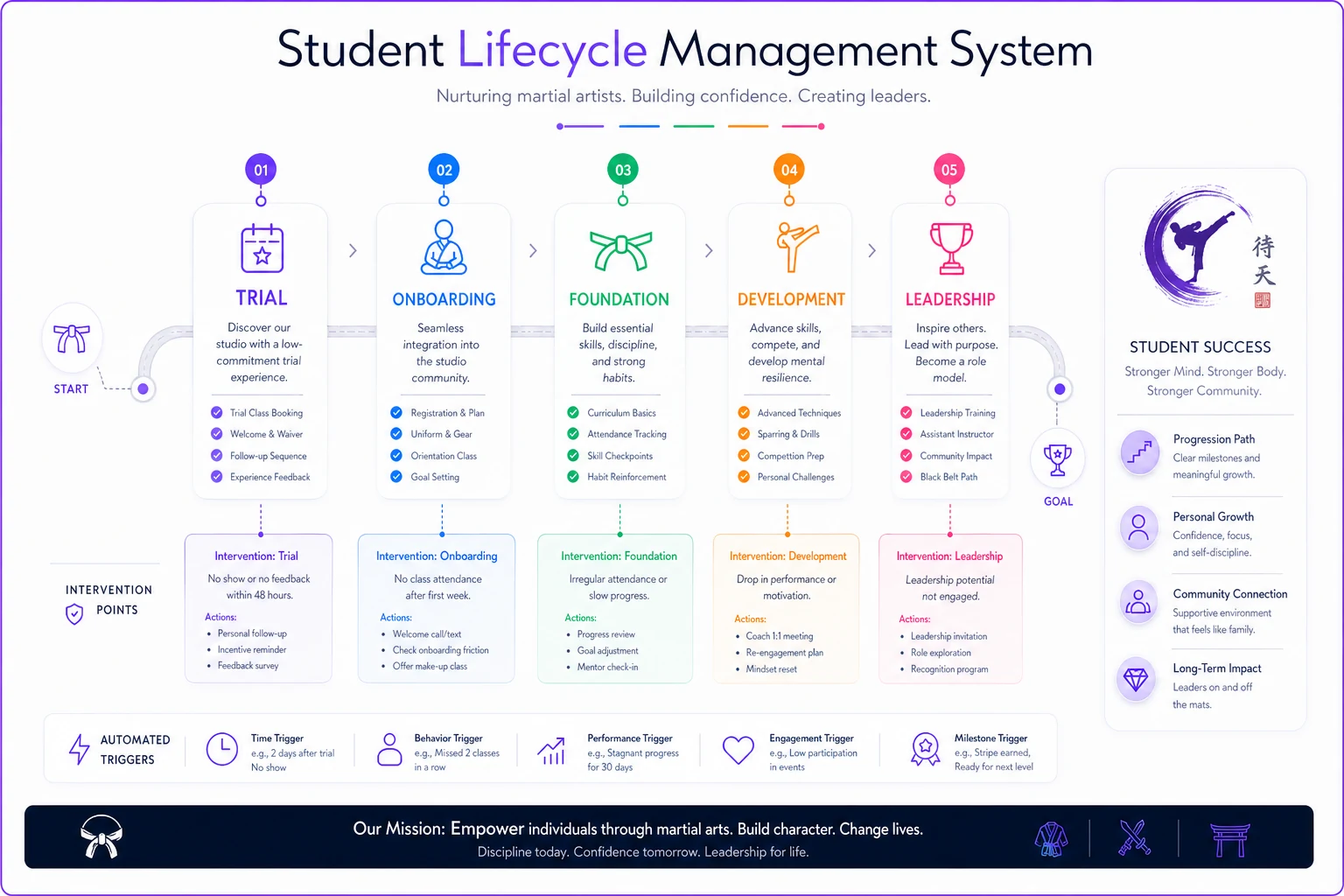
Studios that maintain 80%+ retention rates don't rely on instructor memory or student self-motivation. They build interconnected systems where curriculum milestones trigger specific actions, billing events prompt engagement touchpoints, and attendance patterns automatically flag at-risk students.
Start with mapping your actual student journey, not the idealized version. A trial student needs different touchpoints than a two-year veteran. A kids program requires different milestone celebrations than adult MMA.
For trial conversion, the system needs automatic triggers:
-
Day 1
Capture goals, concerns, and preferred communication method
-
Day 3
Automated check-in about soreness and questions
-
Day 5
Personal message from instructor about progress observed
-
Day 7
Clear next-steps conversation with membership options
-
Day 10
Follow-up if they haven't converted with specific offer
The 30-to-90 day retention window requires different interventions:
-
Week 2
Goal-setting session to establish personal benchmarks
-
Week 4
Progress check-in tied to initial goals
-
Week 6
Introduction to belt curriculum and timeline
-
Week 8
Partner matching for accountability
-
Week 12
First formal progress evaluation
Long-term students need cultivation, not just maintenance. Quarterly progress reviews tied to belt requirements. Semi-annual goal adjustment conversations. Testing prep notifications 6 weeks before eligibility. Celebration touchpoints for training anniversaries. Leadership or assistant instructor opportunities.
Your belt system and payment structure should reinforce each other
Testing eligibility triggers a pre-test package offer. Student has trained 40 classes at white belt level? System automatically sends testing prep resources and schedules their evaluation. They pass? Billing system offers a discounted month to celebrate. They struggle? Automatic enrollment in supplementary training with adjusted pricing.
Align billing dates with testing windows to capture motivation peaks.
Payment timing should align with motivation peaks. Don't bill on random calendar dates. Bill after testing passes, tournament participation, or seminar attendance — when students feel most connected to their training. A student who just earned their blue belt won't quit the next week. One who's been stuck at the same level for six months and just got a rate increase might.
The right balance between instructor attention and automated touchpoints
The best retention happens when human connection and systematic follow-up work together. Instructors shouldn't waste time on tasks software handles better, but software can't replace the personal recognition that keeps students engaged.
Instructors should focus on:
-
Recognizing individual progress during class
-
Having technique-specific conversations after training
-
Building peer connections within the student community
-
Identifying and addressing technical plateaus
-
Creating personalized development paths for dedicated students
Automated systems should handle:
-
Attendance tracking and absence notifications
-
Payment reminders and billing updates
-
Testing eligibility alerts
-
Birthday and anniversary messages
-
Class schedule changes and event announcements
-
Basic check-ins and feedback surveys
The overlap zones need careful orchestration. An automated system flags that Sarah hasn't attended in two weeks. But the follow-up shouldn't be a generic "we miss you" email. The system should notify Sarah's primary instructor, provide her training history and recent progress notes, then the instructor sends a personal message referencing specific techniques she was working on.
This hybrid approach scales. One instructor can meaningfully engage with 150+ students when the administrative burden gets handled systematically. The personal touches feel more personal because they're informed by comprehensive data, not scattered recollections.
KPIs that actually predict retention problems
Most studios track the wrong metrics. Total student count and monthly revenue tell you what already happened, not what's about to break. Predictive KPIs catch problems while you can still fix them.
Attendance frequency changes matter more than absolute attendance. A student who drops from 4 classes weekly to 2 classes weekly is heading toward cancellation, even though they're still "active." The trend predicts the outcome weeks before it happens.
Milestone velocity indicates engagement better than time-in-grade. Two students might both be white belts for six months, but one has completed 80% of the curriculum requirements while the other has completed 30%. The slower progressor needs intervention before frustration leads to departure.
Communication responsiveness drops before physical attendance does. Student stops replying to messages, skips the feedback survey, doesn't RSVP for events — these behaviors precede the actual dropout by 4-6 weeks typically.
Here's a practical KPI dashboard for a 200-student studio:
| Metric | Green Zone | Yellow Zone | Red Zone | Current |
|---|---|---|---|---|
| Trial conversion (30 day) | >55% | 40-55% | <40% | 47% |
| Month 2 retention | >85% | 70-85% | <70% | 78% |
| Month 6 retention | >70% | 55-70% | <55% | 63% |
| Attendance frequency drop | <15% monthly | 15-25% | >25% | 19% |
| Payment issue rate | <5% monthly | 5-10% | >10% | 7% |
| Testing participation | >60% eligible | 40-60% | <40% | 52% |
| Communication response | >70% | 50-70% | <50% | 61% |
These thresholds aren't universal — they depend on your market, style, and student demographics. But tracking the right directional metrics beats perfect accuracy on the wrong ones.
Billing health goes beyond payment status. Track update frequency, decline patterns, and payment method changes. A student who's had three payment issues in two months is planning their exit, whether consciously or not.
Cohort performance reveals systemic issues. If January trial students convert at 60% but March trials convert at 30%, something in your March process broke. Maybe a different instructor ran trials, maybe you changed the offer, maybe seasonal factors hit differently.
How Tiger Wrestling Academy fixed their retention leak
Tiger Wrestling Academy in Ohio was hemorrhaging students. About 190 enrolled, but turnover meant constantly replacing 20-25% every quarter. The owner thought the problem was competition from a new MMA gym nearby. The data showed something different.
Their lifecycle map revealed three critical breaks. First, trial students got overwhelmed by jumping straight into regular classes with no orientation. Second, the belt testing schedule was inconsistent and poorly communicated. Third, nobody noticed when regular students started missing classes until they formally cancelled.
They rebuilt their system with clear phases and triggers. New trials got a separate fundamentals week with dedicated instruction. Every student received a printed curriculum card showing exactly what they needed for their next rank. The attendance system started flagging anyone who missed two classes in a row, triggering instructor outreach.
The billing integration made the biggest difference. Instead of monthly autodraft on random dates, they aligned billing with belt testing cycles. Students paid quarterly, with renewal timed two weeks after testing windows. This created a natural commitment point when motivation peaked.
They added automated touchpoints without overwhelming anyone. Trial students got a day 2 technique video, day 4 soreness tips, and day 6 partner introduction. Existing students received monthly progress reports showing classes attended, techniques covered, and next testing eligibility. The messages felt personal but required zero instructor time.
Six months later: Trial conversion hit 62%. Six-month retention improved to 74%. Annual retention went from barely 40% to 61%. The student count grew to 240, but more importantly, it stabilized. They stopped the constant churn cycle.
The operational load actually decreased. Instructors spent less time on admin tasks and more time teaching. The owner stopped stressing about monthly revenue swings because student lifecycle became predictable. Parents knew exactly when testing happened and what their kids needed to prepare.
Where AI-powered operational software helps vs. hurts
AI automation can transform a chaotic martial arts student lifecycle into a predictable system, but only when deployed strategically. Studios that fail with automation try to remove all human elements. The ones that succeed use it to amplify human connection.
Good automation handles the repetitive communication that instructors forget or delay. Birthday messages, class reminders, payment confirmations — these should flow automatically. But the moment a student shows risk signals, human intervention needs to kick in. Software can flag that Marcus missed three classes, but his instructor needs to reach out personally about the knee injury he mentioned last month.
Curriculum tracking particularly benefits from systematic management. Instead of instructors trying to remember where 200 students are in their progression, the system maintains detailed records. When Marcus comes back from injury, his instructor instantly knows he was working on guard passes and needs 12 more classes before testing eligibility. That informed conversation feels more personal than generic "welcome back" platitudes.
Billing automation prevents awkward money conversations that drive students away. Set up retry logic, payment update reminders, and early warning systems for expiring cards. But when a long-term student has payment issues, the owner should call personally to work out a solution. The software handles the process, humans handle the relationships.
Some studios integrate AI assistants to handle routine questions about schedules, requirements, and policies. This works when students get instant accurate answers at 10 PM instead of waiting for tomorrow's response. It fails when the AI tries to handle nuanced situations like injury modifications or family conflicts.
Building your complete lifecycle framework
Creating this system doesn't require massive technology investment or operational overhaul. Start by mapping what you have, identifying the biggest leak points, then systematically connecting the pieces.
Document your actual student journey first. Not what you think happens, but what really happens. Have three people separately track a trial student through their first 90 days. Compare notes. The gaps will be obvious and probably surprising.
-
Trial phase
First contact through membership decision
-
Onboarding phase
Membership start through first 30 days
-
Foundation phase
Day 31 through first testing
-
Development phase
Subsequent belt progressions
-
Leadership phase
Assistant instructor or competition team
-
Alumni phase
Former students who might return
For each phase, define:
-
Entry criteria and triggers
-
Required touchpoints and timing
-
Success metrics and warning signs
-
Instructor vs. system responsibilities
-
Transition requirements to next phase
Your KPI tracking should ladder up from individual to cohort to studio level. Individual metrics trigger interventions. Cohort metrics reveal process problems. Studio metrics guide strategic decisions.
Connect your systems gradually. Start with attendance and communication. Add billing integration once that's stable. Layer in curriculum tracking last. Each connection should solve specific problems, not add complexity for its own sake.
The timeline looks roughly like:
-
Month 1
Map current state and identify breaks
-
Month 2
Design lifecycle phases and triggers
-
Month 3
Implement attendance tracking and basic automation
-
Month 4
Add billing integration and payment triggers
-
Month 5
Build curriculum connections and progress tracking
-
Month 6
Refine based on data and expand automation
Start with small changes, measure the results, then expand the system as you validate what works.
Why most studios stay stuck in the chaos cycle
The biggest barrier isn't technology or cost — it's mindset. Many martial arts studio owners see themselves as instructors who happen to run a business, not business owners who teach martial arts. They resist "corporatizing" their passion. They worry systems will make their studio feel cold and impersonal.
This thinking keeps them trapped in the chaos-management cycle. They're too busy handling daily fires to build fire prevention systems. They know students are leaving but can't pinpoint why. They see revenue fluctuate but can't predict or prevent the swings.
Good systems create more space for authentic martial arts instruction. When you're not worried about who's behind on payments or whether new students got welcome packets, you can focus entirely on teaching. When student progression is systematically tracked, you can have deeper conversations about their development.
Another blocker is the "perfect system" trap. Studios delay implementation waiting for the ideal software solution or complete process documentation. But an imperfect system running beats a perfect system planned. Start with basic phase definitions and manual tracking. Add automation as you validate what works.
The incremental approach also helps with instructor buy-in. Don't force massive change overnight. Implement one lifecycle phase, show the results, then expand. When instructors see trial conversion jump 20% from simple follow-up triggers, they'll embrace broader systematization.
Making this work in your studio
Your martial arts student lifecycle system should reflect your specific reality. A kids' karate school needs different triggers than an adult BJJ academy. A competition-focused gym requires different phases than a self-defense studio.
But the core framework remains consistent: map the journey, identify break points, create triggers, assign responsibilities, measure what matters, and continuously refine.
Start with your biggest leak. If trials aren't converting, fix that first. If six-month students keep quitting, focus there. Don't try to build the entire lifecycle system simultaneously. Pick one phase, nail it, then expand.
The operational discipline this requires feels unnatural for many martial artists. But consider it another form of mastery. Just as you systematically develop fighting techniques, you can systematically develop business operations. The principles are remarkably similar — consistent practice, measured progress, continuous refinement.
Every student who quits represents both a business failure and a personal disappointment. They won't get the benefits martial arts provides. You won't get the satisfaction of guiding their journey. The lifecycle system isn't about maximizing revenue — it's about maximizing student success. The retention and revenue follow naturally.
Your chaotic whiteboard doesn't have to be your permanent reality. Building a martial arts student lifecycle system that connects curriculum, billing, and engagement isn't just possible — it's essential for sustainable growth. The studios that systematize will thrive. The ones that don't will keep losing students to competitors who do.
Your chaotic whiteboard doesn't have to be your permanent reality. Building a martial arts student lifecycle system that connects curriculum, billing, and engagement isn't just possible — it's essential for sustainable growth. The studios that systematize will thrive. The ones that don't will keep losing students to competitors who do.
Ready to elevate your dojo operations?
Join 500+ martial arts studios using Dojoyly to save time, reduce scheduling conflicts, and improve member engagement.