


Your Tuesday 6pm kids' class has 18 students crammed onto 12 mats. Your Thursday morning adult class runs with 3 people in a space built for 20. Meanwhile, you're turning away new sign-ups for that packed Tuesday slot while bleeding money on the empty Thursday morning.
This isn't a scheduling problem. It's a capacity calculation problem that compounds into a growth ceiling.
Most martial arts studios hit this wall somewhere between 150-200 students. The schedule that worked at 80 students starts breaking down. Classes get unbalanced. Instructors burn out covering popular time slots. Parents complain about overcrowding. New locations or additional instructors make things worse, not better, because the underlying capacity math stays broken.
Studios that plateau at 200 students versus those that scale to 500+ understand mat-by-mat capacity economics and build schedules that flex without breaking.
Why traditional scheduling breaks at scale
Traditional martial arts scheduling follows a simple pattern: pick popular times, assign instructors, hope it works. This works fine when you're small. Once you cross about 120 active students, cracks show up everywhere.
A studio owner recently showed me their "schedule problem." They had 14 classes per week, 3 instructors, and roughly 180 active students. Some classes had waitlists. Others ran nearly empty. Their proposed solution? Add more classes.
-
14 classes × average 90 minutes × 12 mats = 1,512 mat-minutes of weekly capacity
-
Actual usage
468 mat-minutes
-
Result
Two-thirds of their scheduled capacity sat empty while parents complained about overcrowding
Their actual data revealed something different: They were utilizing 31% of their total mat capacity. Not 31% of possible class times—31% of actual mat space during scheduled classes. They didn't need more classes. They needed to redistribute existing capacity.
This happens because studios schedule based on instructor availability and perceived demand instead of actual capacity utilization. Popular classes burst at the seams while off-peak times hemorrhage money.
The mat-by-mat capacity framework
Capacity planning in martial arts differs from yoga or fitness studios. You need partner work space. Belt levels affect class mixing. Sparring requires more room than forms practice. Age gaps create safety issues. Generic scheduling templates are useless.
Simplify class bookings and attendance tracking.
Dojoyly helps you schedule, confirm, and manage every class effortlessly.
- Unified class & student management
- Automated member notifications
- Instructor scheduling & availability
No credit card required
Physical capacity per class:
-
Total mat space ÷ 64 square feet per student (minimum for partner drills)
-
Subtract 20% for movement between stations
-
Subtract 1-2 mat spaces for instructor demonstration area
-
Result = maximum safe capacity per class
For example, a 1,200 square foot mat area:
-
1,200 ÷ 64 = 18.75 theoretical students
-
18.75 × 0.8 = 15 students after movement space
-
15 - 2 = 13 students maximum per class
Functional capacity by program:
| Program Type | Capacity Multiplier | Example (13 student max) |
|---|---|---|
| Little Dragons (ages 4-6) | 60% of physical | 8 students max |
| Kids (ages 7-12) | 80% of physical | 10 students max |
| Teens | 90% of physical | 11 students max |
| Adults (same level) | 100% of physical | 13 students max |
| Mixed adult levels | 70% of physical | 9 students max |
Now map this against your actual enrollment. If you have 60 kids enrolled in your 7-12 program, you need at least 6 class slots at different times to avoid overcrowding (assuming even distribution, which never happens).
Measure your actual usable mat area and remove non-mat fixtures before applying the 64 sq ft rule to avoid overestimating capacity.
If you have 60 kids enrolled in your 7-12 program, you need at least 6 class slots at different times to avoid overcrowding (assuming even distribution, which never happens).
Building schedules that scale across locations
Multi-location scheduling multiplies complexity exponentially. A schedule that works at your main studio might fail completely at a second location with different demographics, mat space, or instructor availability.
Studios that successfully scale to 3+ locations follow a modular scheduling system. Instead of creating unique schedules for each location, they build schedule "blocks" that can be mixed and matched based on local demand.
Basic schedule blocks:
-
Morning Block (6am-12pm)
- 2 adult classes - 1 homeschool kids class - 1 private lesson slot
-
After School Block (3pm-6pm)
- 2 Little Dragons classes (30 min each) - 2 Kids classes (45 min each) - 1 competition team practice
-
Evening Block (6pm-9pm)
- 2 Kids classes - 1 Teen class - 1 Adult class
-
Weekend Block
- 3 Kids classes (different levels) - 1 Family class - 2 Adult classes - Testing/seminar slots
Each location starts with blocks that match their demographic. Suburban location? Heavy after-school and evening blocks. Downtown location? More morning and lunch blocks. You adjust the internal timing of blocks based on local patterns, but the structure stays consistent.
This modular approach solves multiple problems:
-
Instructors can float between locations without confusion
-
Parents with multiple kids can find consistent schedules
-
You can test new locations with minimal schedule risk
-
Staff training becomes standardized across locations
This modular approach solves multiple problems and makes scaling more predictable.
Managing instructor coverage without burnout
Instructor scheduling breaks most multi-location expansion plans. Your best instructor can't teach every popular class. Putting newer instructors in prime slots risks losing students.
The sustainable approach uses a teaching ladder system with clear coverage rules:
Primary instructor assignments:
-
Each class has a designated lead instructor
-
Lead instructors "own" their classes for minimum 6-month blocks
-
Creates consistency for students and accountability for retention
Coverage hierarchy:
-
Another instructor at same or higher rank
-
Senior student (brown/black belt) with instructor supervision
-
Remote class via video with on-site assistant
-
Class cancellation with makeup credits
Workload distribution rules:
-
No instructor teaches more than 15 hours per week
-
No more than 3 consecutive classes without 30-minute break
-
Maximum 2 locations per day
-
Minimum 1 full day off per week
Cross-training requirements:
-
Every class must have 2 qualified instructors who can cover
-
Monthly rotation where backup instructor teaches class
-
Quarterly instructor meetings to review curriculum consistency
One studio with 3 locations and 8 instructors uses this exact system. They went from constant coverage scrambles to having a published 3-month coverage calendar. Instructor burnout dropped significantly. Student complaints about inconsistent teaching disappeared.
Seasonal adjustment patterns that maintain cash flow
Martial arts studios face predictable seasonal swings. September and January bring floods of new students. December and July see massive drops in attendance. Most studios react to these swings instead of planning for them.
Proactive seasonal scheduling adjusts capacity before demand shifts:
September surge planning (start in July):
-
Add 20% more beginner classes
-
Create "fundamentals fast track" 4-week programs
-
Open additional trial class slots
-
Pre-assign instructor overtime for first 3 weeks
December dropout mitigation:
-
Consolidate classes starting December 15
-
Run special "maintenance mode" curriculum
-
Offer flexible attendance passes
-
Plan instructor vacation coverage early
Summer schedule (June-August):
-
Reduce evening classes by 25%
-
Add morning "camp" style programs
-
Introduce outdoor training sessions
-
Run instructor development workshops during slow times
Competition season adjustments:
-
Block out Saturday mornings October-March
-
Add supplemental training sessions 6 weeks before major tournaments
-
Build in recovery weeks after competitions
-
Adjust regular class intensity during peak competition periods
Make these adjustments systematic, not reactive. Create your seasonal schedule variants in advance. Communicate changes to families 6-8 weeks early. This prevents the attendance drops that kill cash flow during traditionally slow periods.
Conflict resolution protocols for schedule disputes
Schedule conflicts create more drama than any other operational issue in martial arts studios. Parents argue about class times. Instructors fight over prime slots. Students complain about overcrowding. Without clear resolution protocols, these conflicts poison studio culture.
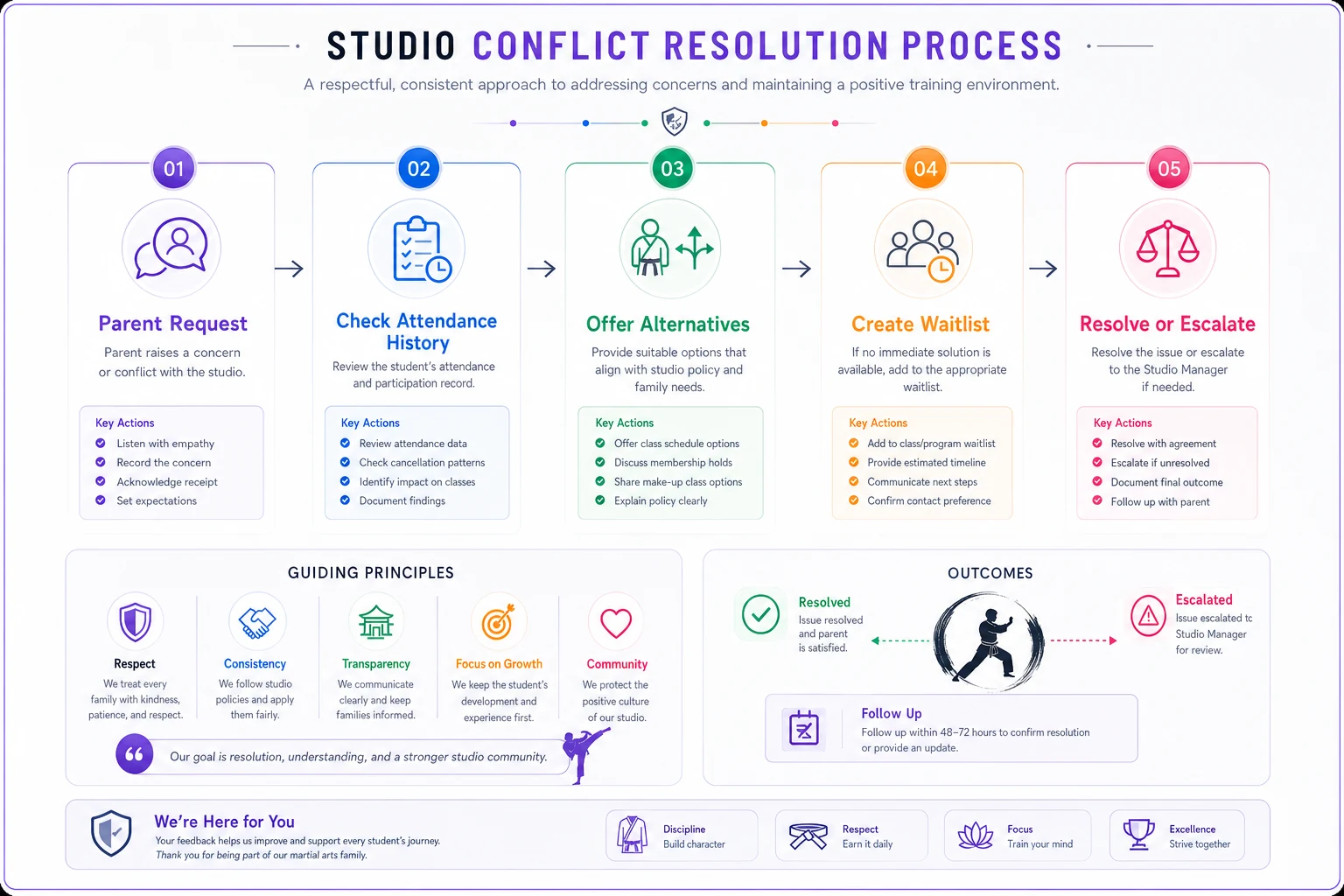
Parent scheduling conflicts:
Common scenario: Two families want the same limited spot in the advanced kids class.
Resolution protocol:
-
Check attendance history (consistent attendance gets priority)
-
Offer alternative time slots with same instructor
-
Create waitlist with clear position numbers
-
If no resolution
Split the class or add capacity
This workflow summarizes the parent request handling steps.
Documentation required:
-
Written record of offered alternatives
-
Timestamp of waitlist additions
-
Follow-up communication within 48 hours
Instructor assignment disputes:
-
Seniority gets first choice (but maximum 2 prime slots)
-
Performance metrics influence assignments (retention rates, student feedback)
-
Rotation system for equally qualified instructors
-
Financial incentives for taking less desirable slots
Studio space conflicts:
-
Regular scheduled classes (always first priority)
-
Pre-paid special events (testing, seminars)
-
Competition team training
-
Birthday parties/private events
-
Instructor training/meetings
Document this hierarchy publicly. Post it. Reference it consistently. This eliminates 90% of space disputes before they start.
Decision rules for expanding class hours
When do you add classes versus when do you optimize existing ones? Most studios add classes too early, diluting their strong programs while trying to capture marginal demand.
Add new classes when:
-
Existing similar classes run at 85%+ capacity for 8 consecutive weeks
-
Waitlist exceeds 30% of class capacity
-
You have qualified instructor availability
-
The time slot has proven demand (survey data or trial class success)
Optimize existing classes when:
-
Overall capacity utilization below 60%
-
Instructor costs exceed 35% of revenue
-
Student retention dropping below 80% monthly
-
Classes have wide skill disparities
Signs you're expanding too fast:
-
New classes launch with fewer than 5 students
-
Instructors teaching at multiple locations same day
-
Parents confused about which class to attend
-
Administrative time exceeds teaching time
A studio owner showed me their "growth problem"—they'd added 8 new classes in 3 months but revenue barely moved. Analysis revealed they'd simply spread their existing students thinner. Average class size dropped from 11 to 7. Instructor costs increased 40%. They reversed course, consolidated back to their original schedule plus 2 strategic additions, and revenue jumped 20% in 60 days.
Technology and systematic scheduling
Manual scheduling stops working around 150 students. You need systematic approaches that handle complexity without constant adjustment.
Operational software transforms scheduling from a constraint into a growth engine. Good scheduling software does more than assign time slots. It should track capacity utilization in real-time, flag underperforming time slots automatically, predict seasonal patterns based on historical data, balance instructor workloads across locations, and handle waitlists and transfers without manual intervention.
The real power comes from connecting scheduling to other operational systems. When scheduling software talks to your billing system, you see exactly which classes generate the most revenue per mat-minute. Connect it to your attendance tracking, and you'll spot retention problems before they become exodus patterns.
AI-powered scheduling assistants can now automatically suggest optimal class times based on parent availability surveys, predict no-show rates and overbook accordingly, identify students at risk of dropping and suggest schedule adjustments, balance skill levels within classes for optimal learning, and generate coverage schedules that respect instructor preferences and labor laws.
Studios using integrated scheduling platforms versus those using basic calendar tools show a stark difference. Integrated systems typically see 20-30% better capacity utilization, higher instructor satisfaction, and faster response to changing demand patterns.
Building your implementation roadmap
Converting from reactive to systematic scheduling doesn't happen overnight. Most studios need 3-4 months to fully implement capacity-based scheduling without disrupting current operations.
Month 1: Baseline measurement
-
Calculate current capacity utilization
-
Document all scheduling conflicts from past 90 days
-
Survey families about schedule preferences
-
Assess instructor availability and preferences
Month 2: Design new framework
-
Create schedule blocks based on your demographic
-
Build seasonal adjustment templates
-
Write conflict resolution protocols
-
Design capacity tracking spreadsheets or select software
Month 3: Pilot implementation
-
Test new schedule with one program (usually kids)
-
Run parallel schedules for comparison
-
Gather feedback from instructors and families
-
Adjust based on actual attendance patterns
Month 4: Full rollout
-
Implement across all programs
-
Train staff on conflict resolution protocols
-
Set up systematic review cycles
-
Document lessons learned for future locations
Studios that successfully implement this playbook typically see 25-40% improvement in capacity utilization, 15-20% reduction in instructor costs (through better distribution), 30% reduction in parent complaints about scheduling, and a clear path to adding additional locations without operational chaos.
The compound effect of systematic scheduling
A martial arts studio running at 35% capacity utilization with random scheduling will struggle to cover costs. The same studio at 65% utilization becomes highly profitable. The difference isn't adding more classes or hiring more instructors. It's understanding the math of your mat space and building schedules that respect that math.
Your schedule is either a growth accelerator or a hidden ceiling. Most studios never realize their schedule is what's holding them back until they fix it and suddenly everything else gets easier. Retention improves because classes aren't overcrowded. Instructors stay longer because workloads are balanced. New locations become possible because you have a replicable system.
Martial arts studios scaling successfully to 500+ students and multiple locations all learned this lesson: growth isn't about adding more of everything. It's about optimizing what you have, understanding your true capacity, and building systems that scale. Your schedule is the foundation of that system. Get it right, and growth becomes systematic instead of chaotic.
Martial arts studios scaling successfully to 500+ students and multiple locations all learned this lesson: growth isn't about adding more of everything. It's about optimizing what you have, understanding your true capacity, and building systems that scale. Your schedule is the foundation of that system. Get it right, and growth becomes systematic instead of chaotic.
Ready to elevate your dojo operations?
Join 500+ martial arts studios using Dojoyly to save time, reduce scheduling conflicts, and improve member engagement.