



That new white belt who just signed up for their trial? You've got exactly 30 days to show them they belong here. Not through sales pitches or constant check-ins, but through a carefully orchestrated sequence of small wins, timely nudges, and strategic human touchpoints that make them feel like they're already part of your community.
Most studios treat trials like extended sales demos. Send a welcome email, maybe a reminder before class, then hope for the best. Meanwhile, that excited parent who enrolled their kid last Tuesday is already wondering if martial arts is worth the commitment after their child complained about being confused in class three.
The studios converting 70% of trials instead of 30%? They're running a completely different playbook.
The three critical windows that determine trial outcome
After tracking conversion patterns across dozens of martial arts programs, the data reveals three make-or-break windows during any 30 day onboarding martial arts trial period.
Days 1-7: The engagement window Miss this and nothing else matters. The student needs to attend at least two classes, understand basic etiquette, and experience one small achievement. Could be landing their first proper stance, remembering the dojo rules, or simply feeling welcomed by name.
Days 8-21: The momentum window This is where most trials quietly fade away. The initial excitement wears off. Parents start calculating drive time against other activities. Adults begin feeling self-conscious about being beginners. Without strategic intervention here, you've already lost them.
Days 22-30: The conversion window By now, the trial student either sees themselves continuing or they don't. The difference isn't skill level or natural athleticism—it's whether they've built enough small wins and social connections to overcome the friction of commitment.
What separates high-converting studios isn't better instruction or fancier facilities. It's understanding that these windows require completely different approaches, messaging, and instructor involvement.
Building your automated backbone without losing the human touch
The operational challenge with trial onboarding isn't dedication—it's bandwidth. Your instructors want every student to succeed, but they're teaching six classes a day, managing belt testing prep, and trying to remember which trial student needs extra attention with their horse stance.
Simplify class bookings and attendance tracking.
Dojoyly helps you schedule, confirm, and manage every class effortlessly.
- Unified class & student management
- Automated member notifications
- Instructor scheduling & availability
No credit card required
This is where smart automation becomes essential. Not to replace instructor relationships, but to ensure nothing falls through the cracks while your team focuses on what they do best: teaching.
Start with the foundation messages:
-
Day zero welcome email goes out within an hour of signup, including parking instructions, what to wear, and a short video from your head instructor
-
Day one follow-up triggers six hours after their first class—not asking how it went, but sharing what their child learned today and what they'll build on next class
-
Day four check-in only sends if they missed their second scheduled class. No guilt, just "We saved your spot for Thursday's class"
-
Day seven progress note demonstrates investment in their journey: "After Emma's third class, she's showing great focus during warm-ups"
Automation handles the consistent touch points. Conversions happen through strategic instructor involvement tied to curriculum achievements, not random check-ins.
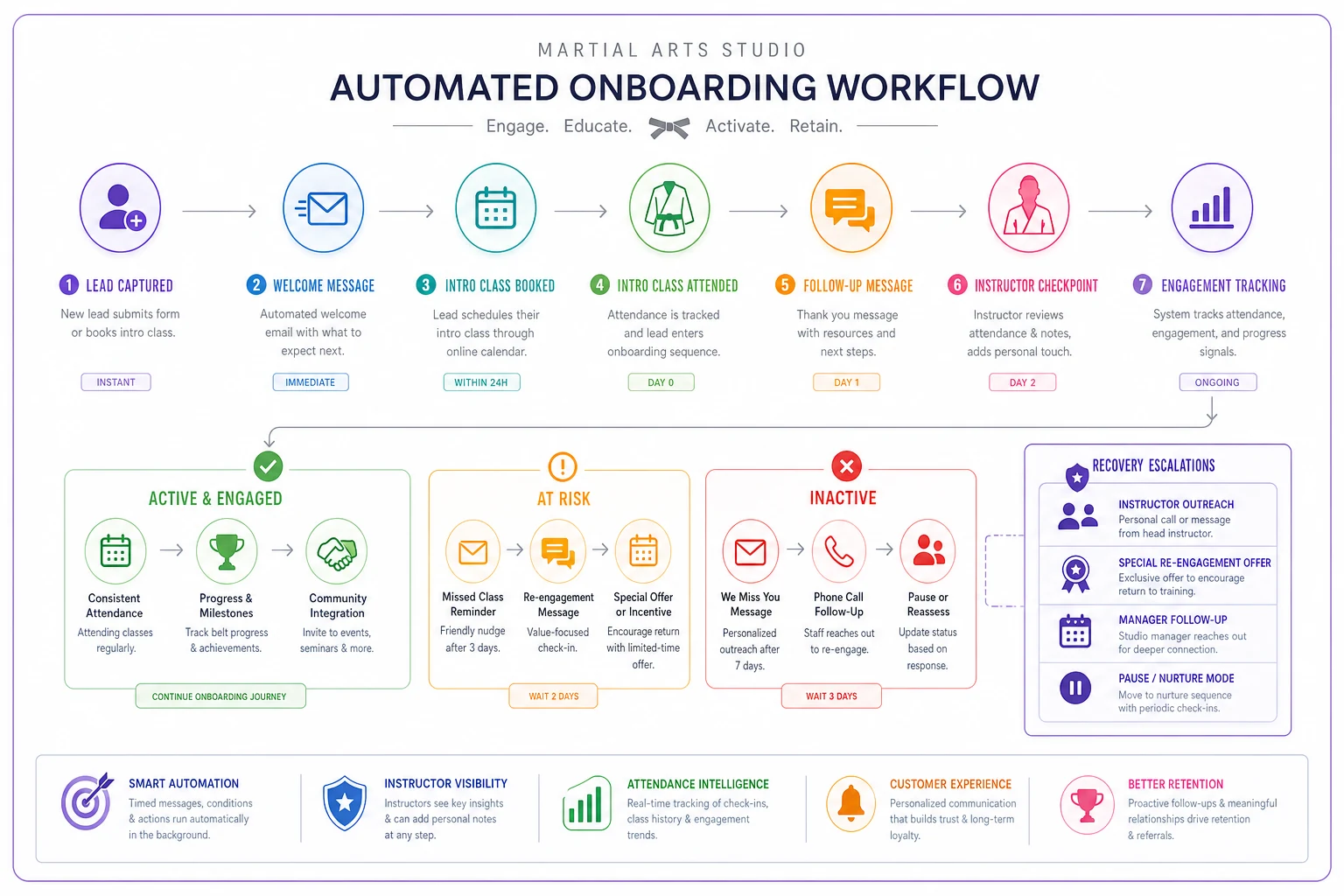
This diagram shows the timed sequence of automated messages, instructor checkpoints, and escalation paths.
Automation shouldn't replace instructor relationships though. Conversions happen through strategic instructor involvement tied to curriculum achievements, not random check-ins.
The instructor checkpoints that actually move the needle
Around day five, your instructor spends thirty seconds with the trial student after class. Not a sales conversation—a technique adjustment. "Your chamber position is getting stronger. Focus on keeping your heel up next class and you'll feel the difference in your kicks." That personal coaching moment gets logged, triggering a parent notification: "Instructor Marcus worked with Emma on her kick technique today. He notes she's picking up the movements quickly."
Day twelve brings the milestone conversation. After class, the instructor mentions to the parent: "Emma's ready for her first stripe. We usually award these when students demonstrate consistent attendance and effort. Would you like her to receive it at our Friday recognition ceremony?" This isn't random—your tracking system flagged this student as hitting attendance and engagement metrics that predict conversion.
Day eighteen requires the belonging intervention. Your system identifies students who've attended consistently but haven't connected socially. The instructor pairs them with a senior student for partner drills, then mentions to the parent: "I had Emma work with one of our green belts today. Building these training relationships helps new students progress faster."
Day twenty-five is decision time. Students showing strong engagement get the assumption close: "Emma's trial wraps up next week. I'll have her uniform order form ready so she can get her official gi when she transitions to regular membership." Students with inconsistent attendance get the recovery approach: "I notice scheduling has been challenging. Would morning classes work better for Emma? We want to find what fits your family."
These touchpoints get triggered by specific behavioral signals your operational system tracks automatically.
When trials go sideways: your recovery protocols
Every trial hits friction. The question is whether you catch it in time.
The missed second class is your first warning signal. One missed class means nothing. Missing class two or three? You've got a 20% conversion rate unless you intervene immediately. Your automated SMS goes out the same day: "Missed you in class today! Here are three makeup times this week [specific times]. Reply with what works."
The inconsistent attendance pattern (attending once a week for two weeks) triggers a different protocol. This isn't about reminders—it's about removing friction. Your system queues a staff call: "We noticed scheduling might be challenging. Would you prefer to lock in specific days each week, or would open attendance work better for your family?"
The parent concern signal comes from specific keywords in communication or front desk notes. Mentions of "confusion," "not sure if it's working," or "thinking about it" trigger immediate instructor intervention. Not to sell, but to solve. "I wanted to check in about Emma's progress. What specific concerns do you have? Let's address them in her next class."
The quiet fade—no attendance for five consecutive days—gets the pattern interrupt. Not another "we miss you" message, but something unexpected: "Emma learned three fundamental techniques in her first week. Rather than lose that progress, would you like to schedule a five-minute skills review before regular class this week?"
Each recovery protocol has a clear escalation path. Automated reminder, personal text from instructor, phone call from program director, final "pause instead of quit" offer. Most studios stop at step one.
The message templates that actually get responses
Generic trial messages get generic results. Your communication needs to demonstrate specific attention to each student's journey.
| Instead of saying... | Try this... |
|---|---|
| "How was your first class?" | "In today's class, your child worked on ready position and basic blocks. Tomorrow we'll build on those with their first combination. Any questions about what they learned?" |
| "We haven't seen you lately" | "You've completed 3 of your 8 trial classes. Your remaining classes expire on [date]. Would switching to morning sessions help you use them?" |
| "Your trial is ending soon" | "Based on Emma's strong progress with basic techniques, she's ready for our white belt program. The next enrollment period starts Monday. Should we reserve her spot?" |
The difference? Specificity. Context. Demonstration that you're tracking their individual journey, not just sending broadcast reminders.
Your re-engagement messages work the same way. Not "Come back and try again" but "You learned front stance and low block in January. Our March beginner intensive covers exactly those fundamentals. Would you like to use your remaining trial classes there?"
Turning the trial conversion system into predictable revenue
Most studios measure trial conversion as a single metric: what percentage signed up? But effective 30 day onboarding martial arts trial management tracks leading indicators that predict outcome by day ten.
Attendance velocity tells you everything. Students who attend four classes in their first ten days convert at 75%. Those who attend twice? Under 30%. Your system should flag slow starters by day five, not day twenty-five.
Engagement depth matters more than frequency. A student who attends twice but stays after class to practice converts better than one who attended four times but rushes out immediately. Track post-class time, parent questions, and practice outside the dojo.
The parent involvement coefficient predicts long-term retention. Parents who watch classes, ask about progress, and engage with your communication stay for years. Parents who drop off and disappear churn within six months even if they initially convert.
By day fifteen, you should know exactly which trials will convert, which need intervention, and which are already gone. Your operational system tracks these signals automatically, queueing human intervention only where it matters.
The scheduling and staffing reality of trial management
Running this level of trial engagement sounds great until you realize someone needs to send messages, make calls, and track progress for twenty concurrent trials while managing 200 existing students.
Most studios design elaborate onboarding processes that work brilliantly for the first three trials, then completely collapse when trial number four signs up during belt testing week.
The solution isn't working harder—it's building operational infrastructure that scales. Your core automation handles 80% of touchpoints. Instructors handle scheduled checkpoints tied to their classes, not random additions to their day. Administrative staff manages escalations and scheduling issues through clear protocols, not general "check in on trials" responsibilities.
A typical week might include fifteen trials at various stages. Your Tuesday instructor knows exactly which three need technique feedback after class. Your admin knows which two require scheduling calls. Your Saturday team knows who's getting their first stripe. Nobody's guessing, nobody's overwhelmed, and nobody falls through cracks.
Building this system when starting from zero
You don't need perfect automation on day one. Start with the highest-impact elements and build from there.
-
Week one
Create your three core templates (welcome, first class follow-up, scheduling recovery). Set calendar reminders to send them manually. Track attendance on a simple spreadsheet.
-
Week two
Identify your instructor checkpoint moments. Train your team on the specific interventions for days 5, 12, 18, and 25. Create a shared document tracking which instructor handled which checkpoint.
-
Week three
Build your recovery protocols. Define exactly what triggers each intervention and who's responsible. Test them with your current trials.
-
Week four
Add progress tracking. Note technique milestones, social connections, and parent engagement. Look for patterns in successful conversions.
-
Month two
Implement basic automation for standard messages. Keep human checkpoints manual but systematized. Start tracking leading indicators.
-
Month three
Refine based on data. Adjust message timing, modify checkpoint conversations, test different recovery approaches. Your conversion rate should already be climbing.
Start by sending the welcome and day-one follow-up manually for your next five trials to see wording that resonates before automating.
Studios hitting 70% trial conversion didn't start there. They built their system incrementally, testing and refining based on actual student behavior, not theoretical best practices.
The technology layer that makes this sustainable
Manual trial management works until about ten concurrent trials. Beyond that, things fall apart fast. You need operational infrastructure that manages the complexity while keeping the human elements human.
Modern martial arts management platforms can trigger messages based on attendance, flag students for instructor attention, track progress through curriculum milestones, and alert staff to concerning patterns. The key is choosing systems that enhance your process rather than forcing you into their framework.
Your platform should track attendance patterns and automatically trigger appropriate responses. Know when a student earned their stripe and queue the parent notification. Recognize scheduling conflicts and suggest alternatives. Do this without requiring daily manual oversight.
Automation shouldn't replace judgment though. When a parent mentions financial concerns, your system should flag it for human intervention, not send an automated payment plan offer. When a child has a breakthrough moment in class, the instructor's personal note matters more than any automated progress report.
The best operational software for martial arts studios acts like an incredibly organized assistant who never forgets a detail but knows when to tap you on the shoulder for the important stuff.
Measuring what matters and adjusting based on reality
Your trial conversion rate is a lagging indicator. By the time you see it drop, you've already lost revenue. Track leading indicators that predict problems before they cost you students.
Day 3 attendance rate: What percentage of trials attend their second class within 72 hours? Below 60% means your first class experience needs work.
Day 10 engagement score: Combined metric of attendance, parent involvement, and instructor interactions. Students scoring above 7/10 convert at 3x the rate of those below.
Day 15 momentum check: Are they accelerating (attending more frequently) or decelerating (spacing out visits)? Deceleration after day 15 almost always means lost conversion.
Day 20 commitment signals: Have they asked about uniforms, testing, or schedules beyond their trial? These questions predict conversion better than attendance alone.
Day 25 decision readiness: Based on all signals, is this student ready for an assumption close or do they need recovery intervention?
Track these metrics monthly, not annually. Seasonal patterns, instructor changes, and competitive pressures all impact conversion. What worked in January might fail in June.
Common trial conversion myths that hurt studios
"More follow-up is better" - Wrong. Strategic follow-up at curriculum milestones beats daily check-ins that feel pushy. Parents know you want them to join. Show them their child is progressing instead.
"Discounting drives conversion" - Rarely true. Students who need heavy discounts to convert churn quickly. Focus on value demonstration through progress and belonging, not price reduction.
"Let them try multiple programs during trials" - This confuses more than it helps. Better to excel in one program for 30 days than sample three programs superficially.
"Experienced students should lead trial orientation" - Sounds good, usually backfires. New students need expert instruction to build confidence. Save peer mentorship for after conversion when they're ready for community integration.
"Extended trials convert better" - Data says otherwise. 30 days provides urgency. 60 days becomes perpetual trial mode. 14 days doesn't allow momentum building. The sweet spot remains 28-30 days for most martial arts programs.
The competitive reality of modern martial arts studios
Every strip mall has three martial arts studios now. Parents comparison shop online before stepping foot in any dojo. Your trial process isn't just about conversion—it's about differentiation.
The studio down the street might charge less. The one across town might have fancier facilities. But if your trial process makes families feel seen, supported, and successful, price and amenities become secondary considerations.
This isn't about being pushy or salesy. It's about operational excellence that demonstrates professionalism. When every message arrives on time, every instructor knows the student's name and progress, every concern gets addressed proactively—parents recognize they've found something different.
Your trial system becomes your competitive moat. Not because it's complicated, but because it's consistent. While competitors wing it with random check-ins and generic follow-ups, you're running a professionally orchestrated experience that builds real connection.
Making your 30-day trial system market-proof
Economic downturns, seasonal slowdowns, and competitive pressure all threaten trial conversion. Building a resilient system means preparing for these realities, not hoping they won't happen.
When budgets tighten, your trial process should emphasize value through progress demonstration, not feature lists. Show parents exactly what their child achieved in 30 days. Make the continuation feel like protecting an investment, not starting an expense.
During busy seasons (back-to-school, January), your system needs to scale without quality drops. Automation handles the volume while instructors focus on high-impact touchpoints. No trial should feel like a number regardless of how many you're running.
When competitors offer free trials or aggressive discounts, your systematic approach becomes the differentiator. While they're giving away classes hoping something sticks, you're running a professionally orchestrated onboarding experience that builds real connection.
The path forward for your trial process
Implementing a comprehensive 30 day onboarding martial arts trial system feels overwhelming. Start small, measure everything, adjust based on reality not theory.
Pick your biggest gap first. If trials ghost after class one, fix your welcome sequence. If they fade during week three, build your momentum interventions. If they resist converting despite good attendance, strengthen your progress demonstration.
Build your system incrementally. Each improvement compounds. Studios that convert 70% of trials didn't start there—they improved 5% at a time through systematic refinement.
Your trial process is really about demonstrating what ongoing membership feels like. Make those 30 days remarkable through systematic attention, strategic intervention, and genuine progress. The conversion conversation becomes a formality when the student already feels like they belong.
Most studios treat trials as extended sales opportunities. Successful ones treat them as the first chapter of a long journey, with every message, interaction, and milestone carefully designed to write a story the student wants to continue.
That white belt who walked in nervous last Tuesday? With the right operational system supporting their journey, they're not just trying out martial arts—they're discovering they belong here. That's a conversion that lasts years, not just months.
Ready to elevate your dojo operations?
Join 500+ martial arts studios using Dojoyly to save time, reduce scheduling conflicts, and improve member engagement.