

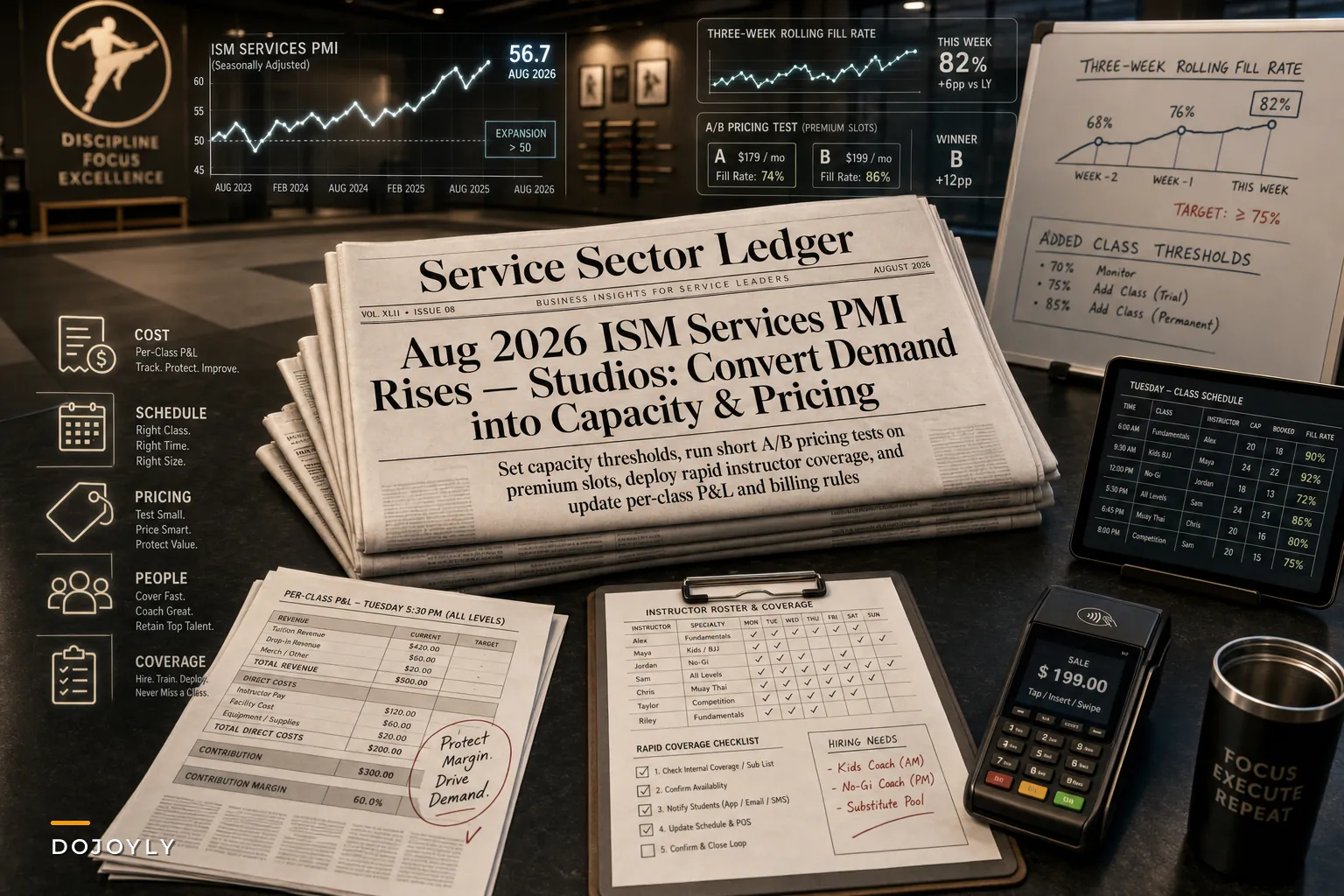

The ISM Services PMI climbed to 55.4 in August 2026, and the report that landed on September 3rd had two things sitting side by side that don't usually make studio owners comfortable: stronger services demand and rising input costs with slower supplier deliveries. Reuters framed it as strong demand boosting the U.S. services sector, which for most industries is a clean positive. For a martial‑arts studio weighing whether to open a second Tuesday kids class or finally pull the trigger on a new instructor, it's a mixed signal that forces a real decision this quarter instead of kicking it to next.
The temptation when demand ticks up is to say yes to everything. More inquiries, more trial signups, parents asking about earlier slots. But an expansion that made sense at last quarter's cost base might be a break-even class at this one. That tension is what a reading like this actually exposes — and it's worth working through before you commit payroll or add slots you can't easily unwind.
What a services demand bump actually means at the mat level
A macro PMI number doesn't show up as a headline in your studio. It shows up as small, easy-to-miss signals over three or four weeks:
-
Trial requests from your website contact form tick up slightly
-
Your 5
30pm and 6:30pm weekday slots start hitting capacity earlier
-
Parents ask about waitlists instead of just asking about price
-
Word-of-mouth referrals start arriving without a promotion attached
None of these individually scream "expand." Together they mean your best time slots are becoming the constraint, not your marketing. And the second half of the ISM report — rising input costs — means mat space, insurance renewals, instructor pay expectations, and even belt and gear supply chains are quietly getting more expensive at the same moment demand is asking you to grow.
The mistake is treating the demand signal and the cost signal as separate conversations. They aren't. If you add a class to capture demand but haven't re-run your per-class math against the new cost base, you can grow revenue and shrink margin in the same quarter. That's the trap.
The real problem: studios expand on gut feel, not thresholds
Most studios don't have a written trigger for when to add a class versus hire versus raise price. The decision gets made emotionally — a good week, a frustrated instructor, a competitor opening down the street. When demand is elevated and costs are rising, gut feel becomes actively dangerous because both signals push you to act, but in opposite directions.
Simplify class bookings and attendance tracking.
Dojoyly helps you schedule, confirm, and manage every class effortlessly.
- Unified class & student management
- Automated member notifications
- Instructor scheduling & availability
No credit card required
The pattern worth naming: elevated demand makes adding capacity feel urgent, while rising costs make it more expensive than the last time you did it. If you don't quantify both, you default to the emotionally louder one, which is almost always "add the class, don't lose the momentum."
What separates studios that grow profitably from ones that grow themselves into a cash crunch is having pre-agreed numbers. Not a philosophy — actual thresholds. When a slot hits X% fill three weeks running, you do Y. This is the same discipline broken down in detail in the guide to capacity‑driven expansion thresholds, and a demand-plus-cost squeeze like this one is exactly when those thresholds earn their keep.
Three levers, and when each one actually fits
You have three real moves this quarter: add classes, hire, or adjust pricing. They aren't interchangeable, and picking the wrong one wastes the demand window.
| Lever | Fits when | Bad idea when | Speed to impact |
|---|---|---|---|
| Add a class | Two+ prime slots consistently >85% full, and you have instructor coverage | Your demand is spread thin across many half-full slots | 1–3 weeks |
| Hire an instructor | You're turning away classes and your bench for subs is empty | You can cover added classes with existing staff or senior students | 4–8 weeks |
| Adjust pricing | Prime-time demand exceeds supply and you haven't raised rates in 12+ months | You're still under-filled overall and price is the barrier | Immediate |
What owners get wrong: they reach for hiring first because it feels like the "real" growth move. But hiring is the slowest and highest-fixed-cost lever. In a demand window that might last a quarter or two, pricing and schedule adjustments capture the upside faster and reverse more cleanly if demand fades.
When adding a class makes sense
Adding a class works when the demand is concentrated. If your Monday and Wednesday 6:30pm classes are both running 22 out of 24 spots for three straight weeks, that's a slot problem, not a marketing problem. A parallel class at 7:30pm or a second room solves it. The math is usually favorable because you're using space you already pay for.
When pricing is the right first move
If prime-time is full and you physically can't add more mat time in those windows, price is doing the rationing whether you manage it or not. A modest increase on new signups into premium slots — while grandfathering existing members — captures the elevated demand without alienating your base. This is the lever most studios underuse, especially right after absorbing a cost increase they haven't passed on.
When you should NOT hire yet
Don't hire because you had two strong weeks. Hire when you've already added the classes your space allows, filled them, and you're still turning people away. Hiring ahead of confirmed, sustained demand during a rising-cost period is how a good quarter becomes a payroll problem by winter.
A 5-step sequence to run this quarter
Here's the order that keeps you from over-committing while the window is open:
-
Re-run per-class P&L against current costs. Rent, insurance, average instructor pay per class, gear. If your break-even fill moved from 9 students to 11, every expansion decision changes. Do this first — everything downstream depends on it.
-
Rank slots by three-week rolling fill rate. Not last night's class. The rolling average tells you what's structurally full versus a one-off good night.
-
Apply your thresholds to the top slots. Slots above your "add capacity" line get a parallel class or a price adjustment. Slots below stay as-is.
-
Run a short, contained pricing test on premium slots only. New-member pricing into your two fullest windows, existing members untouched, 30-day window. Measure conversion, not just revenue.
-
Only then evaluate hiring — against filled added classes plus a genuinely empty substitute bench.
I'll show a simple visual of the sequence to keep the operational steps clear.
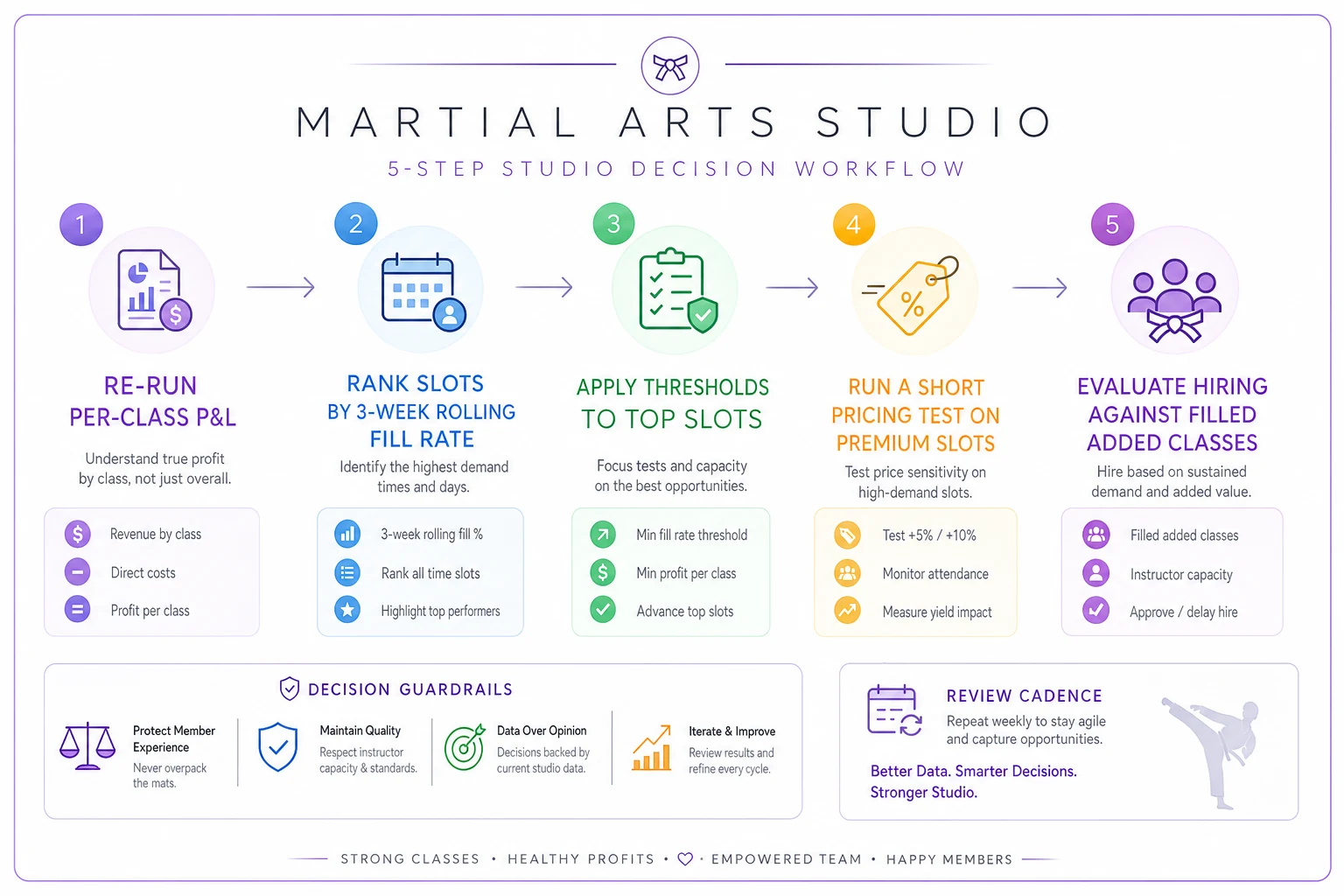
Pricing and scheduling come before hiring. That ordering is the whole point.
Protecting the cash you're about to earn
Elevated demand pulls in more trials, and more trials means more first-time billing — which is exactly where new revenue quietly leaks. A demand spike that converts into 15 extra trial members does you no good if a third of their first charges fail and nobody follows up. When you're capturing a demand window, back-end billing discipline matters more, not less, because the volume of new payment relationships is higher and each one is unproven.
Same logic on capacity: if you add a class and let it fill with no waitlist rules, you get chaotic overflow and no clean signal on whether to add another. Waitlist data is one of the clearest expansion signals you have — a slot with a standing waitlist of six or more people for a month is telling you something a spreadsheet can't guess.
This is where operational software earns its place quietly in the background. Rolling fill-rate tracking, automated waitlist management, and billing retry workflows for new trial conversions aren't glamorous, but during a demand-and-cost squeeze they're the difference between capturing the upside and just being busier. AI-assisted scheduling and billing tools handle the repetitive tracking — flagging which slots crossed your threshold, retrying failed first charges automatically, surfacing waitlist depth — so the owner spends the window making decisions instead of pulling reports.
A quick checklist before you commit anything
A quick checklist before you commit anything
-
[ ] Updated per-class break-even for current rent, insurance, and pay
-
[ ] Three-week rolling fill rate calculated per slot (not single-night)
-
[ ] Written thresholds for add-class / hire / price-adjust
-
[ ] Pricing test scoped to premium slots and new members only
-
[ ] Waitlist rules in place so overflow becomes usable data
-
[ ] Trial billing retry and dunning tightened before the intake bump hits
-
[ ] Substitute bench checked before considering a permanent hire
Substitute bench checked before considering a permanent hire
Real scenario
A single-location studio running mostly kids and teens programs saw trial inquiries climb through late August — nothing dramatic, roughly 8–10 more per week than their summer baseline. Their two weekday 6:30pm classes were sitting at 21–23 of 24 spots for about three weeks straight.
The owner's instinct was to hire. Instead they ran the sequence. Re-running per-class costs showed their break-even fill had crept up because of an insurance renewal, so the margin on any new class was thinner than they'd assumed. Rather than hire, they added one parallel 7:30pm class using an existing senior instructor and ran a small new-member price bump — about $12/month — on the two full evening windows only, existing members untouched.
The parallel class filled to around 15 within a month. The price test barely dented conversion — a couple of prospects hesitated, most didn't blink — and added roughly $600–$800 in monthly recurring revenue once the new signups settled. Total added fixed cost: one instructor's extra class-hours, not a full hire. They kept the hiring decision on the table for next quarter, but only if the added class and a growing waitlist confirmed the demand was real and lasting.
The bottom line for this quarter
A PMI print doesn't tell you to expand. It tells you the environment shifted — and that both your demand and your costs moved at once. The studios that handle a signal like this well aren't the ones who move fastest. They're the ones who already know their thresholds and run pricing and scheduling before they touch payroll.
Capture the demand while it's here, but capture it in the order that reverses cleanly if it fades: costs first, then slots, then price, then — only if the numbers hold — people.
A PMI print doesn't tell you to expand. It tells you the environment shifted — and that both your demand and your costs moved at once. The studios that handle a signal like this well aren't the ones who move fastest. They're the ones who already know their thresholds and run pricing and scheduling before they touch payroll.
Capture the demand while it's here, but capture it in the order that reverses cleanly if it fades: costs first, then slots, then price, then — only if the numbers hold — people.
Ready to elevate your dojo operations?
Join 500+ martial arts studios using Dojoyly to save time, reduce scheduling conflicts, and improve member engagement.