

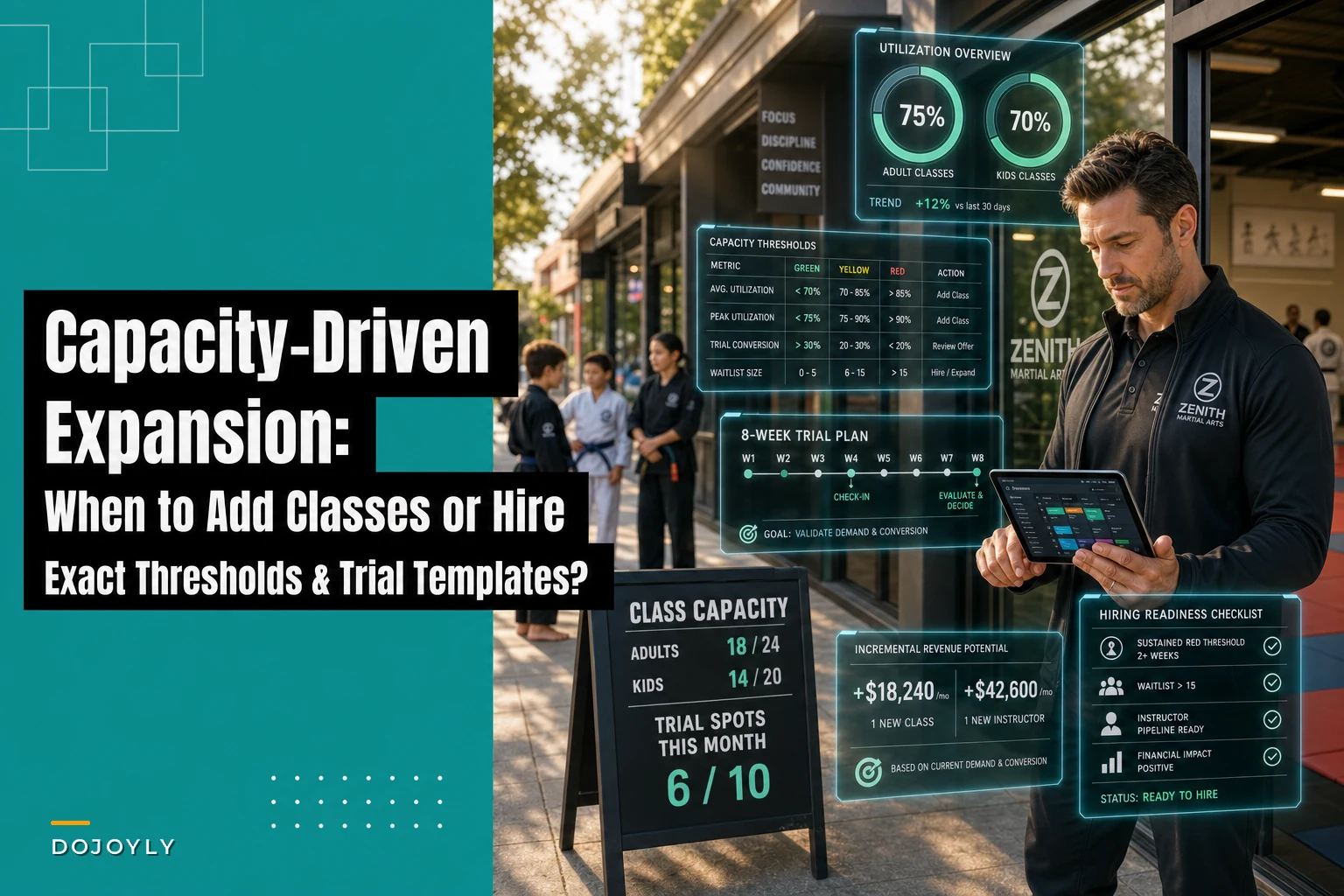

Most studio owners expand based on feeling. The mat seems full. The evening classes feel packed. A parent complains they can't get their kid into the 5pm slot, and suddenly you're pricing out a second location or posting an instructor job you can't really afford yet.
The problem isn't ambition. It's that "full" is not a number, and gut feeling is a terrible way to decide when to add fixed cost. Add a class too early and you're paying an instructor to teach four people. Add it too late and you've quietly bled members who got tired of the waitlist and found the gym down the road.
Capacity driven expansion means you decide before the pain, using thresholds you set in advance. Not "it feels busy," but "the 6pm kids' class has run above 82% capacity for six straight weeks, so we split it." That's what this piece is about—building those thresholds and the math underneath them.
The three expansion decisions, and why people confuse them
There are really only three levers, and studio owners routinely reach for the wrong one:
-
Add a class (or split an existing one) — cheapest, fastest, lowest risk
-
Hire an instructor — medium cost, medium commitment, changes your labor math
-
Open a new site — highest cost, months of lead time, changes everything
The mistake that comes up constantly: owners jump straight to hiring or opening a location when their actual problem is a scheduling problem. They've got a jammed 6pm slot and three empty midday slots, and they read that as "we're out of room." You're not out of room. You're out of room at the times people want.
Before spending a dollar on expansion, it's worth stress-testing whether your current schedule grid is even working. A lot of what looks like a capacity ceiling is really a scheduling ceiling—and there's a full breakdown on that in When your schedule is capping growth. Read that first if your empty slots and full slots are wildly uneven. You may not need to expand at all.
Utilization is the metric, but you have to define it correctly
Utilization sounds simple: how full is the class. But there are three flavors, and mixing them up is where bad decisions start.
Simplify class bookings and attendance tracking.
Dojoyly helps you schedule, confirm, and manage every class effortlessly.
- Unified class & student management
- Automated member notifications
- Instructor scheduling & availability
No credit card required
-
Roster utilization — enrolled students ÷ max capacity. What most software shows you by default.
-
Attendance utilization — average bodies actually on the mat ÷ max capacity. The one that matters operationally.
-
Peak utilization — attendance on your busiest single session ÷ max capacity.
A class can show 95% roster utilization and feel dead because attendance runs at 60%. Or it can show 70% roster and feel suffocating because everyone actually shows up and the mat turns into a collision zone.
Make expansion decisions on attendance utilization, sanity-checked against peak. Roster tells you about revenue. Attendance tells you about physical and instructional capacity. They're different problems.
> Take the last 6 weeks of a specific class slot. Add up actual check-ins across those sessions, divide by (sessions × max capacity). That's your number.
Example: your Tuesday/Thursday 6pm kids' class caps at 24. Over six weeks that's 12 sessions × 24 = 288 possible spots. Actual check-ins totaled 214. That's 74% attendance utilization. Comfortable, not urgent.
The threshold table
This is the part owners actually want—the "at what number do I act" table. These thresholds assume you're looking at a rolling 6-week average of attendance utilization for a specific class slot, not a one-week spike.
| Attendance utilization (6-wk avg) | What it means | Action |
|---|---|---|
| Below 45% | Underfilled, likely wrong time or wrong program | Consolidate or move the slot; do NOT add anything |
| 45–65% | Healthy but has room | Hold. Focus on filling, not expanding |
| 66–78% | Getting tight, instructor working harder | Watch weekly; prep a split plan |
| 79–88% | Functionally full for quality instruction | Add/split the class or add capacity |
| 89%+ sustained | You're turning people away, silently | You're already late—act now |
Two things people consistently get wrong with a table like this.
First, the ceiling is lower than you think. Most owners assume "full" means 100% of the roster line. But at 90%+ attendance in a kids' class, instruction quality collapses—too many students per correction, too much waiting, safety spacing gone. For technical arts like BJJ, judo, or anything with throws and ground work, your practical ceiling might be closer to 75%, not 90%, because of floor space per pair.
Second, one week doesn't count. A single packed Tuesday after a holiday is noise. The 6-week rolling average filters signal from noise. If you react to spikes, you'll add a class in November that's empty by February.
Trend heuristics: direction matters more than the snapshot
A static utilization number tells you where you are. The trend tells you whether to act now or in six weeks. Two classes both sitting at 76% are in completely different situations if one is climbing and one has been flat for two months.
-
Three consecutive weeks of increases in a slot already above 70% → start split planning now, don't wait for the threshold.
-
Waitlist forming on a slot (even two or three names) while adjacent slots sit under 50% → scheduling fix, not an expansion.
-
New-student inquiries clustering around one time band you can't serve → leading indicator that demand exists before it shows in attendance.
That last one is the most overlooked signal in the whole business. The demand that never converts because you had no open 5:30 slot never shows up in your utilization report—it's invisible. The only way to catch it is to log why trial requests don't book. "No class at a time that works" is a category most studios never track. If you did nothing else from this article, start logging declined-trial reasons by time band.
The incremental revenue math (this is where it gets honest)
Adding a class or an instructor is a fixed-cost decision. The only question that matters: does the incremental revenue clear the incremental cost with margin to spare?
A real example.
Scenario: splitting a jammed kids' class into two.
-
Current single class
one instructor, ~2 hrs/week, ~$40/hr = $80/week labor
-
After split
two instructor slots, ~4 hrs/week = $160/week labor
-
Incremental labor
~$80/week, roughly $340/month
To justify that cost, the new slot needs to pull enough net-new members—not just shuffle existing ones. If your average membership runs around $150/month, you need a bit more than two net-new enrollments to break even, and realistically four or five to make the split worth the operational hassle.
Here's the honest part most break-even math skips: splitting a class doesn't automatically create new members. If you redistribute the same 18 kids across two slots, you've doubled your labor cost and added zero revenue. The split only pays off if the previously-turned-away demand is real—which is exactly why the declined-trial log matters. It's your evidence before you commit the cost.
Hiring an instructor is a bigger version of the same math, with a longer payback window. A part-time instructor at $1,600–$2,000/month needs to unlock enough new class capacity to generate roughly 12–15 net-new members over a couple of months. If you can't map where those members come from—specific new slots, specific demonstrable demand—you're hiring on hope.
Staged scheduling templates: expand in steps, not leaps
The safest way to expand capacity is in stages that each de-risk the next. Don't go from "one packed class" to "brand new instructor on payroll." Ladder it.
-
Stage 0 — Confirm the signal (2–3 weeks). Verify the 6-week attendance average is genuinely above 79% and trending up, not a seasonal blip. Pull the declined-trial log.
-
Stage 1 — Reclaim capacity you already have. Can you move a low-fill class off the prime slot and open that time for overflow? Can you raise the cap by two or four if floor space and the instructor genuinely allow? Zero fixed cost.
-
Stage 2 — Add a single new session, temporary. Run the new slot for an 8-week trial using an existing instructor's flexible hours or a trusted senior student under supervision. Measure fill weekly.
-
Stage 3 — Make it permanent. If the trial slot clears 60% attendance by week 6 and is still climbing, lock it into the schedule and formalize instructor hours.
-
Stage 4 — Hire. Only when you have two or more permanent slots you can't cover with existing staff. Now the instructor has a defined book of classes on day one, not a hope.
-
Stage 5 — New site. A separate decision entirely, triggered by geography and sustained demand across the whole location—not by a single crowded evening slot. The operational complexity of running two sites is covered in the multi-site operations playbook.
A quick workflow to follow:
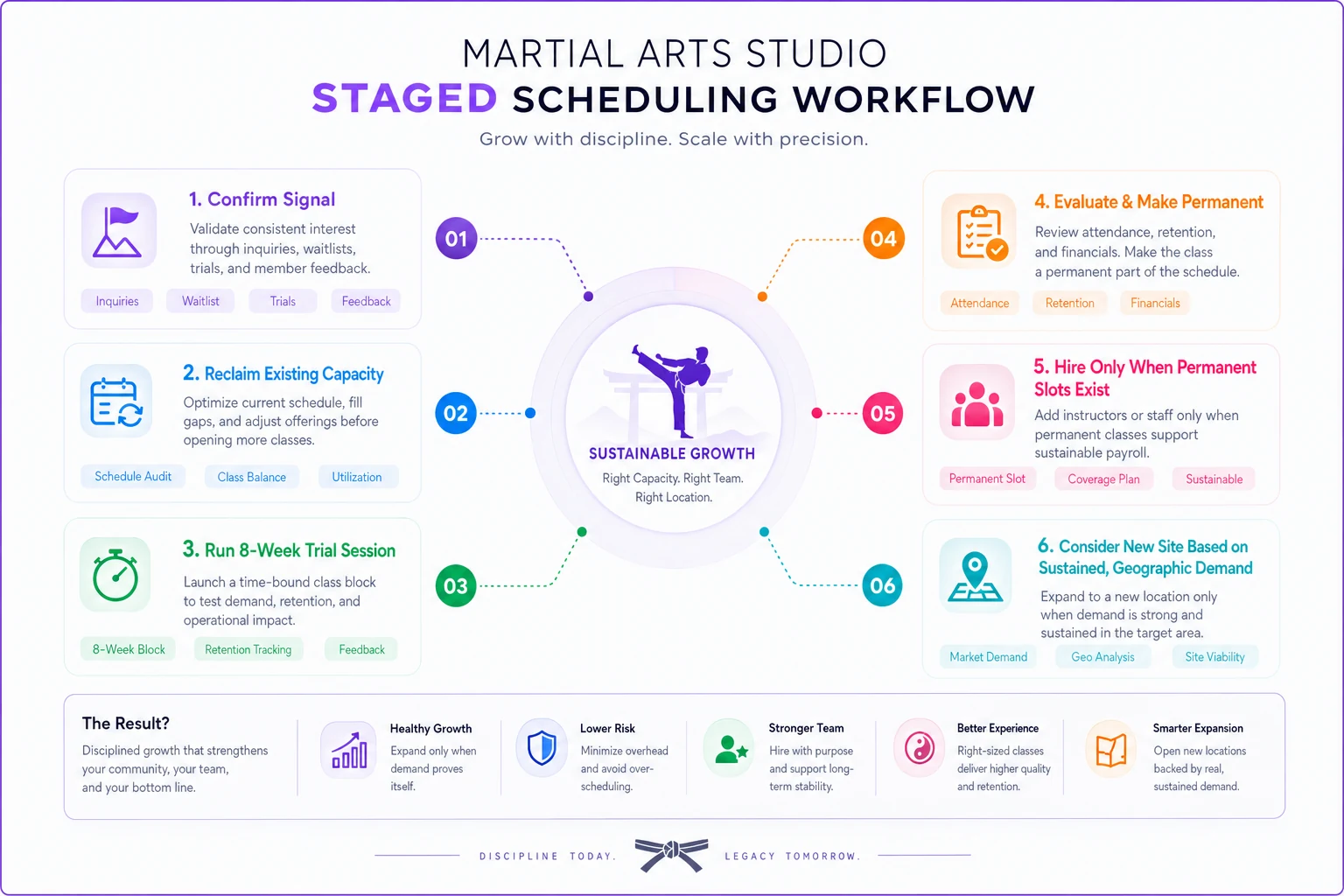
Treat each stage as reversible and use the trial to validate demand before adding fixed payroll or a lease.
When opening a new site actually makes sense
Owners fall in love with the second-location idea way too early. The honest filter:
A new site makes sense when:
-
Your primary location has run near practical capacity across most prime slots—not just one or two—for three months or more.
-
You've got a defined geographic pocket of declined trials
people who inquired but were too far to attend.
-
Your current location is throwing off consistent profit you could survive without for 6–12 months while the new site ramps.
-
You have a bench
at least one instructor ready to lead, so you're not personally teaching in two buildings.
A new site is probably the wrong move when:
-
Only your evening slots are full and your daytime grid is sparse. That's a scheduling problem wearing an expansion costume.
-
Your "full" is roster utilization, not attendance. You might have 95% enrolled and 60% actually showing up.
-
You haven't systematized the first location yet. If it still runs on you personally, a second site multiplies the chaos rather than dividing it.
Anyone whose current location isn't consistently profitable on its own shouldn't be opening a second site. A second location doesn't fix a broken first one. It amplifies whatever's already there, good or bad.
A short real scenario
A single-location kids-and-adults studio, roughly 180 active members. The owner was convinced she needed a second location—her 5pm and 6pm kids' classes felt impossible to manage.
When she pulled attendance utilization by slot, the picture looked different. Those two evening kids' slots ran at 86–90% attendance. But her 4pm, her noon adult classes, and her Saturday mid-morning slots were all sitting between 35% and 50%. The building was maybe 60% utilized overall. She wasn't out of space. She was out of space at 5pm.
She staged it instead. Moved a low-fill adult class off the 6pm prime slot, opened a third kids' session, and ran it as an 8-week trial with an existing instructor picking up two extra hours. The declined-trial log had shown a cluster of parents wanting a 4:30 start for younger kids, so she aimed the new slot there.
Over about two months the new slot filled into the mid-60s in attendance and kept climbing. Net-new members from the addition landed somewhere around nine or ten. Incremental labor was a few hundred dollars a month; incremental revenue cleared it comfortably by the second month. No lease, no build-out, no second rent check. The second-location plan went back in the drawer for a year—correctly.
The reporting cadence that keeps this honest
None of this works if you check utilization once a year in a panic. The whole system depends on the numbers being in front of you regularly, broken out by slot—not just as a studio-wide average that hides everything.
A workable rhythm:
-
Weekly glance at attendance by slot, flag anything crossing into the 79%+ band.
-
Every 6 weeks recompute the rolling attendance average per class; check trend direction.
-
Quarterly review the declined-trial log for demand clusters you're not serving.
Start logging declined-trial reasons by time band so your trial data becomes actionable rather than anecdotal.
Most studio management platforms surface roster numbers easily, but attendance utilization by slot—the number you actually need—often takes some setup. Worth the one-time effort, though, because the alternative is making six-figure expansion decisions based on the feeling that the mat looks busy.
Studios that build this kind of reporting discipline treat check-in data as an early-warning system, not an attendance log they open twice a year. That shift in how you use the data is what separates owners who expand at the right time from owners who either move too fast and bleed margin, or move too slow and lose members to whoever opened down the street.
The takeaway
Expansion isn't a vibe. It's a threshold you set before you're under pressure, measured on attendance utilization by slot, confirmed by trend, and justified by incremental math that assumes new demand is real, not just reshuffled.
Set your bands. Log your declined trials. Stage every expansion so each step is cheap enough to walk back. Do that, and you'll add classes at the right moment, hire when the book already exists, and only open a second location when the first one is genuinely, provably full—not just full at 6pm on a Tuesday.
Ready to elevate your dojo operations?
Join 500+ martial arts studios using Dojoyly to save time, reduce scheduling conflicts, and improve member engagement.