

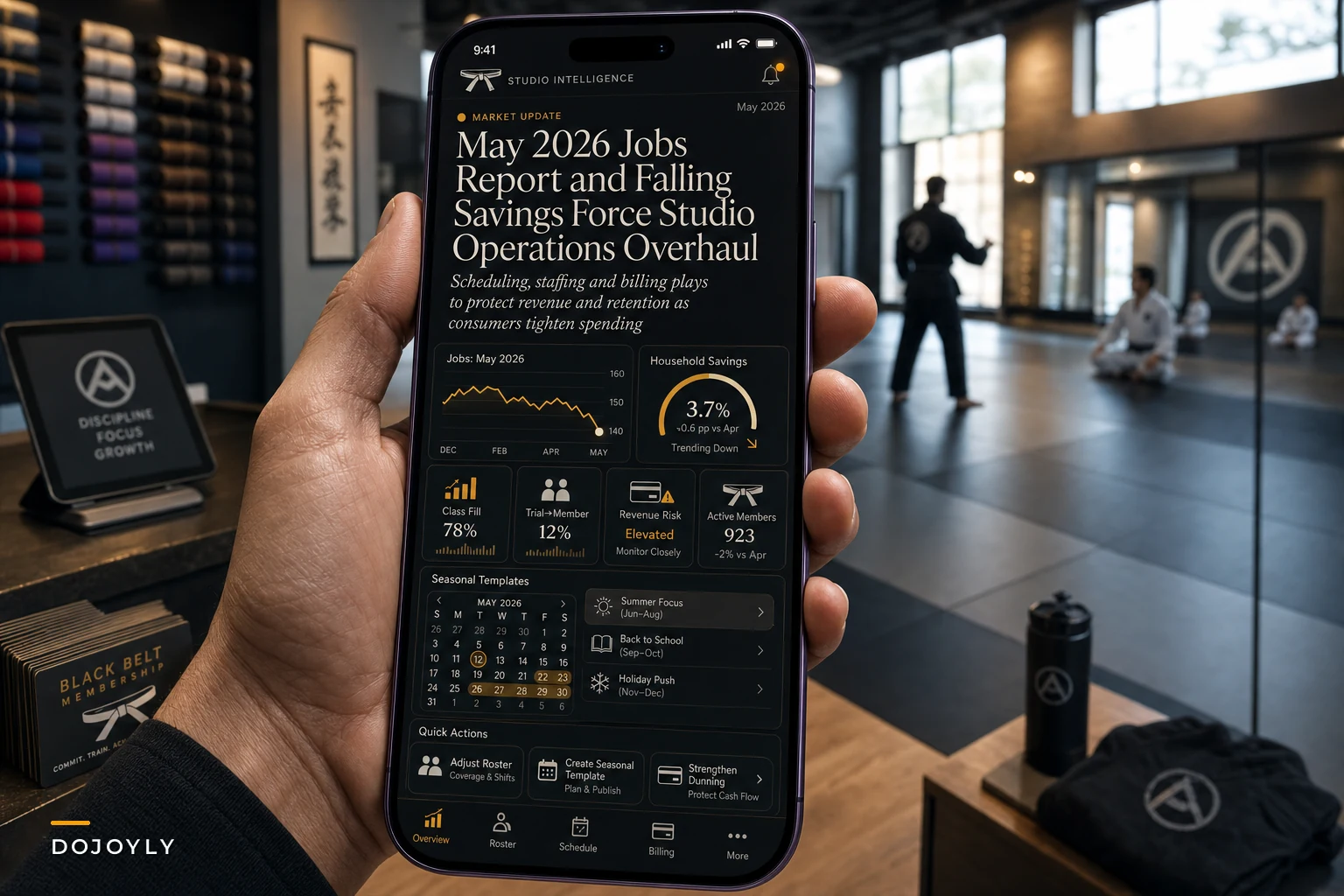

The May jobs report dropped yesterday, and it's got me thinking about a conversation with a studio owner in Phoenix last week. He lost three part-time instructors to restaurant jobs in the past month — all for basically the same hourly rate but with more flexible scheduling.
NPR's coverage of the May report shows hospitality added the most jobs last month, with wages holding steady around 3.4% growth year-over-year. For martial arts studios, this creates a problem: you're competing with Chipotle and local breweries for the same pool of part-time workers, except they can offer immediate hours while you're stuck with fixed class schedules.
The timing couldn't be worse. Summer camp season starts in three weeks for most studios. That's when you need maximum instructor coverage, right as the labor market gets more competitive and your potential new members are feeling the pinch from depleted savings buffers.
The hidden scheduling problem that's about to blow up
Most studios run "rigid block scheduling" — Monday/Wednesday kids classes at 4pm, adult classes at 7pm, Saturday mornings for beginners. These blocks made sense with stable instructor rosters and predictable attendance.
When instructor availability becomes unpredictable, things fall apart fast. Sarah can only teach Tuesday/Thursday now because she picked up shifts at Target. Your Wednesday evening adult class instructor just gave two weeks notice. And that reliable Saturday morning person? They're asking for a raise because the gym down the street offered them $22/hour for personal training.
Your schedule stays rigid while everything around it shifts.
A studio in Tampa tried to solve this by adding more classes. They went from 18 weekly classes to 26, thinking more options would help. Instead, they diluted attendance across too many time slots, increased payroll by almost 40%, and still had gaps when instructors called out. The actual problem isn't coverage — it's that traditional studio scheduling assumes stable inputs that don't exist anymore.
Why traditional staffing models break during economic shifts
Studio staffing typically follows one of three models:
Simplify class bookings and attendance tracking.
Dojoyly helps you schedule, confirm, and manage every class effortlessly.
- Unified class & student management
- Automated member notifications
- Instructor scheduling & availability
No credit card required
The Owner-Heavy Model: Owner teaches 60-70% of classes, brings in assistants for overflow. Works until the owner burns out or wants to scale.
The Senior Instructor Model: 2-3 full-time instructors handle core curriculum, part-timers fill gaps. Breaks when those senior instructors leave.
The Gig Model: Mostly part-time instructors paid per class. Maximum flexibility, minimum loyalty.
Each model has fundamental weaknesses when labor markets tighten. The owner-heavy model caps growth. The senior instructor model creates massive risk points. The gig model means you're constantly recruiting and training.
There's a fourth model emerging that some studios are testing: dynamic team teaching with overlapping coverage zones.
Building overlapping coverage zones (not just backup instructors)
Instead of "John teaches Monday kids class," you create coverage zones where 2-3 instructors share responsibility for a block of classes. They coordinate among themselves who takes which specific session, with built-in overlap periods.
| Coverage Zone | Schedule | Instructor Count |
|---|---|---|
| Early week kids | Mon/Tue 3-6pm | 3 instructors |
| Early week adults | Mon/Tue 6-9pm | 3 instructors |
| Mid-week kids | Wed/Thu 3-6pm | 3 instructors |
| Mid-week adults | Wed/Thu 6-9pm | 3 instructors |
| Friday mixed | 3-8pm | 2 instructors |
| Weekend blocks | Sat/Sun morning | 3 instructors |
Each zone has three instructors who split the hours based on availability. The key: they pay a small retention bonus ($50-75/month) to each instructor in the zone, whether they teach that week or not. This keeps them engaged even during slow weeks.
Result: When someone quits, you lose one-third of a coverage zone, not an entire class block. New instructors onboard into a team instead of solo responsibility. And instructors can trade shifts within their zone without involving management.
Pay a small retention bonus to each instructor in a coverage zone to keep them engaged.
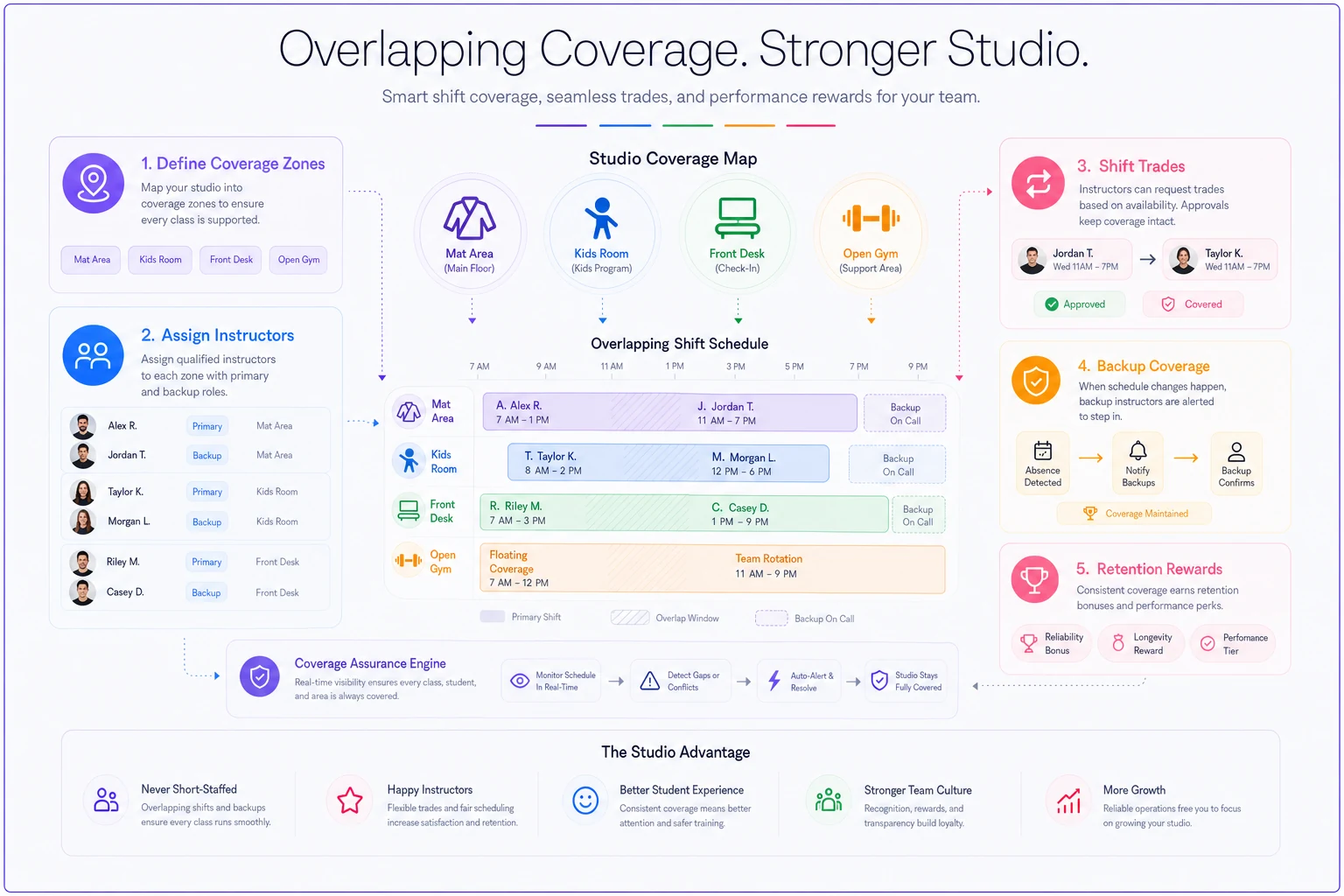
Here's a quick visual of how zones, overlaps, shift trades, and bonuses interact.
The billing reality nobody wants to discuss
When consumer savings dry up, the first discretionary expenses people cut are gym memberships, martial arts classes, and similar services. Reuters reported that savings buffers are essentially gone for most Americans.
They don't usually cancel outright. First, they'll miss a payment and ask to pause. Then they'll downgrade from unlimited to twice-weekly. Then they'll pull their second kid from classes. It's a gradual erosion that most studios aren't set up to track or manage.
The typical studio bills on the 1st of each month, runs cards automatically, and deals with failures as they come. When 8% of charges fail (normal), you chase them down individually. When 15-20% fail (economic pressure), your whole week becomes payment collection.
Creating payment flexibility without destroying cash flow
Some studios are shifting to "payment matching" — aligning billing dates with when members typically have money. Instead of everyone on the 1st, you offer four billing cycles:
-
1. 1st of month (salaried workers)
-
2. 15th of month (bi-weekly pay cycles)
-
3. 3rd Friday (service workers)
-
4. 25th of month (government benefits, Social Security)
One studio owner in Orlando said this reduced their payment failures from around 18% to under 10% during the past six months. The administrative complexity increases slightly, but the cash flow improvement more than compensates.
You can also introduce "micro-pauses" — one-week holds that don't require cancellation and reactivation. Member keeps their spot, you keep the relationship, they don't feel trapped. Limit it to twice per year to prevent abuse.
Rethinking summer camp as a staffing solution, not just revenue
Traditional summer camp model: hire extra staff, run intensive day programs, hope for profit. But with instructor shortages, this becomes a staffing nightmare.
Alternative approach: use summer camps to recruit and train your next generation of instructors.
Instead of hiring outside help, promote your senior teenage students (16-17 years old) to assistant camp counselor roles. Pay them $12-15/hour to help with camps while learning instruction basics. By end of summer, you've got 3-4 trained assistants who can cover simple classes during the school year.
A studio in Austin ran this model last summer. They promoted six teen students to camp assistants. Four stayed on as junior instructors in the fall, now teaching beginner kids classes. The studio essentially got paid (through camp revenue) to develop their instructor pipeline.
The scheduling automation everyone gets wrong
Studios love the idea of automated scheduling. Set it and forget it, right? Except most automation just locks in rigid patterns that break under pressure.
-
Schedule classes at 80% optimal size, not 100%, so you can combine when short-staffed
-
Build 15-minute buffers between classes for setup/breakdown flexibility
-
Create "convertible" time slots that can be kids or adults based on demand
The automation should handle the predictable stuff — sending reminders, tracking attendance, managing waitlists — while leaving humans to handle the dynamic decisions.
Why pricing changes matter more than price levels
Studios obsess over their monthly rate. Should it be $149? $179? $199? But during economic uncertainty, the structure matters more than the number.
Consider offering:
-
Shorter commitment periods (3 months vs 12 months) at slightly higher rates
-
Family caps (pay for 2 kids, additional kids free)
-
Loyalty locks (freeze current rate for continuous members)
A studio in New Jersey introduced "commitment pricing" — $189/month with no contract, $169/month for 6-month commitment, $149/month for annual. Surprisingly, about 40% chose the 6-month option, providing predictable revenue without the sticker shock of annual prepayment.
Building financial cushions into operations
The studios that survive economic turbulence build cushions everywhere — staffing, scheduling, billing, even curriculum. This doesn't mean being inefficient. It means having predetermined flex points.
For staffing: maintain 120% coverage capacity. If you need 10 instructor-hours per week, have 12 available.
For scheduling: keep 2-3 "surge slots" weekly that can activate when demand spikes or combine when it drops.
For billing: maintain a 10% revenue buffer through add-on programs (private lessons, workshops, gear sales) that can expand or contract.
When properly designed, your schedule becomes an asset rather than a constraint. The difference is building in adaptability from the start, not trying to force flexibility onto a rigid structure.
The coordination problem that kills studios
Every struggling studio has some version of the same coordination problem: instructors don't know who's covering what, members don't know about schedule changes, parents show up for cancelled classes, and the owner spends half their time putting out communication fires.
This isn't a people problem — it's a system problem. When your coordination relies on group texts, shared Google calendars, and hoping everyone checks their email, you're running on prayer.
The fix isn't more communication; it's better information architecture. Every piece of scheduling data should live in one place, accessible to everyone who needs it, with automatic notifications for changes. When an instructor calls out sick, the system should handle notification workflows seamlessly.
Most studios try to solve this with multiple apps — one for scheduling, another for billing, a third for communication. The gaps between these systems are where problems hide.
What summer 2026 actually demands
Looking at the economic signals, summer 2026 shapes up as a perfect storm: tight labor markets making instructors expensive and hard to find, reduced consumer savings making members price-sensitive and quick to cancel, and seasonal demand spikes testing every operational weakness.
Studios that approach this with business-as-usual thinking — just hire more instructors, maybe discount memberships, hope for the best — are setting themselves up for a rough few months.
The ones that'll thrive are rethinking fundamental assumptions:
-
Staff scheduling isn't about filling slots; it's about building resilient coverage systems
-
Billing isn't about collecting payments; it's about matching cash flow to member reality
-
Pricing isn't about finding the perfect number; it's about creating flexible structures
-
Summer camps aren't just revenue; they're instructor development programs
You can't rebuild operations overnight, and you shouldn't try. But you can start introducing flexibility in stages.
Making the transition (without breaking what works)
You can't rebuild operations overnight, and you shouldn't try. But you can start introducing flexibility in stages.
Start with scheduling. Pick your highest-risk time block (probably weekday afternoons) and test coverage zones with 2-3 instructors. Run it for a month, work out the kinks, then expand.
Next, tackle billing. Offer new members choice of billing dates. See what they pick. Use that data to potentially migrate existing members later.
For staffing, identify your top 3-4 teenage students who might become instructors. Start giving them small responsibilities — warm-up leading, technique demonstration, beginner assistance. Build their confidence before summer camp season.
The operational software powering modern studios increasingly handles this complexity through workflow automation — tracking instructor availability, managing coverage zones, coordinating schedule changes, and keeping everyone informed automatically. But the strategic decisions about structure still require human judgment.
The bottom line on studio scheduling and staffing
The economic pressures hitting studios right now — competitive labor markets, reduced consumer savings, seasonal demand fluctuations — aren't temporary inconveniences. They're the new operating environment. Studios still running on rigid scheduling, single-point-of-failure staffing, and inflexible billing are basically hoping the world returns to 2019 conditions.
The path forward requires building adaptability into core operations. Coverage zones instead of individual assignments. Payment flexibility instead of rigid billing cycles. Instructor development pipelines instead of just-in-time hiring. These aren't revolutionary ideas, but implementing them requires rethinking how studios operate at a fundamental level.
Summer's coming whether you're ready or not. The question is whether you'll spend it fighting fires or building stronger foundations for the reality of running a studio in 2026 and beyond.
Summer's coming whether you're ready or not. The question is whether you'll spend it fighting fires or building stronger foundations for the reality of running a studio in 2026 and beyond.
Ready to elevate your dojo operations?
Join 500+ martial arts studios using Dojoyly to save time, reduce scheduling conflicts, and improve member engagement.