

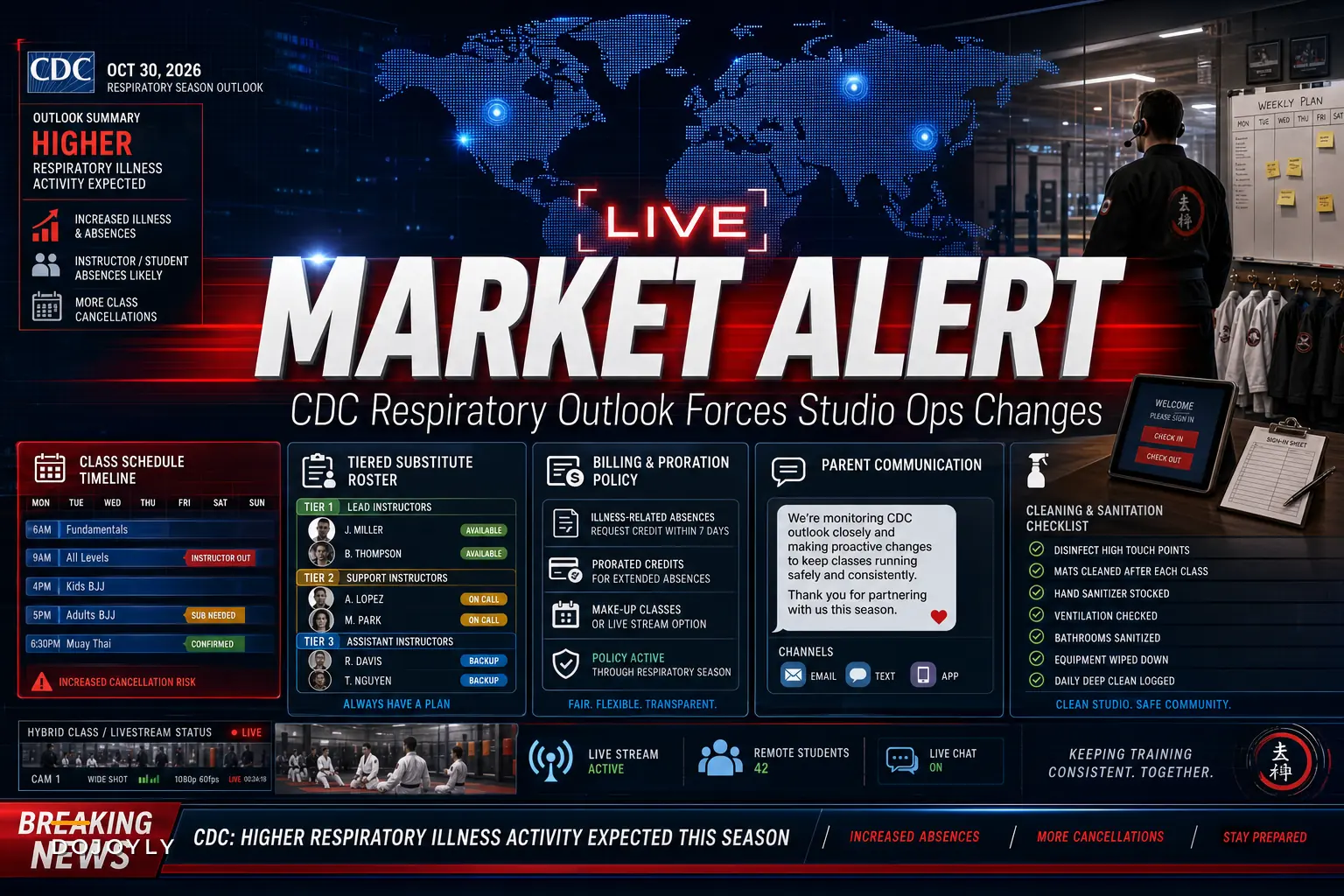

The CDC's late‑October outlook put some numbers to what most studio owners already feel coming this time of year. Flu is low but rising across much of the country, COVID activity is drifting down, and RSV is starting to climb among young kids. The agency's read, laid out in its weekly respiratory illness data channel, is that 2026–27 should look roughly like last season.
"Roughly like last season" isn't exactly comforting if last season meant three instructors out in the same week, a parent group chat blowing up with refund requests, and a Tuesday kids' class running at a third of normal headcount. The seasonal pattern is predictable. What's not is which Tuesday it hits you — and that gap is where studios lose both revenue and goodwill.
So skip the hand‑washing reminders. You know those. This is about the operational side of respiratory season: how your schedule, your substitute bench, and your billing rules hold up when attendance gets lumpy and people get sick at the worst possible times.
The real problem isn't illness. It's that your operations assume full attendance.
Most studio schedules are built for a healthy week. Every class has one instructor, no backup. Billing runs on autopilot. The front desk handles cancellations one text at a time. That works fine for nine months of the year.
Then respiratory season hits and the brittleness shows up fast. One sick instructor isn't just a staffing inconvenience — it's a coverage problem, and if you have no coverage system, it becomes a cancellation, which becomes a refund request, which becomes a retention risk. The illness is the trigger. The damage comes from operations with no slack built in.
Studios that tend to come through winter in decent shape aren't healthier than everyone else. They just made their decisions in October — before the first instructor called out sick. The ones who struggle are improvising in real time, in a group chat, at 6:45am.
Respiratory season is a stress test for systems you already have. It doesn't create new problems. It just finds the weak ones.
Three pressure points, and what each one actually breaks
Studios tend to treat winter as one blob of "it's hard right now" when there are actually three distinct things going wrong, each needing a different fix.
Simplify class bookings and attendance tracking.
Dojoyly helps you schedule, confirm, and manage every class effortlessly.
- Unified class & student management
- Automated member notifications
- Instructor scheduling & availability
No credit card required
| Pressure point | What breaks | What it costs if ignored |
|---|---|---|
| Instructor absence | No coverage plan, classes cancel | Cancelled classes, overworked owner teaching back‑to‑back |
| Student absence / no‑shows | Half‑empty classes, awkward small groups | Lost momentum, retention dip, wasted instructor pay |
| Billing friction | Refund/credit requests pile up | Revenue leakage, disputes, chargebacks, parent frustration |
You can't substitute your way out of a billing problem, and you can't refund your way out of a coverage gap. Studios that lump these together end up solving none of them well.
Instructor absence is the one that cascades
When a student is out, one person is missing. When an instructor is out, an entire class is at risk. That asymmetry is why coverage planning matters more than anything else here.
The mistake is treating substitute coverage as something you arrange when someone's sick. By then you're negotiating with three people who all have day jobs while the clock runs down. The fix is building the bench and the rules before you need them — who covers which class, what they get paid, how fast you need a yes or no. If you haven't built that system yet, our substitute‑instructor playbook for last‑minute absences walks through the coverage tiers and payout structure to set up in advance. Do it now, not in January.
A pre‑season setup you can finish in a weekend
You don't need a big project. Just a handful of decisions made and written down while things are calm.
-
Map your coverage risk. List every class. Next to each, write how many qualified people could actually teach it. Any class with one name next to it is a single point of failure — those are your winter liabilities.
-
Build a tiered sub list per class. For each at‑risk class, line up a primary backup and a secondary. Confirm their availability windows now, in writing.
-
Set a substitute pay rate in advance. Decide what short‑notice coverage pays — usually a small premium over the standard per‑class rate — so nobody's negotiating at dawn.
-
Write your attendance‑floor rule. Put a number on the minimum headcount at which you'll run, combine, or cancel. "If fewer than 4 of 14 confirm by 2pm, we merge the beginners and intermediate kids' class." Clarity beats judgment calls when you're stressed.
-
Draft three parent messages before you need them. One for a cancelled class, one for a sick‑kid credit, one for "we're running but reduced." Pre‑writing these turns a 20‑minute scramble into a 20‑second send.
-
Lock your credit/refund policy and publish it. The biggest source of billing disputes is a policy that didn't exist until someone asked for a refund. Decide now, communicate it now.
One afternoon of decisions saves a lot of panicked mornings later.
A quick visual of the weekend setup workflow.
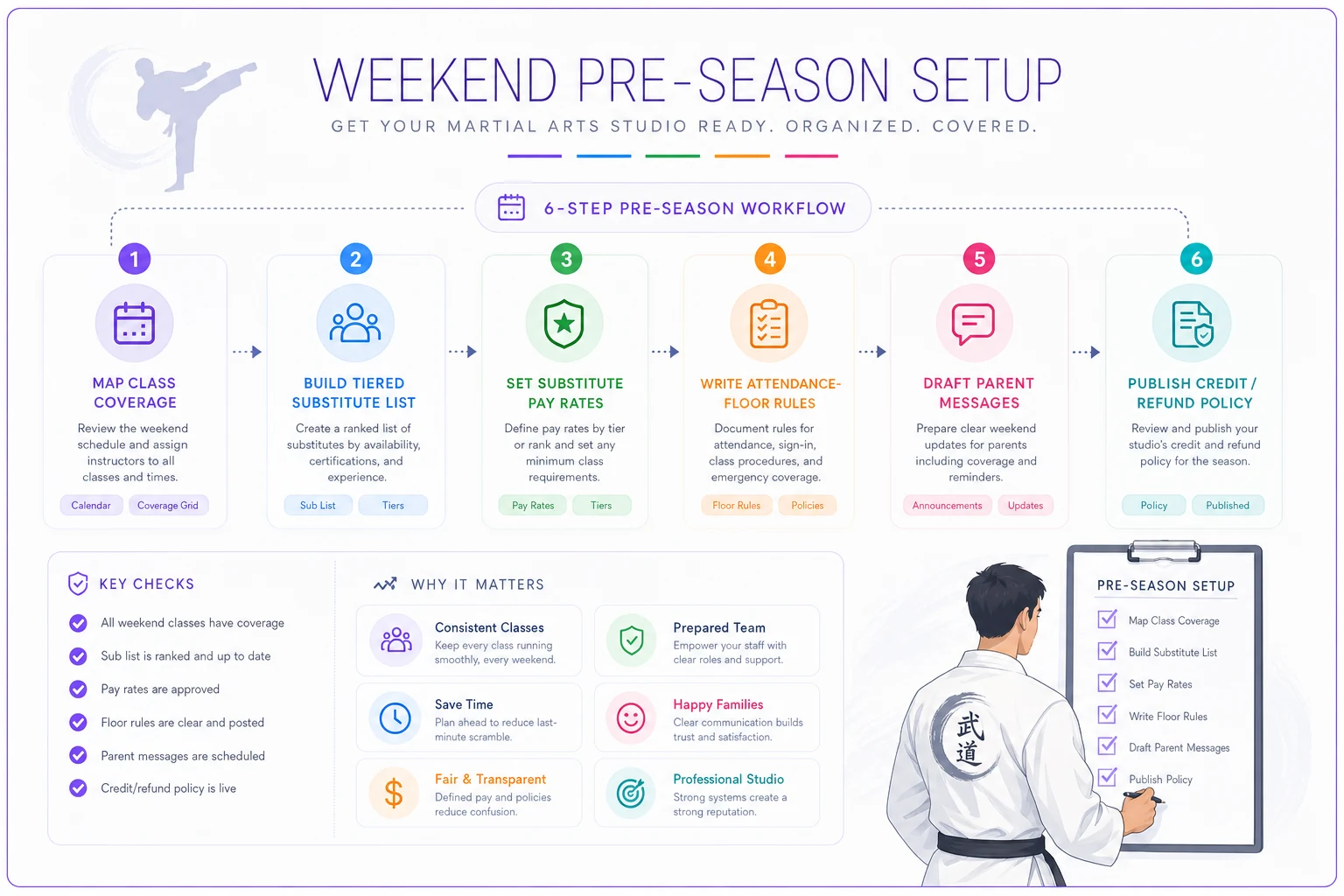
Use this flow as a simple checklist during your weekend setup.
The billing conversation nobody wants to have early
Refund and credit requests spike in winter for an understandable reason: parents feel they're paying for classes their kid can't attend because of a fever you'd actually want them to stay home for. That's a fair feeling. But you can't refund your way to profitability. If every sick week becomes a credit, your recurring revenue model quietly turns into pay‑per‑visit — which it was never priced to be.
Studios that handle this well draw a clear line before the season starts: illness doesn't get cash refunds, it gets make‑up credits with limits. Something like "up to two make‑up classes per month for absences, book within 30 days" keeps revenue intact while giving families something real and fair.
The part owners often miss isn't the policy itself — it's the timing of communication. A make‑up‑credit policy announced the day a parent asks for a refund feels like a dodge. The exact same policy, emailed to all members in early November as "here's how we handle winter absences," feels like you're taking care of them. Same rule. Completely different reaction. The difference is whether you looked proactive or defensive.
A checklist for your winter billing readiness
-
- [ ] Credit vs. refund policy written and published to all members
-
- [ ] Make‑up class rules defined (how many, how long to redeem, how to book)
-
- [ ] Freeze/hold option documented for extended illness
-
- [ ] Dunning rules reviewed — failed cards spike when people are distracted and sick
-
- [ ] Front desk has scripts so everyone gives the same answer
-
- [ ] Policy is visible at signup, not buried in a contract nobody reads
That last one matters more than it looks. When the policy is inconsistent — one instructor grants a refund, another offers a credit — you've trained parents to keep asking until they find a soft yes. Consistency is a revenue protection tool, not just an administrative preference.
Attendance gets lumpy — plan your schedule around it
The quiet winter killer isn't the dramatic cancellation. It's the half‑full class. An instructor shows up, gets paid, and teaches six kids in a room built for eighteen. Nothing dramatic enough to flag, but it drip‑feeds for weeks.
-
Combine low‑enrollment classes during peak sick weeks instead of running both half‑empty
-
Keep a lightweight virtual option for students who are mildly unwell — not a whole program, just a way to stay engaged and not lose the routine
-
Adjust which classes get your scarce instructor hours based on who's actually confirming attendance
Demand for smaller and virtual options genuinely rises in winter. Some families would rather their kid join a Zoom warm‑up than skip entirely and fall out of the habit. You don't need to build a full hybrid program overnight — just have a fallback that keeps engaged students connected while they recover.
Real scenario: a two‑location kids' program, mid‑January
A studio running youth classes across two small locations hit the usual January wall. Flu swept through the after‑school crowd, and in one week two of their four regular instructors were out. Their default move was to cancel and send apology texts. That particular week, the cancellations plus a batch of refund requests cost them somewhere around $1,800–$2,200 in credits, and a couple of families quietly stopped showing up afterward.
The following fall they did the boring prep: a confirmed backup for every kids' class, a published make‑up‑credit policy sent in early November, and a merge rule for low‑attendance days. When the same kind of sick wave hit that next winter, they covered what they could, merged two small classes cleanly, and handled absence requests with credits instead of cash. The refund outflow dropped significantly. And the quiet departures mostly didn't happen — because families felt handled rather than abandoned.
Nothing exotic. They just made the decisions in October instead of January.
Where software quietly carries the load
Tooling doesn't fix this — the decisions above are the real work. But execution gets a lot easier when your management platform handles the mechanical parts automatically: sending a pre‑written cancellation notice to the right class roster in one click, applying make‑up credits consistently so no two staff members do it differently, flagging which classes are below your attendance floor by early afternoon, retrying failed charges when a distracted parent's card bounces.
That's the honest role of good operational software during winter — not strategy, just removing friction between a decision you already made and actually getting it done at 6:45am. The studios that struggle aren't usually the ones without software. They're the ones who never decided the rules, so there's nothing to automate in the first place.
When flexibility becomes a trap
A quick note on overcorrecting. Some owners read "respiratory season" and swing to blanket freezes, unlimited credits, and generous no‑questions refunds. That's a mistake. If your policy lets anyone pause or credit any week with zero limits, you've handed members a way to pay for January without actually attending in January — and your recurring revenue collapses right when fixed costs stay exactly the same.
The goal is fair and bounded, not infinitely accommodating. Make‑up credits with redemption windows. Freezes with a minimum duration and a cap. Refunds reserved for genuine exceptions. Protecting families and protecting the business aren't opposites — but you only hit both if the limits are in writing before the pressure hits.
The takeaway for the next few weeks
The season's trajectory is already clear enough to act on. The window to prepare is the quiet weeks before things peak, not the morning your first instructor calls in sick.
Spend one afternoon this month on the unglamorous decisions: who covers each class, what short‑notice coverage pays, where your attendance floor sits, and exactly how you handle absences on the billing side. Write it down, communicate the family‑facing parts early, and build the substitute bench while everyone's healthy and easy to reach. Respiratory season will still arrive on schedule. It just won't catch your operations flat‑footed.
Ready to elevate your dojo operations?
Join 500+ martial arts studios using Dojoyly to save time, reduce scheduling conflicts, and improve member engagement.