

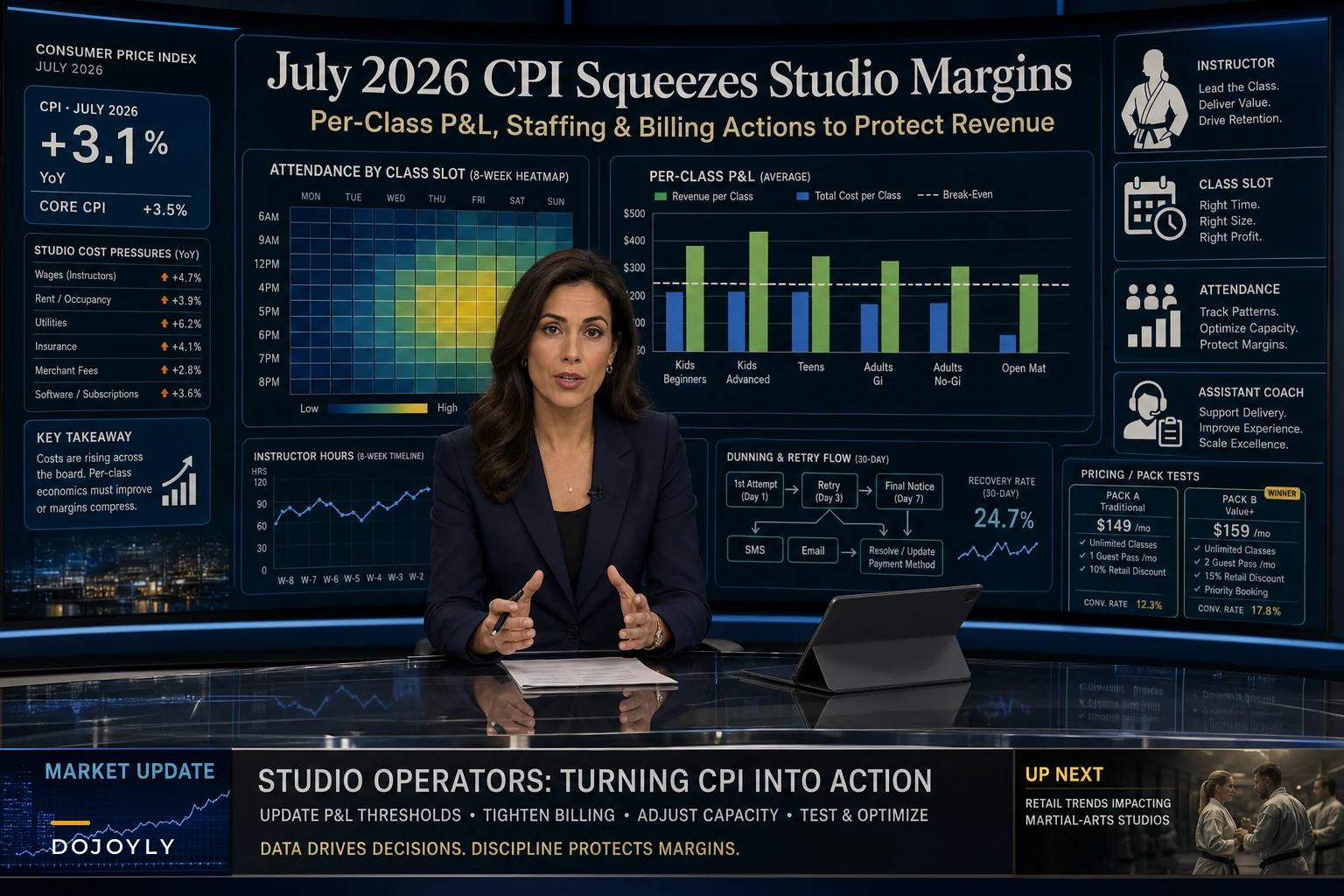

The July 2026 CPI came in at 3.4% year-over-year — a slight cooldown, mostly driven by softer energy prices. The Bureau of Labor Statistics release called it a mild month, and a Reuters analysis noted the economy still isn't out of the woods. Fine. But nobody signs up for a Muay Thai program because CPI ticked down a tenth of a point, and nobody quits because it ticked up. So why does this matter to you?
Because "mild" inflation doesn't mean your members feel relief. Prices are still climbing — just a little slower. Discretionary spending, which is exactly where martial-arts tuition sits in most household budgets, stays under pressure. Parents renewing three kids' memberships in September are dealing with the same grocery bills, the same fuel costs, and your program is one of the easier lines to cut. That's the real signal, and it's worth acting on before fall enrollment kicks off.
This isn't a piece about macroeconomics. It's about translating a soft data point into actual decisions you can make this month around pricing, staff hours, and billing.
The decision most owners get backwards
When costs creep up and members get price-sensitive at the same time, the instinct goes one of two ways: freeze prices to protect retention, or raise them across the board to protect margin. Both are usually wrong.
A flat freeze quietly erodes you. Rent renewals, insurance premiums, mat replacement cycles, instructor wages — none of those care that you decided to hold tuition. If operating costs rise around 4% and you hold price, you didn't protect your members. You just gave yourself a pay cut you'll feel three quarters from now.
An across-the-board hike treats a loyal four-year black belt family and a two-month trial member as the same risk. They're not. The family that's been drafting for four years has serious switching friction. The eight-week member is still deciding if this is a real habit. Raise both by the same percentage and you'll lose the wrong people.
The better move is to think in segments and per-class economics, not one number. Which brings us to the part most studios skip entirely.
Start with what a single class actually costs you
You can't make smart pricing or staffing calls without knowing your fully-loaded cost per class delivered. Not per member. Per class on the schedule.
Simplify class bookings and attendance tracking.
Dojoyly helps you schedule, confirm, and manage every class effortlessly.
- Unified class & student management
- Automated member notifications
- Instructor scheduling & availability
No credit card required
| Cost component | Per-class estimate | Notes |
|---|---|---|
| Instructor wage (60 min class + 15 min setup) | $28–$42 | Depends on rank/pay band |
| Assistant / mat coach (if used) | $12–$18 | Not every class |
| Facility allocation (rent, utilities) | $18–$25 | Rent ÷ usable class-hours per month |
| Insurance + equipment wear | $4–$7 | Averaged across the schedule |
| Admin/overhead allocation | $6–$10 | Front desk, software, cleaning |
| Total loaded cost | ~$68–$102 | Per class delivered |
Now overlay attendance. A class that costs around $85 to run and pulls 4 students on a Tuesday at 2pm is a completely different animal from one costing the same $85 that packs 22 kids on a Wednesday evening. Same cost line, wildly different return.
That's the whole game in a tightening consumer environment: stop bleeding on low-yield slots so you can afford to protect the high-value ones. Most owners have never mapped this because their scheduling and their financials live in two separate places. If you haven't built a weekly per-class P&L rhythm yet, the studio financial operations playbook we published earlier walks through the cadence — that's the foundation everything below sits on.
Segment your pricing before you touch a single rate
Once you know per-class cost, price the relationship, not the plan.
-
Tenured members (12+ months) Protect them. Hold their rate or apply the smallest increase possible, and tell them explicitly they're being grandfathered. Loyalty communicated is loyalty retained.
-
Mid-tenure members (3–12 months) A modest, well-explained increase — somewhere in the 4–6% range — is usually absorbable here. They've formed the habit but haven't hit deep loyalty. Pair the increase with something tangible: an added open-mat, a seminar credit.
-
New enrollments going forward Set the new baseline here. New members never experienced the old price, so there's no anchoring pain. This is your cleanest lever and the one studios consistently underuse.
-
At-risk or price-sensitive families Offer a downgrade path — two days a week instead of unlimited — before they cancel, not after. A retained member at a lower plan beats a churned one every time.
The mistake that keeps showing up: owners send one email announcing one price to everyone. It creates a single loud moment of resistance instead of quiet, staggered adjustments that different segments barely notice.
Staff hours are the fastest lever you're ignoring
Payroll is almost always the biggest controllable line in a studio. It's also where soft-consumer periods hit hardest — because the instinct is to keep the full schedule running so members don't feel cuts, while half-empty classes quietly drain you.
The fix isn't cutting classes people love. It's matching staff intensity to attendance patterns.
WEEKLY STAFFING REVIEW WORKFLOW Pull 8–10 weeks of attendance by class slot ↓ Flag slots averaging below break-even headcount ↓ Is the slot small and shrinking, or small and building? ↓ ↓ Consolidate or downstaff Protect it — don't cut momentum ↓ Reserve full staffing for peak-demand windows
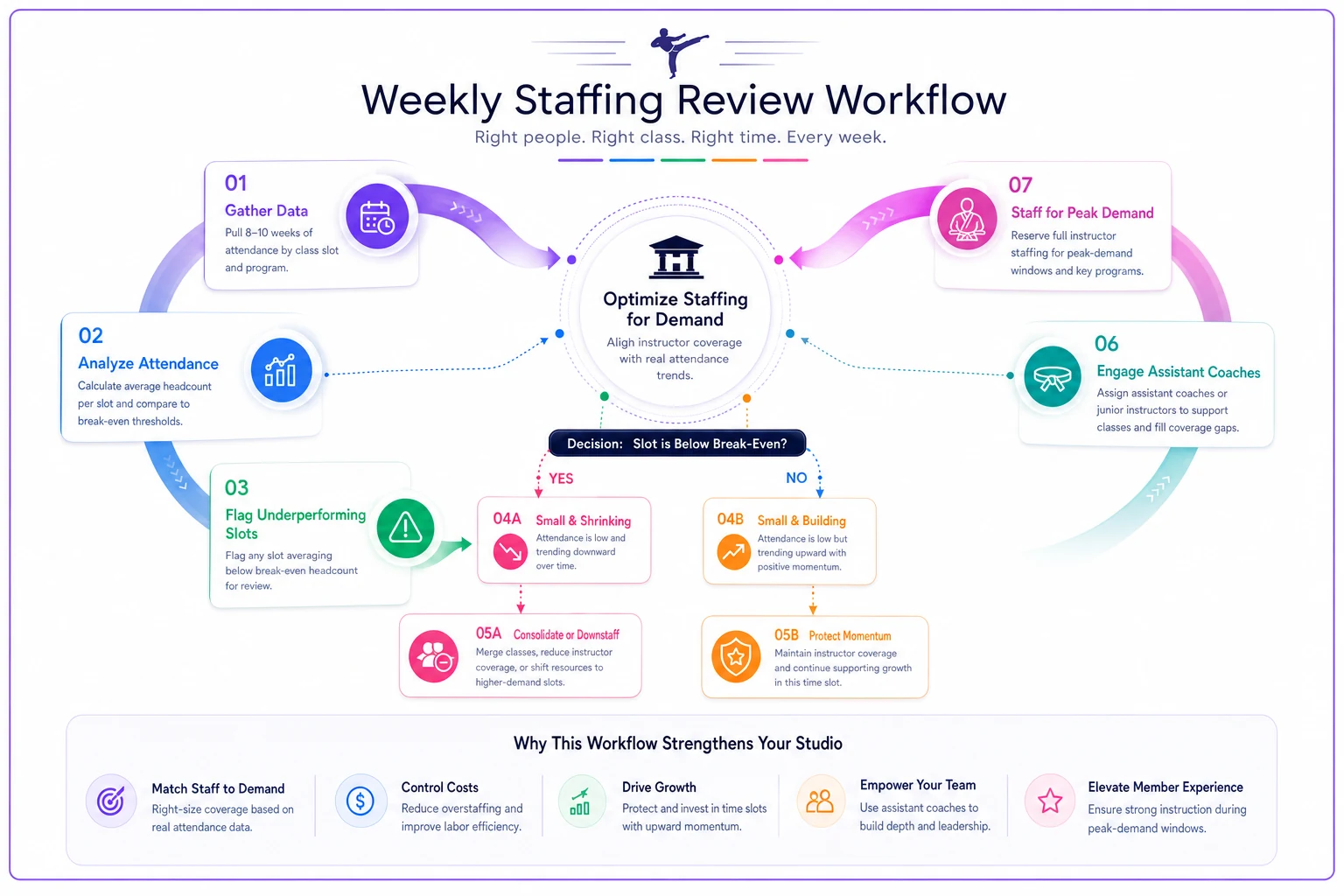
Here it is laid out visually for quick reference.
-
Pull the last 8–10 weeks of attendance by class slot.
-
Flag any recurring class averaging below your break-even headcount. At roughly $85 a class and a $22 average per-student contribution, you need around 4 students just to break even.
-
For chronically low slots, don't kill them immediately. First try consolidation (merge two thin weekday slots into one) or downstaffing (drop the assistant coach on that slot only).
-
Reserve full staffing for peak-demand windows where you might actually be turning people away.
Reserve full staffing for peak-demand windows where you might actually be turning people away.
Cutting redundant assistant-coach hours on four low-attendance weekday classes can recover the equivalent of a part-time salary. Nobody complains, because the class still runs and the head instructor is still there.
When downstaffing is a bad idea
Don't downstaff safety-critical classes — sparring-heavy sessions, weapons curricula, little-kids programs where student-to-instructor ratios matter for liability. And don't cut hours on a class that's growing even if it's currently small. You'll strangle momentum. The difference between "small and shrinking" and "small and building" matters a lot, and those two things look identical on a headcount report.
Tighten billing before you touch pricing at all
More revenue leaks through broken billing mechanics than through pricing being too low — especially when household budgets are tight. Failed cards, expired payment methods, and passive-cancel behavior all spike in exactly this kind of environment.
-
[ ] Confirm auto-retry logic is running on failed drafts (retry at 3 and 7 days, not just once).
-
[ ] Set up expiring-card alerts before the card expires, not after the draft bounces.
-
[ ] Standardize your proration and mid-month signup rules so front-desk staff aren't improvising discounts.
-
[ ] Require a short conversation or a form for cancellations instead of a one-click exit — a lot of "cancels" are really "I need to pause" or "I can't do unlimited right now."
-
[ ] Audit any lingering comped or manual memberships that never got cleaned up.
Every dollar recovered from a failed-payment fix is nearly pure margin, because you already delivered the service. Compare that to chasing a new signup, which costs you marketing spend and trial-class time. Recovery is cheaper than acquisition, particularly when consumers are hesitant to commit to anything new.
A real scenario
A single-location studio with around 180 active members was running a full schedule of about 34 weekly classes. Attendance had softened over the spring — nothing dramatic, but several weekday afternoon slots were consistently drawing 3–5 students against a break-even closer to 5.
Before changing anything, the owner mapped per-class cost against actual attendance for eight weeks. Five weekday slots were running at a loss — quietly costing somewhere in the $900–$1,100 range monthly once loaded costs were counted.
The response wasn't a price hike. They consolidated three thin afternoon classes into two, dropped assistant-coach hours on the remaining low slots, tightened their payment retry rules (which had been firing once and giving up), and grandfathered their 12-month-plus members while setting a higher baseline for incoming students.
Over the next two months, recovered failed payments and the staffing adjustments added up to a noticeable monthly swing — low four figures — without a single tenured member churning over price. New enrollments came in at the higher rate without pushback, because they never knew the old one.
Where software quietly earns its keep
None of this requires fancy technology to understand — but executing it manually, every week, indefinitely, is where it falls apart. That's the real reason studios don't do it.
Pulling per-class attendance against loaded cost, flagging failed drafts before they age out, alerting on expiring cards, segmenting members by tenure for staggered pricing — these are exactly the tasks that fall through the cracks when you're also teaching four classes a day. AI-assisted operational platforms help here not as some futuristic gimmick, but as the system that runs retry logic on schedule, surfaces low-yield classes before they've bled for six months, and flags the right member segments when it's time to adjust rates. The automation isn't really the point. Not losing money to things you simply didn't have time to check — that's the point.
What to actually do this week
You don't need a strategic overhaul over one CPI print. You need a short, focused pass:
-
Calculate loaded cost for your five busiest and five thinnest class slots.
-
Pull eight weeks of attendance and flag anything running below break-even.
-
Decide consolidation vs. downstaffing for the underperforming slots — don't just cut.
-
Segment your roster by tenure and draft a staggered pricing plan.
-
Audit your payment-retry and expiring-card handling before September drafts run.
The studios that come through a cautious-consumer fall in decent shape aren't the ones who guessed right on pricing. They're the ones who knew their per-class numbers and adjusted the small levers — staff hours, billing hygiene, segment-aware rates — before the season forced their hand.
A soft inflation print isn't good news or bad news for your studio. It's a nudge to go look at the math you've been putting off.
Ready to elevate your dojo operations?
Join 500+ martial arts studios using Dojoyly to save time, reduce scheduling conflicts, and improve member engagement.