

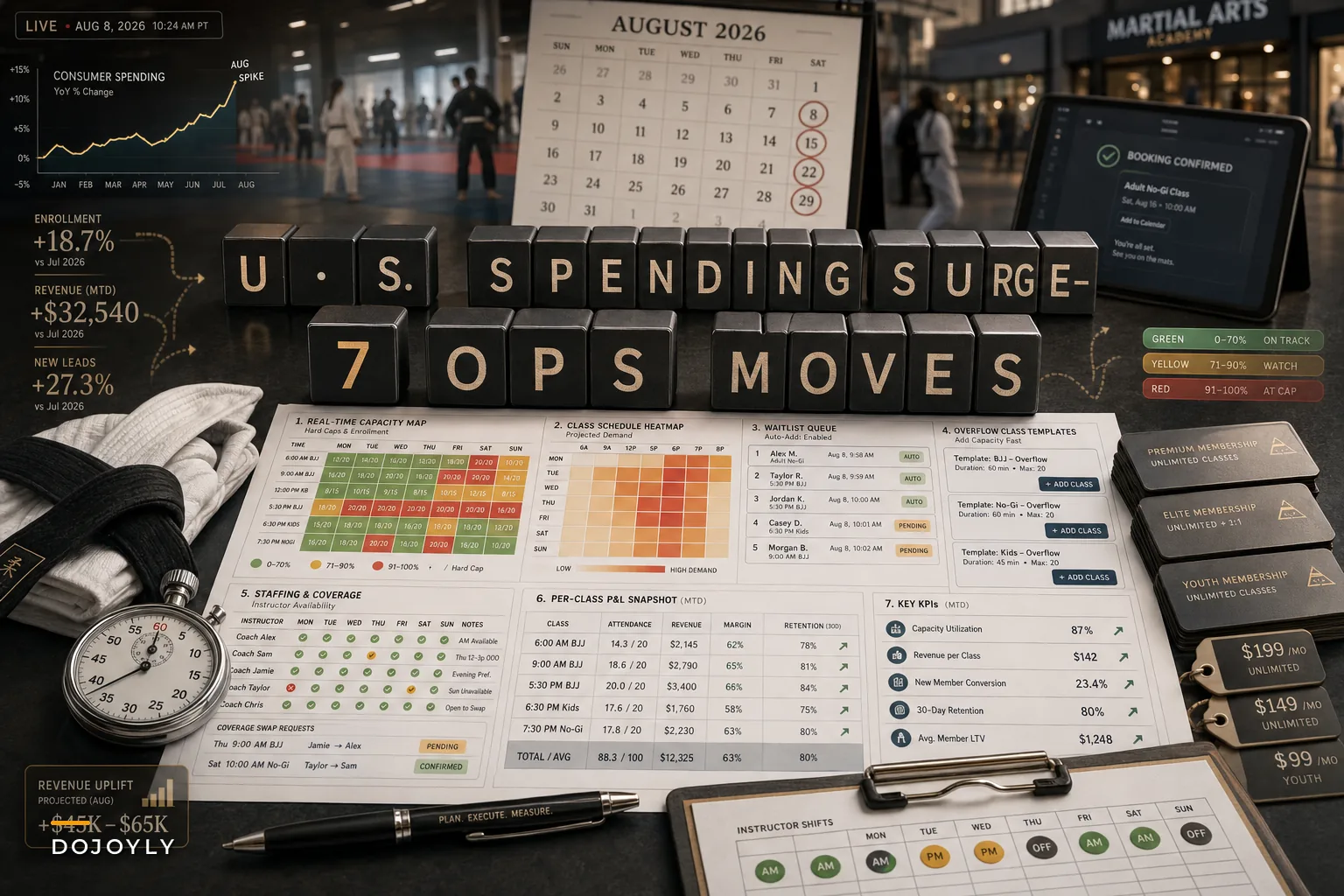

The end-of-September numbers caught a lot of people off guard. According to a Reuters report, U.S. consumer spending jumped in August at the fastest pace in over a year, with inflation coming in softer than forecast. For anyone running a local service business, that means households still have discretionary dollars and they're spending them — on exactly the kind of experiences martial-arts studios sell.
What most owners miss is that a spending surge doesn't automatically become your revenue. It becomes somebody's revenue. Whether that's you or the gymnastics place three blocks over depends almost entirely on how fast your operations can absorb a wave of trial requests without dropping the ball. And studios are notoriously bad at this, because systems that work fine at normal demand quietly fall apart when inquiries spike 30–40% over a few weeks.
This post is about the moves that matter in the next 2–4 weeks — not a quarterly strategy. Fast, operational, done-by-Friday stuff.
Why a demand spike is harder on studios than it looks
When demand rises, the instinct is to celebrate and keep doing what you're doing, just more of it. That's where it goes sideways.
A studio running at comfortable capacity usually has three or four "good" time slots — the 6pm weekday kids class, the Saturday morning adult class — already sitting at 80% full. When demand surges, those are the slots everyone wants. So you get a cluster of trial requests all aimed at the exact classes with no room, while your 2pm Tuesday slot sits half-empty.
What tends to happen in real operations: the front desk books trials into the popular slots anyway because nobody wants to say no to a prospect. The mat gets crowded, the instructor splits attention, the trial experience drops, and conversion falls at the precise moment you have the most prospects walking in. You end up converting a lower percentage of a higher volume, and the net gain is much smaller than it should be.
The underlying problem a surge exposes is that most studios manage capacity reactively. There's no live view of which slots can absorb more students and which are already maxed. That's a data problem before it's a mat problem.
Move 1: Lock down a real-time capacity map before you promote anything
Before you spend a dollar acquiring new trials, you need to know exactly where you can put people.
Simplify class bookings and attendance tracking.
Dojoyly helps you schedule, confirm, and manage every class effortlessly.
- Unified class & student management
- Automated member notifications
- Instructor scheduling & availability
No credit card required
Spend 30 minutes building a simple grid: every class on the schedule, its hard cap (mat space, ratio, insurance limit), current enrollment, and the gap. Color it. Green = room for 5+, yellow = room for 1–4, red = full or waitlist.
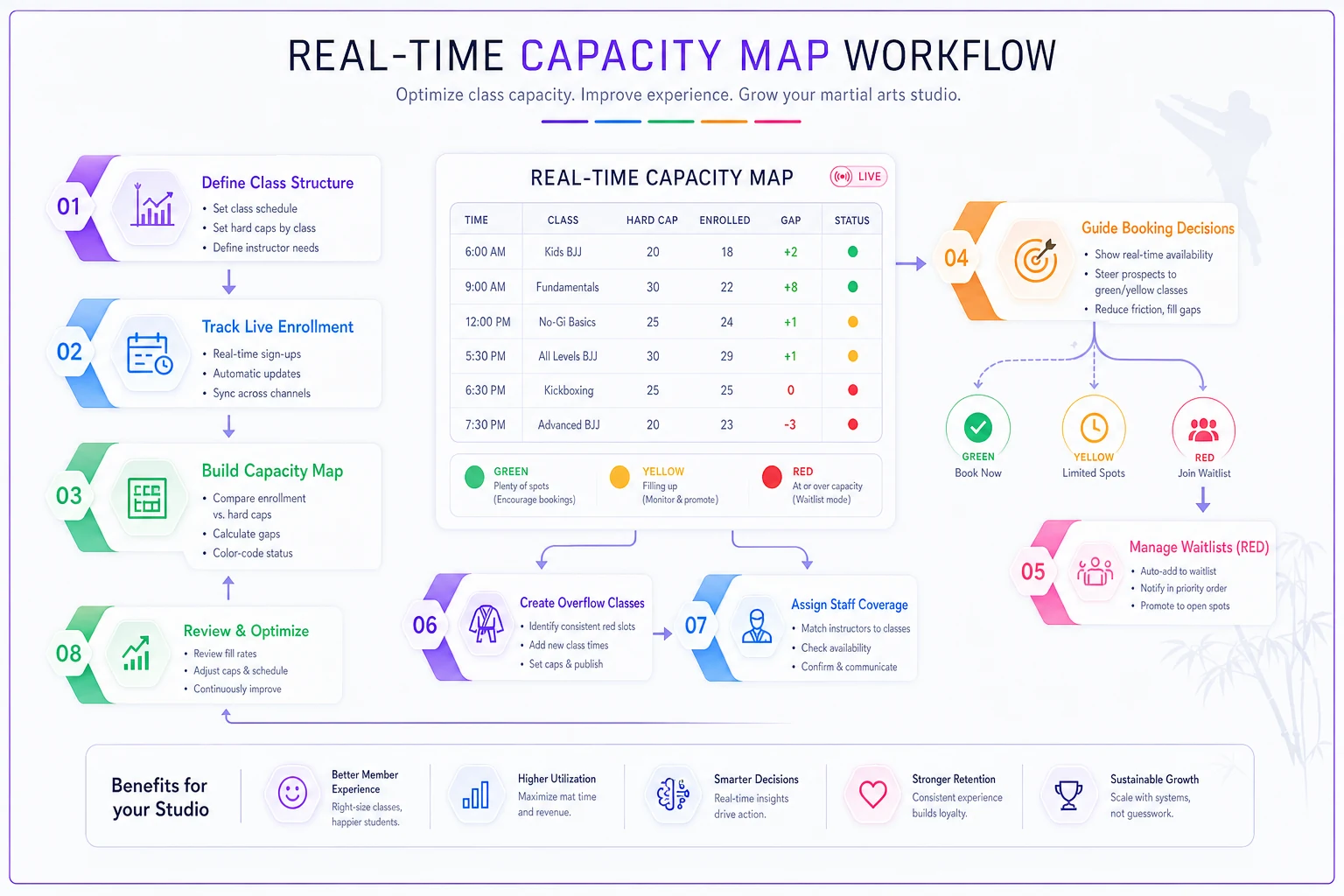
Export recent attendance rather than relying on 'enrolled' counts to estimate actual open spots.
This sounds obvious. Almost nobody does it. A lot of studios are off by a wide margin when estimating capacity — usually because they're counting active members instead of actual attendance. A class with 24 "enrolled" students might average 15 on the mat. That's 9 real slots nobody knew existed.
Once you have the map, every trial booking decision becomes mechanical: steer prospects toward green and yellow, build waitlists on red. No front-desk guesswork.
Move 2: Open overflow classes on the slots that are actually maxed
If your best slots are red, don't just waitlist people — add capacity where the demand actually is.
The mistake here is adding classes at times convenient for the studio rather than times that match demand. A new Wednesday 2pm class doesn't help if everyone wants Monday 6pm. Look at your red slots and figure out the nearest adjacent time you could run a parallel or overflow class — a 5pm feeder before the 6pm, or a second Saturday session.
When this makes sense: You have a red slot with a real waitlist (6+ people) and an instructor who can cover it.
When it's a bad idea: You open a class to chase a temporary spike, then it limps along at four students for six months. A surge is not a permanent demand shift. Treat new classes as provisional — commit to a 6-week trial run and set a clear enrollment floor (say, 10 paying members) before it becomes a permanent fixture.
Move 3: Run a fast price/pack test on your premium slots
A spending surge is one of the rare windows where price sensitivity actually drops. People are in a buying mood. This is the moment to test — carefully — whether your best slots can carry a premium.
You don't need a complicated experiment. Pick your two most in-demand slots and offer a "prime time" pack or a modest premium for guaranteed spots, while keeping standard pricing on off-peak classes. Watch conversion over two weeks.
| Slot type | Test approach | What to watch |
|---|---|---|
| Red / maxed slots | Small premium or priority-access pack | Do conversions hold? If yes, you were underpricing |
| Yellow slots | Standard pricing, light promotion | Fill rate improvement |
| Green / off-peak slots | Introductory discount to steer demand | How many prospects accept the alternative time |
The goal isn't to gouge anyone. It's to use the window to find out whether your pricing was leaving money on the table at peak demand all along. A lot of studios discover their 6pm class could carry $15–25 more per month without any meaningful churn.
Move 4: Pre-stage your staffing and substitute coverage
What breaks studios during a spike: you add classes and trials, attendance climbs, and then an instructor calls in sick during the busiest stretch you've had in a year. Now you're scrambling to cover a packed mat in front of a dozen prospects.
A surge multiplies the cost of every staffing gap. One canceled class during a slow week is an annoyance. The same cancellation when you've got 8 trials booked is lost conversions you won't get back.
-
Which instructors can pick up extra classes, and at what rate
-
A confirmed backup for every new or high-demand slot
-
Who runs the floor if your lead instructor is tied up with trials
-
Whether assistant or student-leader coverage is pre-arranged for peak nights
Studios that handle demand spikes well solve coverage before the spike, not during it.
Move 5: Tighten billing and dunning so new revenue actually lands
More sign-ups means more cards on file, which means — statistically — more failed charges. During a growth push this is sneaky, because revenue looks great on paper while a chunk of it quietly doesn't collect.
A typical pattern: a studio adds 20 new members in a month, feels great about it, then three months later realizes 3–4 of them have had failed payments nobody followed up on. Not a huge number on its own, but it compounds. Those members often drift out entirely because the relationship started with a billing hiccup that never got fixed.
Before the surge hits full force, make sure your retry logic and dunning follow-up are actually working — automatic retries on soft declines, a clear message sequence for hard declines, and a human check on anything that fails twice. Growth that doesn't collect isn't really growth.
Move 6: Target acquisition at higher-intent, higher-spend cohorts
When spending is up broadly, the temptation is to blast a wide discount and pull in everyone. That's usually a mistake, because deep discounts attract the cohort most likely to churn the moment the promo ends.
A spending surge is actually a better moment to go narrower, not wider. Households with more discretionary budget are more willing to commit to full-program enrollment, family plans, or longer terms. Instead of a 50%-off trial that fills your mat with price-shoppers, lean toward offers that signal commitment:
-
Family/sibling enrollment bundles
-
Full-program onboarding packages rather than month-to-month
-
Priority access to premium slots for members who commit to a term
Who you acquire during a spike determines your retention six months later, long after the surge is forgotten.
Move 7: Watch per-class P&L so ad-hoc discounts don't erode margin
The quiet killer during a demand surge is discount creep. Front desk gives a small break here, you comp a trial there, someone gets a "just this once" deal — and because volume is up, nobody notices margins slipping until the month closes.
Run a simple per-class profitability check weekly during the surge:
-
Pull revenue collected per class (not billed — collected)
-
Subtract instructor pay for that class
-
Allocate a flat overhead per class slot
-
Flag any class running at thin or negative margin
-
Check whether the thin margin is from discounting, under-enrollment, or overstaffing
-
Fix the cause, not the symptom
If you only track studio-wide numbers, a surge can look healthy while individual classes bleed. Granularity is how you catch it.
A quick real scenario
A single-site studio with roughly 180 members saw inquiries climb noticeably through a strong local demand stretch. Their instinct was to book every trial into the packed 6pm kids slot. Conversions actually dropped because the mat was crowded and the trial experience suffered.
They changed two things. First, they built a capacity map and started steering trials into a new 5pm feeder class and their underused Saturday slot. Second, they shifted from a deep trial discount to a sibling bundle aimed at families. Over about two months they added somewhere in the range of 20–25 net members — and more importantly, that cohort retained better than their usual trial crop because they'd committed upfront rather than chasing a discount.
The spike itself didn't create that outcome. Routing demand to open capacity and converting on quality did.
Where the systems come in
Most of these moves live or die on having current, accurate numbers in front of you — live attendance, real collection rates, per-class margins, who's on a waitlist for which slot. Doing this on spreadsheets during a surge is possible, but that's exactly where things slip. Running your scheduling, billing, and capacity data on a connected operational platform means the capacity map stays current and failed charges don't quietly disappear into the background. The automation isn't the point — the point is that when demand spikes, you're making decisions on real data instead of gut feel.
If you want the deeper playbook on turning rising demand into capacity and staffing decisions beyond the immediate window, we covered the full version in our breakdown of converting stronger demand after the ISM Services jump.
The takeaway
Demand surges are won in the boring layer — capacity maps, coverage plans, collection rates — not in the marketing. The studios that capture a spending window aren't the ones with the flashiest promo; they're the ones whose operations could absorb the volume without tanking the trial experience. Spend the next two weeks making your capacity visible and your billing airtight, then promote into the slots that can actually hold the people you bring in. Do that, and the surge becomes your members instead of someone else's.
Ready to elevate your dojo operations?
Join 500+ martial arts studios using Dojoyly to save time, reduce scheduling conflicts, and improve member engagement.