



Most billing model debates in martial arts end up circling the same argument: "recurring is predictable, packs bring in cash up front." True, but not particularly useful when you're trying to decide what to actually run at a 200‑member school. The interesting part isn't which model sounds better — it's what each one does to your monthly recognized revenue, your bank balance, your mat capacity, and the amount of admin time your front desk burns every week.
So this is a comparison built around one specific school. Two hundred active members. We'll run the same roster through all three models and watch what changes.
The school we're modeling
Here's the baseline so every number below means something:
-
200 active members
-
Average revenue target of roughly $150/member/month in equivalent value
-
Blended cost to deliver a class seat (instructor time, floor space, insurance, overhead) around $6–$8 per attended class
-
Members attend, on average, about 6 classes/month when on unlimited plans
-
Front desk / admin
one part‑time person plus the owner picking up slack
That gives you a rough top line of $30,000/month if everyone paid their equivalent. The question is how that $30k behaves depending on how you collect it.
The three models, side by side
Recurring monthly is the flat unlimited (or capped) subscription. Card on file, charged the 1st, member trains as much as they want.
Simplify class bookings and attendance tracking.
Dojoyly helps you schedule, confirm, and manage every class effortlessly.
- Unified class & student management
- Automated member notifications
- Instructor scheduling & availability
No credit card required
Prepaid class‑packs sell blocks of classes — a 20‑pack, a 40‑pack — that the member draws down over time. Cash arrives up front; you deliver the service later.
Hybrid (monthly + class bank) is a smaller recurring base fee that includes a set number of classes, plus a "bank" of extra classes the member can buy or roll into. Think $99/month for 8 classes, with a top‑up bank for members who train more.
| Factor | Recurring monthly | Prepaid class‑packs | Hybrid (monthly + bank) |
|---|---|---|---|
| Cash timing | Even, monthly | Lumpy, front‑loaded | Mostly even + spikes |
| Revenue predictability | High | Low–medium | Medium–high |
| Deferred revenue liability | None | Large | Moderate |
| Breakage upside | None | High (5–20%) | Moderate |
| Churn visibility | Clear (missed charge) | Hidden (just stops buying) | Clear on base |
| Admin complexity | Low | Medium | High |
| Capacity risk | Predictable | Spiky | Manageable |
The table hides the interesting stuff, so let's actually run the money.
Month one: what hits your bank account
This is where owners get surprised.
Recurring monthly. 200 members × $150 = $30,000 collected in month one. Clean. Predictable. Recognized as revenue immediately because the service period matches the billing period.
Prepaid class‑packs. Say you price a 40‑class pack at $520 (that's $13/class, a small discount to nudge the purchase). If your 200 members convert to packs and buy at their natural refill cadence, roughly a third of them buy in any given month rather than all at once — but if you launch packs and everyone buys in, month one can spike to $60,000–$90,000 in cash collected.
Feels amazing. It's also mostly not yours yet. Almost all of that is a liability — deferred revenue you owe in future classes.
Hybrid. Base fee of $99/month × 200 = $19,800 recurring, plus bank top‑ups. If about 40% of members top up an extra 8‑class bank at $88, that's another ~$7,000. Month one lands around $26,000–$27,000, with the bank portion again being deferred.
On a pure cash basis, month one ranks: packs > recurring > hybrid. On recognized revenue, it's the opposite — recurring recognizes everything, packs recognize almost nothing.
That gap is exactly what trips people up. They see the pack cash spike, spend it like it's profit, and then get squeezed three months later when collections normalize and there's nothing left in the account but obligations to teach.
Month twelve: what steady‑state actually looks like
Run it forward a year and the picture flips again.
Recurring stays flat at ~$30k/month recognized, ~$360k/year, assuming you hold membership. Simple and boring in the good way.
Packs settle into a rhythm once the launch spike clears. If your 200 members each burn ~6 classes/month and refill accordingly, monthly recognized revenue lands close to the recurring number — but your bank balance carries a permanent cushion of unearned deferred revenue (money already collected for classes not yet taught). At steady state that cushion might sit at $40k–$70k depending on pack size and refill timing.
Hybrid stabilizes around $27k–$31k/month recognized once bank purchases normalize, with a smaller deferred cushion than pure packs.
Over 12 months, all three land in roughly the same recognized‑revenue neighborhood if retention is equal. Retention is never equal. Which brings us to the part that actually decides profitability.
Churn, breakage, and what they do to lifetime value
This is the real fork in the road.
Recurring monthly churn is visible. A card fails or a member cancels, and you see it that month. Typical martial‑arts monthly churn runs 3–6%. At 4% monthly churn, average member lifespan is about 25 months. At $150/month, that's an LTV around $3,700 before delivery cost.
Prepaid packs don't churn — they lapse. A member buys a 40‑pack, attends 28 classes, life gets busy, and the pack expires with 12 classes unused. That's breakage, and it's real money you keep without delivering the service. Realistic breakage ranges 5–20% of purchased classes depending on expiry policy. Higher breakage flatters your margin but usually signals members drifting away — the same drift that kills renewals. Pack "LTV" depends entirely on repurchase rate, which is where packs get scary: there's no automatic renewal, so every refill is a fresh sales moment. Miss it and the member is gone silently.
Hybrid splits the difference. The recurring base gives you visible churn and a renewal anchor. The bank generates modest breakage (3–10%). LTV tends to land higher than pure packs because the base fee keeps members psychologically enrolled even in low‑attendance months.
-
Recurring member, 4% churn, $150/mo → ~$3,700 LTV
-
Pack buyer, 55% annual repurchase, ~12% breakage → ~$2,400–$2,900 LTV (highly variable)
-
Hybrid member, 4% base churn + bank spend → ~$3,900–$4,300 LTV
The pattern across schools that switch to packs and then quietly switch back: packs win the cash‑flow month and lose the retention year. The silent‑lapse problem is the killer. A monthly member who's about to quit at least triggers a failed charge you can chase. A pack member just stops refilling, and you don't notice until you pull a report.
The accounting nobody warns you about
If you sell packs or hybrids, you're now running deferred revenue, and your books have to reflect it or your P&L will lie to you.
Selling a 40‑class pack for $520:
Dr Cash / Bank 520 Cr Deferred revenue 520
You collected cash but earned nothing yet.
Recognizing one attended class ($520 ÷ 40 = $13/class):
Dr Deferred revenue 13 Cr Class revenue 13
Repeat every time a class is burned. This is why per‑class tracking matters — if you can't tie attendance to draw‑down, you can't recognize accurately.
Recording breakage when a pack expires with 12 classes unused (12 × $13 = $156):
Dr Deferred revenue 156 Cr Breakage revenue 156
Hybrid base fee ($99, service period = current month) recognizes immediately like recurring; the bank top‑up follows the pack entries above.
The mistake here is enormous and common: treating pack cash as revenue on the day it lands. Owners who do this overstate profit, over‑distribute to themselves, and get caught when the deferred obligation comes due. If you take one thing from this section — collected is not earned.
Operational cost: the hidden staff‑time tax
Billing models cost different amounts to run, and this rarely shows up in the sales pitch.
-
Recurring is the cheapest to administer. Cards on file, automated retries, one monthly run. Front desk touches billing maybe 2–3 hours/week for failed charges. If failed cards are eating you alive, the fix is a retry workflow, not a model change.
-
Packs generate constant micro‑admin
tracking balances, warning members about low counts, chasing refills, handling expiry disputes ("I didn't know it expired!"). Realistically 5–9 hours/week at 200 members.
-
Hybrid is the most admin‑heavy because you're running two systems at once — recurring base plus bank draw‑down. 8–12 hours/week unless your software handles the bank ledger automatically.
If failed cards are the main issue, implement an automated retry and notification workflow before swapping your billing model.
At even $18/hour, the pack model's extra ~5 hours/week is roughly $4,500/year in admin cost that recurring simply doesn't incur. That's a real line item people forget when the up‑front cash makes packs look profitable.
There's also proration and mid‑month signup mess to think about — a topic worth its own read, because packs and hybrids interact badly with sloppy proration rules. If your signup and discount logic is already shaky, adding a bank ledger on top makes it worse. It's covered in depth here: Don't lose revenue to confusing billing: proration, mid‑month signups and discount rules.
Capacity risk: the part that can actually hurt students
Recurring unlimited plans have a built‑in capacity governor — members who train constantly are visible, and attendance is roughly steady.
Packs remove that governor. A member sitting on 30 unused classes may suddenly decide to burn them before expiry, and if a dozen members do that at once, your Tuesday evening class blows past mat capacity. This is a genuine safety and quality problem, not just an inconvenience.
-
Cap draw‑down velocity — e.g., a pack can't be used more than 3x/week.
-
Reservation‑required classes so you can see demand before it shows up on the mat.
-
Rolling expiry rather than hard cliffs, which smooths the end‑of‑term burn rush.
-
Blackout the biggest surge windows for pack burn (belt‑test prep season, January).
Hybrid is naturally smoother here because the base plan sets a rhythm and the bank is a supplement, not the whole diet.
Pricing and pack sizing recommendations
A few rules of thumb that hold up at the 200‑member scale:
-
Price packs above your true per‑class cost with margin for breakage risk, not because of it. Don't build a business that only works if members waste classes.
-
Keep packs small enough to force regular repurchase contact — 10 to 20 classes beats 50. Every refill is a retention touchpoint; a giant pack removes those touchpoints for months.
-
Set expiry at roughly 1.5× the expected burn time. A 20‑pack for a 2x/week trainer burns in ~10 weeks; give it 90 days. Long enough to feel fair, short enough to prevent hoarding.
-
For hybrid, make the included‑class count match your median attender, then price the bank as a light discount on the base per‑class rate.
For hybrid, make the included‑class count match your median attender, then price the bank as a light discount on the base per‑class rate.
KPI dashboard and reporting cadence
If you run packs or hybrid, you cannot fly blind. Track these:
-
Recognized revenue vs. cash collected (the gap = your deferred liability) — monthly
-
Deferred revenue balance — monthly, and watch the trend, not just the number
-
Breakage rate — quarterly
-
Pack repurchase rate — monthly (this is your hidden churn)
-
Base plan churn (hybrid/recurring) — monthly
-
Classes burned per active member — weekly for capacity
-
Admin hours on billing — monthly, so you catch the cost creep
Cadence: weekly capacity + burn check, monthly financial review, quarterly breakage and LTV review.
Member‑facing scripts
Language matters more than owners expect, especially at renewal and expiry.
> "Hey [name] — you've got 4 classes left on your pack. Want me to set up your next 20 so there's no gap in training? Takes ten seconds."
> "Quick heads‑up: 6 classes on your pack expire on the 30th. You train Tue/Thu, so that's about three weeks of classes. Want to reserve them now?"
> "We're moving to a plan that's actually cheaper for how you train — a base monthly that covers your usual classes, plus a small bank for the weeks you come extra. Most members like you end up paying about the same or less."
Notice these frame everything around the member's training, not your revenue. That's the difference between a nudge and a nag.
When each model actually makes sense
Recurring is the right default when you want predictable revenue, low admin, visible churn, and steady capacity. For most single‑location schools, this is home base.
Packs make sense when you have a genuinely seasonal or drop‑in‑heavy audience — adult fitness kickboxing, corporate groups, people who can't commit to a schedule. They're a bad fit as your primary model for a committed‑curriculum kids or BJJ school, because the silent‑lapse problem quietly guts retention.
Hybrid makes sense when you have a mixed base — committed members who train a lot and casual ones who don't — and you want to capture both without forcing everyone into the same box. The tradeoff is admin complexity you must have software to absorb.
Who should NOT switch: if your front desk is already stretched, your attendance tracking is unreliable, or you don't have clean deferred‑revenue accounting, don't add packs or hybrid yet. You'll create a liability you can't measure and a workload you can't staff.
Scenario: 20% migration to packs
Say you keep recurring as the default but let 20% of members (40 people) move to a 20‑class pack at $260.
-
Cash those 40 members buying in over a quarter adds a front‑loaded bump of ~$10k spread over the migration window.
-
Recognized revenue roughly neutral versus their old monthly, assuming similar attendance.
-
Breakage upside at 12% breakage on that group, ~$1,200/year of extra margin.
-
Risk those 40 lose the automatic renewal anchor. If pack repurchase drops to 60%, you could lose 6–8 of them per year silently — members who'd likely have stayed on auto‑renew.
Net read: a small pack carve‑out for the genuinely commitment‑averse members can work. Migrating your committed members to packs is where schools accidentally increase churn while congratulating themselves on the cash spike.
Migration checklist
If you decide to change models, run it in this order:
-
Reconcile current members — clean list, plan, attendance history, card status.
-
Lock your accounting first — deferred revenue account, per‑class recognition rule, breakage policy in writing.
-
Size packs / set hybrid base using your median attender data, not a guess.
-
Write expiry and velocity‑cap rules before you sell a single pack.
-
Grandfather existing members or offer opt‑in migration — never force‑convert loyal recurring members.
-
Brief the front desk on the new scripts and the balance‑tracking workflow.
-
Run a 60‑day pilot with one segment before rolling wide.
-
Watch repurchase and deferred balance weekly during the pilot.
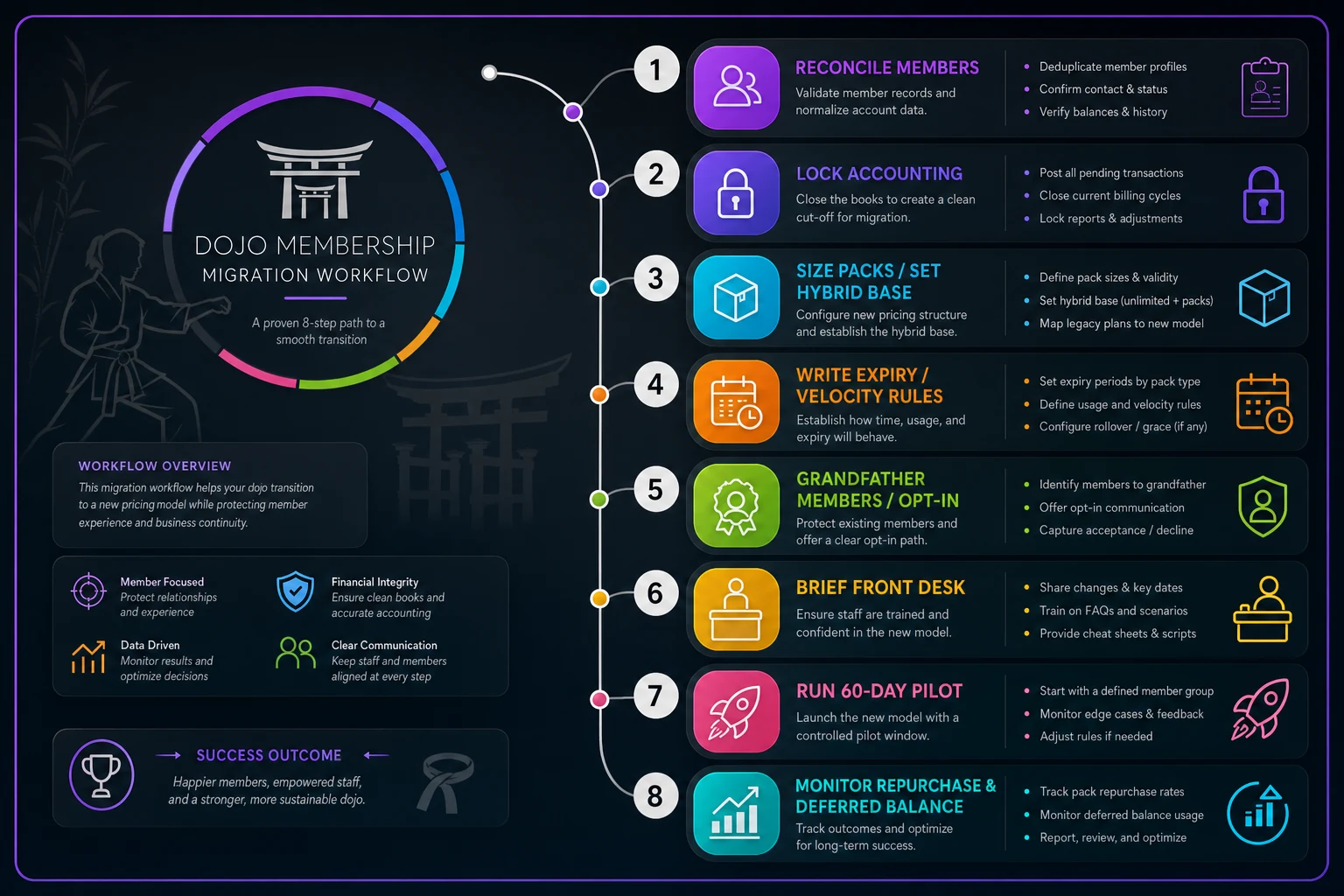
Visualize this flow to keep the rollout tidy.
Watch repurchase and deferred balance weekly during the pilot.
Real scenario: a 210‑member school that tried packs, then pulled back
A suburban school with about 210 members launched a 40‑class pack push to raise cash for a floor renovation. Month one they collected close to $78,000 — a euphoric number. They spent a chunk of it fast.
By month five, the problems showed up. Recognized revenue was flat because they were just teaching off pre‑paid balances. Repurchase on the pack group ran around 58%, so members quietly lapsed without any failed‑charge flag to catch them. Front desk admin jumped by roughly 6 hours a week chasing refills and expiry questions. And a belt‑test burn rush blew two evening classes past safe mat capacity.
They ended up moving to a hybrid: $109 base covering 8 classes, plus an optional bank. Cash smoothed out, the base fee restored a renewal anchor, breakage settled around 7%, and — the part that mattered most — the silent lapses dropped because members were psychologically "enrolled" again. Recognized revenue stabilized near their old level, but retention improved noticeably over the following two quarters.
The lesson wasn't "packs are bad." It was that they'd used a cash‑timing tool as a business model and let it quietly erode the retention that actually paid the bills.
Downloadable template
To run these numbers on your own roster, use a simple spreadsheet with tabs for: member roster + attendance, model comparison (cash vs. recognized), deferred revenue ledger, breakage tracker, and LTV by model.
Build the model‑comparison tab so you can flip the migration percentage and watch cash and recognized revenue move independently — that single view answers most of the questions in this article faster than any debate will.
Recurring wins on simplicity and retention visibility. Packs win on up‑front cash and capture breakage, but silently hurt retention and load your front desk. Hybrid captures most of the recurring stability while giving heavy trainers room to spend more — at the cost of admin complexity you need clean systems to handle.
For most 200‑member schools running a committed curriculum, recurring as the default with a small optional pack or a hybrid bank for the outliers is the sane answer. The trap to avoid is the pack cash spike — it feels like winning right up until the month collections normalize and the only thing left in the account is a promise to teach a lot of classes you already spent the money for.
Ready to elevate your dojo operations?
Join 500+ martial arts studios using Dojoyly to save time, reduce scheduling conflicts, and improve member engagement.