



Most studio owners don't set an instructor payroll model. They inherit one. You paid your first part‑time instructor $25 a class because that felt right, then hired a second one and matched it, and now three years later you have four people on four slightly different arrangements, one of whom you promised a "cut of new signups" verbally, and payroll takes you a full afternoon every two weeks because none of it lives in one place.
That's the actual problem. Not "which model is best" in the abstract — but the fact that studios rarely compare the models side by side with real numbers before committing, and by the time they realize per‑class is capping instructor motivation or commission is creating weird incentives, they've already got contracts and expectations baked in.
So let's do the comparison properly. Numbers, tax realities, bonus formulas tied to the metrics that actually matter (attendance and retention), and language you could drop into a real agreement.
The four base models, compared with real math
Before the bonus layer, you're choosing a foundation. Here's how the four common ones actually behave once you run a real instructor through them.
Assume a mid‑level instructor teaching a typical week: 10 classes, average class size of 12 students, monthly membership around $140/student, and roughly 48 teaching weeks a year.
| Model | How it pays | Monthly cost (this instructor) | Predictability | Motivation risk |
|---|---|---|---|---|
| Hourly | $28/hr, ~1.25 hrs per class block | ~$1,500/mo | High for you, low upside for them | Instructor optimizes for hours, not outcomes |
| Per‑class | $45/class | ~$1,950/mo | High both sides | No reward for filling classes |
| Commission | 15% of revenue from their classes | ~$3,000/mo (varies with attendance) | Low, swings monthly | Can cannibalize other instructors' students |
| Base + KPI bonus | $35/class + bonus pool | ~$2,100–$2,600/mo | Medium, mostly stable | Lowest — rewards the right things |
A few things jump out once it's on paper.
Hourly is cheapest and worst for engagement. At roughly $1,500/month it looks fine on the P&L, but you've tied pay to time in the room rather than what happens in the room. Instructors on pure hourly rarely chase attendance or retention because there's no connection between effort and income. Fine for a front‑desk‑adjacent assistant. Weak for anyone whose energy determines whether students come back.
Commission looks generous until attendance dips. That ~$3,000 figure assumes classes stay full. In a slow February with holds and cancellations, that same instructor might pull $1,900, and they'll feel the drop hard. Commission also creates a subtle turf problem — instructors start caring about their roster instead of the studio's, which quietly undermines the coordination work you've probably already fought to build. If you've read our take on instructor coordination and performance measurement, you'll recognize how fast pure commission works against consistency.
Per‑class is the honest middle — predictable for both sides, easy to schedule around, easy to budget. Its flaw is that it pays the same whether 4 students show up or 18. That's the gap the bonus layer is meant to close.
Why the bonus layer matters more than the base
The base pay keeps someone showing up. The bonus is what makes them care about the two numbers that actually determine whether your studio survives — attendance and retention.
Simplify class bookings and attendance tracking.
Dojoyly helps you schedule, confirm, and manage every class effortlessly.
- Unified class & student management
- Automated member notifications
- Instructor scheduling & availability
No credit card required
An instructor can teach a technically flawless class to a shrinking group and still get paid identically under hourly or per‑class. You want a small, clean bonus mechanism that says: when the students you teach keep coming back and keep renewing, you earn more.
The mistake most owners make is bolting on a bonus that's too complicated to understand. If your instructor can't calculate roughly what they'll earn in their head, the bonus doesn't change behavior — it just becomes a surprise deposit they don't connect to anything they did.
Keep it to two metrics. That's it.
KPI‑linked bonus formulas that actually work
Two clean formulas, both tied to things the instructor genuinely influences.
1. Attendance‑rate bonus (monthly)
Attendance rate = (avg attendees per class) ÷ (class capacity) Bonus tiers: Below 55% → $0 55%–69% → $75 70%–84% → $150 85%+ → $250
One thing that matters in practice: pull the no‑show‑adjusted number if you can, because otherwise a slot full of no‑shows looks like attendance the instructor never actually earned.
2. Retention bonus (quarterly)
Retention rate = (active students at quarter end) ÷ (active students at quarter start) Quarterly bonus: Below 80% → $0 80%–89% → $200 90%+ → $400
Real example of how this pays out: an instructor teaching 10 classes/week on a $35/class base earns roughly $1,470/month in base pay. A good month hitting the 85%+ attendance tier adds $250. A strong quarter at 90%+ retention adds another ~$133/month averaged out. That instructor now makes around $1,850/month — meaningfully more than flat per‑class, and every extra dollar is tied to students staying.
Worth noting: retention bonuses paid quarterly do something monthly ones can't. They discourage the short‑term hustle of packing a class for one good month and reward the slower work of building relationships that keep people enrolled through belt plateaus and busy seasons.
The tax and contract fork you can't skip
This is where studios get themselves in real trouble, and it has nothing to do with the pay math.
Employee vs. contractor is not your choice — it's a test. A lot of owners default to 1099 because it's simpler and cheaper. But if you set the schedule, require a specific curriculum, provide the mats and the space, and control how the class is taught, most jurisdictions will treat that instructor as a W‑2 employee no matter what your contract says. Commission‑heavy models don't magically make someone a contractor.
-
Contractor (1099) leans defensible when the instructor sets their own hours, brings their own students or programs, teaches specialty seminars, or runs an independent program renting your space.
-
Employee (W‑2) is the honest answer when they're on your schedule, teaching your curriculum, covering shifts, and you're managing their performance.
The KPI bonuses complicate this further. When you tie pay to your attendance and retention metrics, you're directing outcomes — which pushes strongly toward the employee side. That's not a reason to avoid bonuses; it's a reason to classify correctly and stop pretending a core instructor is a contractor.
-
Bonuses paid to W‑2 employees are supplemental wages and get taxed accordingly — don't hand someone a "$250 bonus" and be surprised when the net is smaller. Say "up to $250 gross" in every document.
-
If you use per‑class pay, confirm it still clears minimum wage once you account for prep and cleanup time. A $45 class that quietly involves two hours of work can fall below the line.
Two things that trip people up:
Sample contract language you can adapt
Plain, usable clauses. Have a local attorney check them, but this is the shape.
Base compensation (per‑class):
> "Instructor shall be compensated at a rate of $35.00 per class taught, where a 'class' is defined as a scheduled session of 45–60 minutes led by the Instructor. Compensation is paid on a bi‑weekly basis."
Attendance bonus:
> "Instructor may earn a monthly attendance bonus of up to $250 gross, determined by the average no‑show‑adjusted attendance rate across the Instructor's assigned classes, per the tier schedule attached as Exhibit A. Attendance figures are drawn from the Studio's attendance records of record. Bonuses are discretionary supplemental wages subject to applicable withholding."
Retention bonus:
> "Instructor may earn a quarterly retention bonus of up to $400 gross, calculated as the percentage of active students in the Instructor's assigned classes at the start of the quarter who remain active members at the quarter's end. Membership status is determined solely by the Studio's records."
Coverage clause (worth including):
> "Attendance and retention metrics for any class covered by a substitute at the Studio's request shall be excluded from the covering Instructor's calculations and attributed neither positively nor negatively to the assigned Instructor."
That last one matters more than it looks. Without it, an instructor who covers three chaotic last‑minute classes gets their attendance numbers dragged down through no fault of their own — which quietly kills their willingness to help out. If you run a real substitute system (and you should — here's our substitute‑instructor playbook), the metric exclusion needs to match how coverage actually works.
When each model actually makes sense
Hourly makes sense for assistant instructors, front‑desk hybrids, or brand‑new hires you're still evaluating. Don't attach retention bonuses to someone who doesn't own a class outcome yet.
Per‑class + KPI bonus is the default for your core teaching staff. It's predictable enough to budget, and the bonus layer aligns them with the numbers that keep the lights on. If you only implement one model from this article, implement this one.
Commission makes sense in exactly one situation: an instructor running a semi‑independent program — a competition team, a specialty seminar series, an adult kickboxing track they built themselves. Give them upside on what they genuinely drive. Don't use it for general curriculum classes, because the turf incentives will cost you more in coordination friction than you save.
Who should not touch commission: any studio with fewer than three instructors sharing overlapping student pools. You'll create arguments over whose class a student "belongs" to, and those arguments show up in the schedule and the vibe on the floor.
A real scenario
A single studio eyeing a second location — around 180 active members, four instructors — was running a messy mix: two on per‑class at $42, one on a verbal commission deal, one hourly. Payroll took the owner most of a Sunday, and the commission instructor had developed a habit of steering trial students toward his own classes.
They moved everyone except the assistant onto $35/class + the two‑tier bonus structure above. Base per‑class dropped slightly, but the attendance and retention bonuses more than made up the difference for the instructors who were actually performing well — which was the point.
Over the next two quarters, the change was noticeable rather than dramatic: average class fill improved by roughly 8–10 percentage points, the turf‑steering behavior disappeared once commission was gone, and quarterly retention landed in the high 80s. Payroll prep dropped from a Sunday afternoon to under an hour, mostly because the metrics all pulled from the same attendance and membership records instead of four separate arrangements living in the owner's head.
The interesting part wasn't the retention number. It was that two instructors started asking the front desk which of their students hadn't shown up in two weeks — a question they'd never thought to ask when pay was flat.
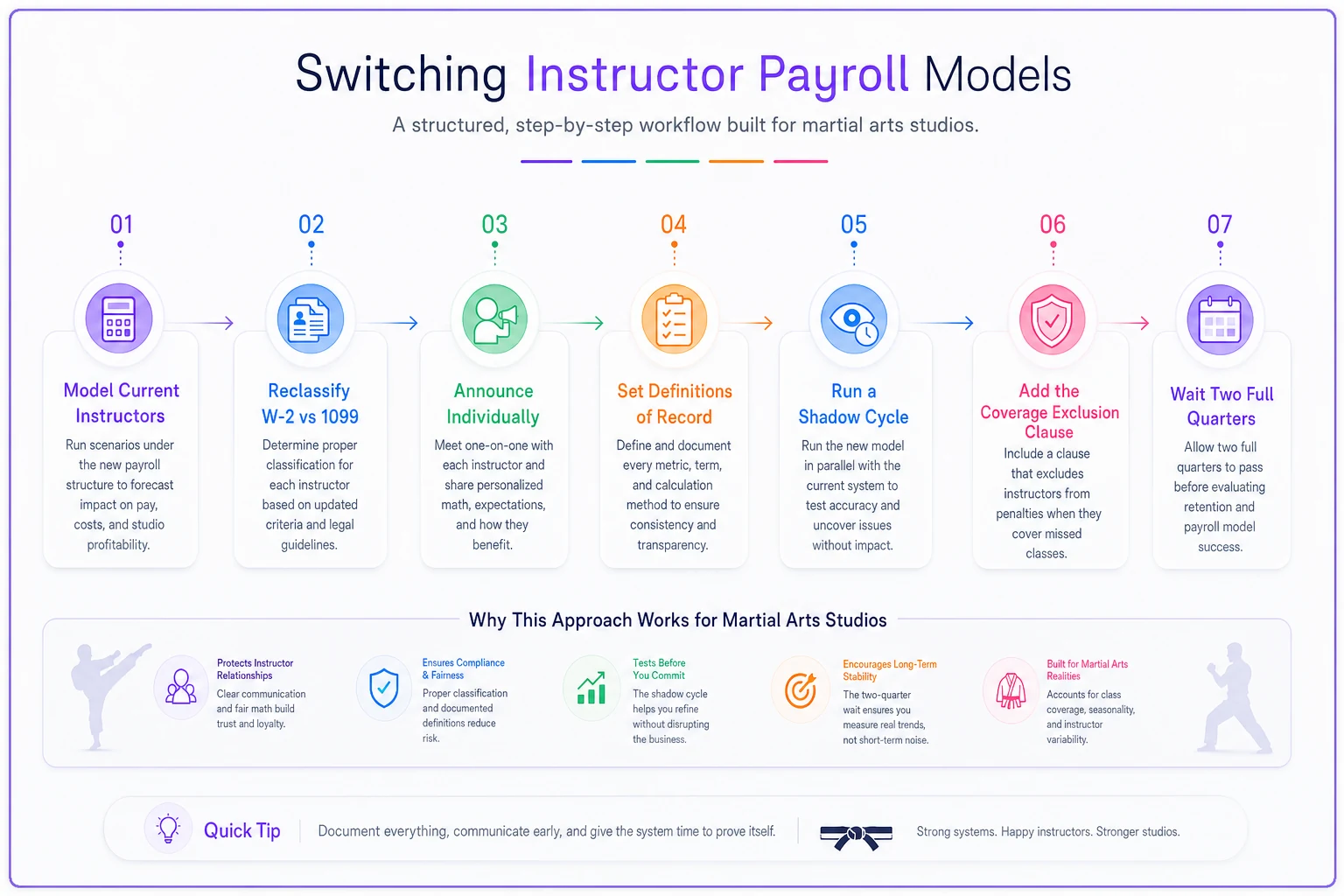
The transition checklist
Switching payroll models mid‑stream is where good intentions blow up relationships. Do it in this order.
A simple visual of the step sequence can make it easier to follow.
-
Model every current instructor under the new structure first. Run their last three months through the new formulas. If a strong instructor comes out worse, adjust the base or tiers before you announce anything.
-
Reclassify before you change pay. Sort out W‑2 vs. 1099 correctly. Don't stack a comp change on top of an unresolved classification question.
-
Announce individually, not in a group email. Each person's number is different. Walk them through their own math.
-
Set a definition‑of‑record for every metric. Attendance from where? Retention counted how? Put it in writing so there's no monthly argument.
-
Run one "shadow" cycle. Calculate bonuses for a month, show instructors what they would have earned, but pay under the old model. Removes fear.
-
Add the coverage exclusion clause before you go live, not after the first dispute.
-
Give it two full quarters before judging the retention side. That metric needs time.
Switching payroll models mid‑stream is where good intentions blow up relationships. Do it in this order.
The thing that actually matters
The right payroll model isn't the one that pays instructors the least or the most. It's the one where your best instructors earn more specifically because students keep showing up and keep renewing — and where the math is simple enough that everyone can predict their own paycheck.
Per‑class base plus two clean KPI bonuses gets you there for most studios. Keep the formulas readable, classify people honestly, exclude coverage from the metrics, and model everyone's numbers before you change a thing. Do that, and payroll stops being the afternoon you dread and starts being one of the few systems in your studio that actually reinforces the behavior you want on the floor.
The right payroll model isn't the one that pays instructors the least or the most. It's the one where your best instructors earn more specifically because students keep showing up and keep renewing — and where the math is simple enough that everyone can predict their own paycheck.
Per‑class base plus two clean KPI bonuses gets you there for most studios. Keep the formulas readable, classify people honestly, exclude coverage from the metrics, and model everyone's numbers before you change a thing. Do that, and payroll stops being the afternoon you dread and starts being one of the few systems in your studio that actually reinforces the behavior you want on the floor.
Ready to elevate your dojo operations?
Join 500+ martial arts studios using Dojoyly to save time, reduce scheduling conflicts, and improve member engagement.