


Your best instructor just quit to open their own studio. The one you spent three years training, who knew every student by name, who could handle both the terrified five-year-old and the aggressive teenager. They're taking six families with them.
This keeps happening because most martial arts studios treat instructor development like an afterthought. No clear advancement path, vague performance standards, compensation that feels arbitrary. Instructors plateau around eighteen months, start going through the motions, then either burn out or leave.
The studios that keep quality instructors for five-plus years run structured development programs. Not motivational speeches or occasional seminars — actual operational systems with competency frameworks, scheduled assessments, and transparent pay progression tied to measurable teaching outcomes.
Why traditional martial arts instructor training breaks down
Most studios inherit instructor development from competitive martial arts culture. Black belt equals teaching ability. Seniority determines pay. Performance reviews happen when someone complains or quits.
That worked when studios had eight students and one assistant. At forty students across six class types, the cracks show. Your brown belt might demonstrate perfect kata but can't manage a room of eight-year-olds. Your senior instructor teaches brilliantly but refuses to follow curriculum updates. New instructors copy whoever trained them, creating wildly inconsistent experiences across classes.
The progression path usually looks like: student becomes assistant, assistant becomes instructor, instructor gets frustrated and leaves. No intermediate steps, no skill development tracking, no real connection between performance and pay.
Studios try fixing this with mentor programs that fizzle out after a couple months. Or they send instructors to expensive seminars that don't translate to daily operations. The fundamental structure stays broken.
Building competency ladders that map real teaching skills
Competency ladders work because they define exact skills for each instructor level. Not "demonstrates leadership" but "maintains 85% student engagement during forms practice as measured by participation tracking."
Simplify class bookings and attendance tracking.
Dojoyly helps you schedule, confirm, and manage every class effortlessly.
- Unified class & student management
- Automated member notifications
- Instructor scheduling & availability
No credit card required
Start with four instructor tiers. More than that gets unnecessarily complex for studios under 200 students:
Assistant Instructor (Level 1)
-
Leads warmups independently
-
Demonstrates techniques with correct form
-
Manages groups of 6 students for 15-minute segments
-
Maintains safety protocols without reminders
-
Completion target
3-6 months
Junior Instructor (Level 2)
-
Teaches full classes with lesson plan
-
Adapts instruction for different skill levels
-
Handles basic behavioral issues without escalation
-
Achieves 80% student progression rate on curriculum benchmarks
-
Completion target
6-12 months
Senior Instructor (Level 3)
-
Develops modifications for special needs students
-
Mentors assistant instructors
-
Maintains 90% student retention in assigned classes
-
Handles parent concerns independently
-
Completion target
12-24 months
Lead Instructor (Level 4)
-
Creates curriculum improvements
-
Conducts instructor training sessions
-
Maintains 95% retention rate
-
Manages schedule gaps and coverage situations
-
Ongoing role with annual reviews
Every criterion needs to be observable. "Good with kids" becomes "maintains safe mat spacing with youth classes, documented through quarterly spot checks." If you can't evaluate it, it doesn't belong on the ladder.
The structure also creates natural progression without forcing promotions. Some instructors stay happily at Level 2 for years, teaching their three favorite classes well. Others push through to Level 4 in eighteen months. Both paths work when expectations are clear.
Quarterly assessment routines that instructors actually value
Annual reviews don't work for instructor development. Too much changes in twelve months. By the time you address a problem, habits are entrenched and students have already left.
Quarterly assessments create regular touchpoints without being a burden — but the structure matters. Most studios run assessments like corporate performance reviews: vague ratings, uncomfortable conversations, no clear outcome.
Effective quarterly assessments follow a predictable routine:
Pre-assessment phase (Week 11 of quarter)
The instructor completes a self-evaluation against the competency ladder. Not "rate yourself 1-10" — they document specific examples: "Achieved 82% pass rate on yellow belt testing (target was 80%)" or "Had two parent escalations, both regarding schedule changes."
Observation phase (Week 12)
Three class observations spread across different days and class types. Not surprise inspections — instructors know when these happen. Document specific behaviors against the competency framework. Track participation, curriculum adherence, safety compliance.
Assessment meeting (Week 13)
A thirty-minute structured conversation. Review metrics first, then observations, then gaps from the self-evaluation. Focus on patterns, not individual incidents. Missing warmup protocols three times indicates a training need. Missing them once during a chaotic Saturday class means nothing.
Development planning (Post-meeting)
Specific action items for next quarter. Not "improve student engagement" but "implement two-minute focus exercises at transition points, measure participation rate weekly." Every action ties to a competency ladder skill.
The routine stays identical each quarter. Instructors know what's coming, how to prepare, and what happens next. No surprises, no subjective judgments — just operational feedback tied to clear standards.
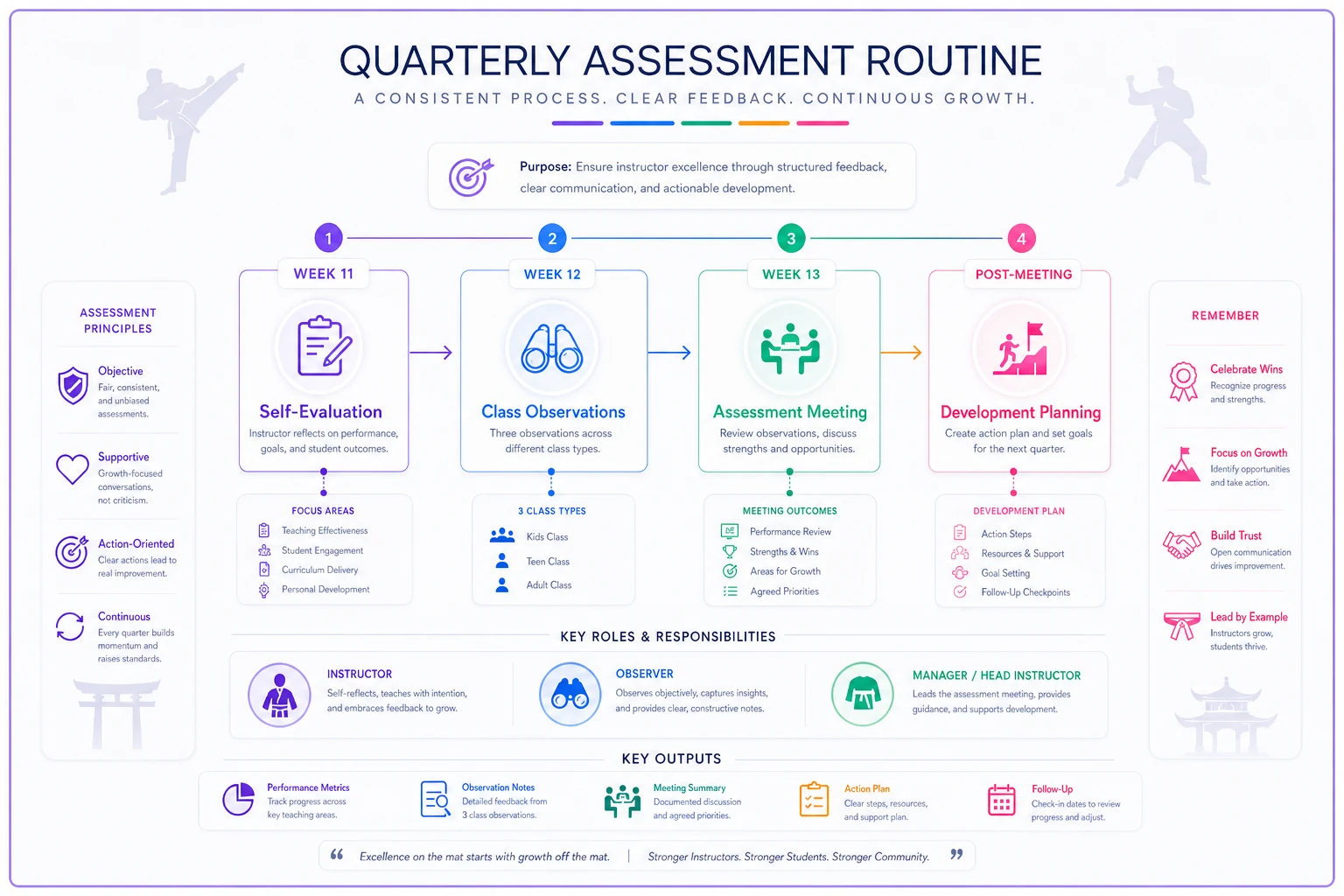
The graphic above outlines who does what and when in the quarterly assessment routine.
Sample compensation bands that reward teaching excellence
Money conversations make a lot of studio owners uncomfortable. Most got into this to teach, not negotiate salaries. But unclear compensation drives away quality instructors faster than almost anything else.
Traditional pay in martial arts follows seniority or flat hourly rates. The instructor teaching for five years makes more than the one teaching for two years, regardless of actual performance. That creates a situation where mediocre instructors hang around for pay bumps while excellent newer instructors leave for studios that recognize their value.
| Level | Base Hourly | Student Retention Bonus | Testing Pass Rate Bonus | Monthly Range |
|---|---|---|---|---|
| Assistant | $15-18 | N/A | N/A | $480-576 |
| Junior | $18-22 | +$2/hr at 80% retention | +$1/hr at 75% pass rate | $576-832 |
| Senior | $22-28 | +$3/hr at 85% retention | +$2/hr at 80% pass rate | $704-1,088 |
| Lead | $28-35 | +$4/hr at 90% retention | +$3/hr at 85% pass rate | $896-1,520 |
Based on 32 hours/month average teaching load
The bands overlap intentionally. A high-performing Junior Instructor can earn more than a Senior who coasts. This creates pressure to maintain performance rather than just wait for a promotion.
Bonuses calculate quarterly based on the previous period's metrics. An instructor who maintains 87% retention for three months gets the bonus for the entire following quarter — rewarding consistency, not a lucky individual month.
Some owners worry about instructors gaming the metrics. In practice, the opposite tends to happen. When instructors see a direct connection between student success and their paycheck, they invest more in teaching quality.
Mentor rotation templates that spread expertise
Mentorship in martial arts usually means the senior instructor occasionally watches newer instructors teach and maybe offers some tips afterward. Usually they're too busy with their own classes to give meaningful feedback.
Quarter 1: Technical Skills Focus
Junior instructors shadow seniors for form corrections and technique progression. Two hours weekly of observation plus one hour of practice teaching with feedback. The senior demonstrates how to spot common form mistakes across different body types and experience levels.
Quarter 2: Classroom Management Focus
Pair instructors struggling with behavior issues with those who excel at youth classes. Focus on transition management, attention recovery, and de-escalation. Document specific strategies that work for different age groups.
Quarter 3: Curriculum Development Focus
Seniors work with leads on building class plans and adapting curriculum for special populations — modification techniques for students with disabilities, acceleration paths for advanced students.
Quarter 4: Business Operations Focus
All instructors learn retention strategies, parent communication, and how their teaching affects studio economics. Leads share metrics and explain how individual class performance connects to overall studio health.
Rotations happen during paid training hours, not volunteer time. Budget around four hours monthly per instructor for mentor activities. For a team of six instructors, that's roughly $500-700 monthly — an investment that pays back quickly through improved retention and instruction quality.
The rotation schedule posts quarterly so instructors know upcoming assignments. This prevents the common situation where one senior instructor gets stuck training everyone while managing a full teaching load of their own.
Budget examples for sustainable instructor development
Studio owners resist formal instructor development because they assume it's expensive. They'll spend $3,000 on new mats without hesitation but won't commit $500 monthly to instructor training. Then they lose their best instructor and spend three months rebuilding, often bleeding $5,000 or more in revenue along the way.
Small Studio (50-75 students, 3-4 instructors)
-
Quarterly assessments
3 hours × $30/hour = $90/quarter
-
Mentor rotation hours
4 hours/month × $25/hour × 3 instructors = $300/month
-
Performance bonuses
$200-400/month average
-
Training materials and resources
$50/month
-
Total monthly investment
$550-750
-
Per-student cost
$7-15
Medium Studio (100-150 students, 6-8 instructors)
-
Quarterly assessments
6 hours × $35/hour = $210/quarter
-
Mentor rotation hours
4 hours/month × $28/hour × 6 instructors = $672/month
-
Performance bonuses
$500-900/month average
-
Training materials and resources
$100/month
-
Dedicated training coordinator (part-time)
$800/month
-
Total monthly investment
$2,072-2,472
-
Per-student cost
$14-25
Large Studio (200+ students, 10-12 instructors)
-
Quarterly assessments
10 hours × $40/hour = $400/quarter
-
Mentor rotation hours
6 hours/month × $30/hour × 10 instructors = $1,800/month
-
Performance bonuses
$1,200-2,000/month average
-
Training materials and resources
$200/month
-
Dedicated training coordinator (full-time)
$3,500/month
-
Total monthly investment
$6,700-7,500
-
Per-student cost
$25-38
The per-student cost reveals the real economics. Spending $20 monthly per student on instructor development seems like a lot until you calculate that losing one family costs $150-200 monthly in recurring revenue.
If better instruction keeps even two families from leaving each quarter, the program more than pays for itself.
Common failure points in instructor development systems
Even well-designed programs fall apart when implementation ignores operational realities. The most common breakdown: studios create elaborate competency frameworks and never follow through with actual assessments. The quarterly review gets pushed to "next month" repeatedly until everyone forgets the system exists.
Another common problem is overbuilding the system too early. Studios create twenty-page evaluation forms with sixty competencies across twelve dimensions. Instructors spend more time on paperwork than improving their teaching. Start with five core competencies per level and add complexity only after the basic system has run smoothly for at least six months.
Pay band failures usually come from unrealistic targets. Setting retention goals at 95% when the studio average is 70% makes bonuses feel impossible. Instructors start seeing the system as punitive rather than motivating. Set targets based on current performance plus reasonable improvement margins.
Mentor rotations fail when they become unpaid extra work. Instructors already teaching twenty hours weekly won't volunteer another five hours for mentoring. Build mentor time into paid schedules, or the program collapses quickly.
The biggest failure of all is treating instructor development as separate from day-to-day operations. When development only comes up during review season, nothing really changes between those conversations. Studios that make it work integrate feedback into regular operations — brief notes after classes, weekly skill focus areas, ongoing measurement rather than quarterly cramming sessions.
Technology and systemization opportunities
Manual tracking kills instructor development programs. Spreadsheets for competencies, paper assessment forms, verbal feedback nobody writes down — these create enough overhead to make even well-intentioned programs unsustainable.
Modern operational software handles the routine tracking automatically while preserving human judgment where it actually matters. Student retention rates pull from attendance data. Testing pass rates come from belt promotion records. Class observation notes complete on tablets during live observations. The quarterly assessment routine runs through automated scheduling and reminder systems, self-evaluation forms go out two weeks before reviews, and metrics compile into dashboards showing performance trends over time rather than single-point snapshots.
Connect your attendance system to retention metrics so bonuses calculate automatically and transparently.
This kind of systemization doesn't replace development conversations — it removes the administrative drag that makes programs fail. Instead of spending three hours pulling retention numbers from spreadsheets, you spend three hours actually discussing how to improve them.
Pay band calculations work the same way. Rather than manually tracking bonus eligibility each quarter, the system calculates compensation based on achieved metrics. Instructors can see real-time progress toward bonus thresholds, which creates consistent motivation rather than end-of-quarter surprises.
The combination of clear structure and operational software turns instructor development from something you aspire to into something that actually runs. Instructors know where they stand, what they need to improve, and how that improvement affects their compensation.
Making instructor development sustainable long-term
The studios succeeding with instructor development treat it like any other operational system. They track inputs and outputs, adjust based on results, and stay consistent even during busy stretches.
Start implementation gradually. Launch competency ladders first and run them for one quarter before adding formal assessments. Once assessments run cleanly, introduce pay bands. Add mentor rotations last. This staged approach prevents overwhelming your team or abandoning the whole system during a busy season.
Review everything annually. Which competencies actually predict student retention? Do the pay bands motivate performance or create unhealthy competition? Are mentor rotations producing measurable improvements? Adjust based on what the data shows, not assumptions.
Most importantly, involve instructors in how the system evolves. They know which skills matter most for student success. They see where assessment criteria miss reality. Their buy-in determines whether the program becomes embedded culture or forgotten paperwork.
The instructor development program that works long-term isn't the most sophisticated one. It's the one that runs consistently, measures what matters, and connects instructor growth directly to studio success. When instructors see a clear path forward and fair pay for doing good work, they stop eyeing the exit and start building careers — which is better for them, their students, and your business.
Ready to elevate your dojo operations?
Join 500+ martial arts studios using Dojoyly to save time, reduce scheduling conflicts, and improve member engagement.