
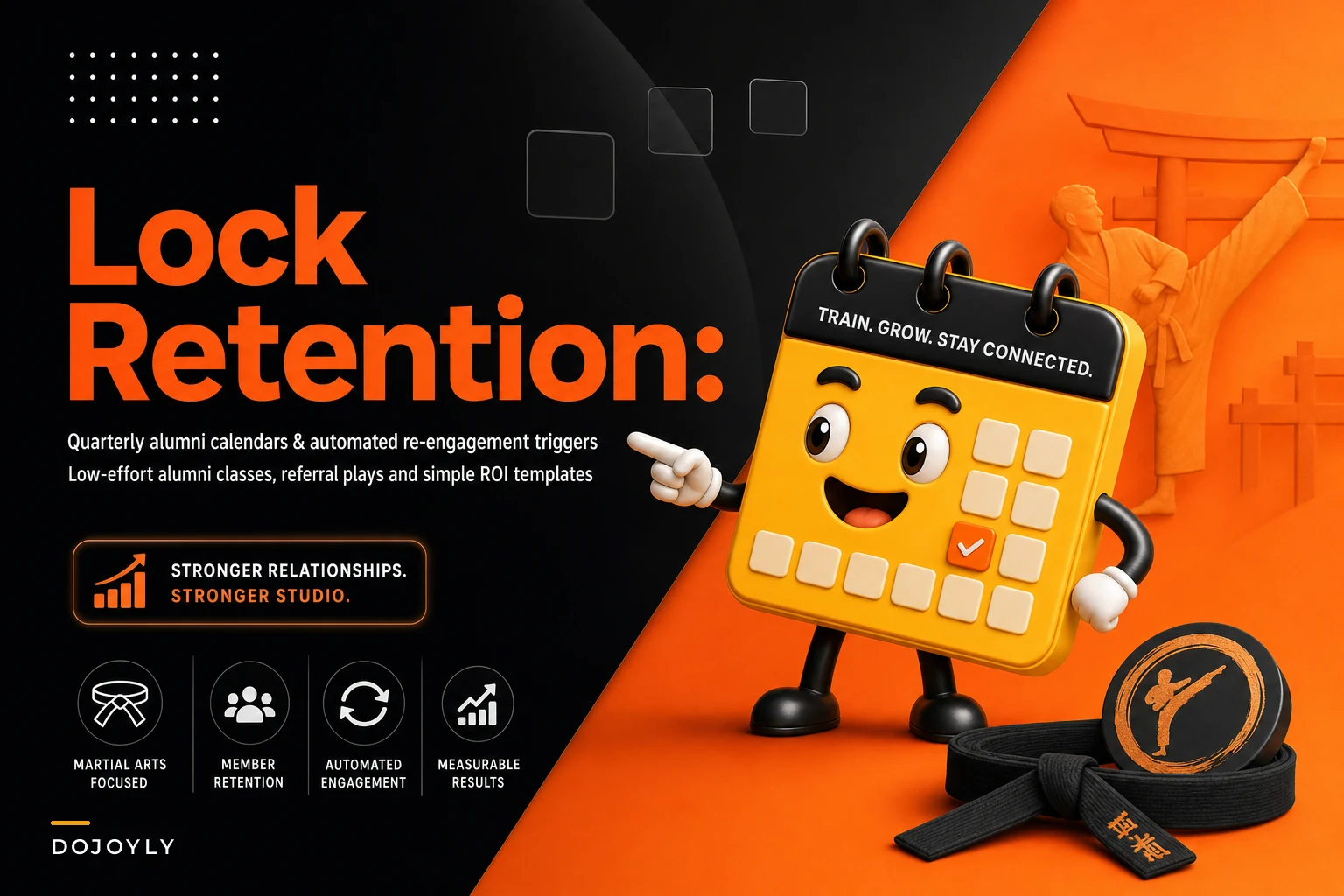

Most studios treat former students like they're gone forever. Someone earns their black belt and drifts off. A parent pulls their kid after soccer takes over. An adult stops coming when work gets busy. The mats fill up with new faces, the old ones fade, and nobody ever reaches out.
That's expensive. The people who already trained at your studio are the warmest leads you'll ever have. They know your instructors. They trust your curriculum. Their kids grew up on your floor. Bringing one back costs a fraction of what it takes to convert a cold trial, and yet almost nobody has a real system for it.
A martial arts alumni engagement program isn't a newsletter. It's a repeatable operational rhythm — a quarterly calendar, a set of re‑engagement triggers, and a couple of low‑effort revenue plays that mostly run themselves. This post is about building exactly that, tight enough that one person can manage it in a few hours a week.
Why alumni slip away in the first place
It's usually not that people hated training. Most of the time they liked it. Life just moved, and nothing pulled them back.
The pattern is pretty consistent: a student stops attending, the studio quietly cancels the membership, and the record gets buried in a spreadsheet or an old CRM tab labeled "inactive." No follow‑up sequence, no reason to return, no reminder the door is still open. Six months later that person tells a coworker, "Yeah, I used to do jiu‑jitsu" — past tense about something they'd happily restart if someone just asked.
The gap is operational, not emotional. Studios pour energy into onboarding and almost nothing into the back half of the relationship. If you've already built a strong front end — and if you haven't, the student lifecycle framework here is worth reading first — the alumni side is the natural extension nobody finishes.
The quarterly alumni calendar
Randomly emailing old students "we miss you!" doesn't work. What works is a predictable rhythm that gives alumni real reasons to show up at specific times of year. Four touchpoints a year is enough. More than that and you burn the list; fewer and you lose momentum.
Simplify class bookings and attendance tracking.
Dojoyly helps you schedule, confirm, and manage every class effortlessly.
- Unified class & student management
- Automated member notifications
- Instructor scheduling & availability
No credit card required
| Quarter | Anchor Event | Who It Targets | Revenue Angle |
|---|---|---|---|
| Q1 (Jan–Mar) | "Back on the Mat" alumni week | Recently lapsed (0–12 months out) | Discounted 4‑week restart pack |
| Q2 (Apr–Jun) | Alumni sparring / open mat + belt reunion | Long‑term alumni, black belts | Drop‑in fees, merch, guest passes |
| Q3 (Jul–Sep) | Bring‑a‑friend alumni class | Active-adjacent alumni w/ networks | Referral-driven trials |
| Q4 (Oct–Dec) | Holiday "alumni + family" seminar | Parents, family units | Gift memberships, sibling signups |
The point of anchoring each quarter to an event rather than an offer is that events feel like invitations. Offers feel like sales. An alumni sparring night with pizza afterward gets people through the door; a "20% off comeback special" email gets ignored.
One studio ran a Q2 belt reunion where they invited everyone who'd ever tested for a rank, no matter how long ago. Around 40 people came through over a weekend. Not all of them re‑signed — maybe a dozen did over the following month — but the room was full, the energy was real, and people started asking about it the following year.
Re‑engagement triggers: catch people before they're gone
The quarterly calendar handles people who already left. Triggers catch people in the act of leaving, which is far more valuable. Reactivating someone at week three of no‑shows is a lot easier than winning them back after six months of silence.
A trigger is just a rule: when X happens, this specific outreach fires. The trick is making the timing tight and the message human, not a generic blast.
-
The two‑week silence. Any active member who hasn't checked in for 14 days gets a short, personal message from their actual instructor — not a mass email. Something like "Hey, haven't seen you on the mat in a couple weeks, everything alright?" This single trigger recovers more members than any discount ever will.
-
The post‑cancellation 45‑day check. When someone formally cancels, do nothing for six weeks. Let the dust settle. Then reach out with a low‑pressure "door's open" note. People who cancel in a moment of stress often regret it by week six.
-
The milestone anniversary. One year after a student's first class — active or not — send a note acknowledging it. For lapsed students, it's a natural, non‑salesy reason to reconnect.
-
The stalled‑progress flag. An active student who's been attending but hasn't tested or advanced in an unusually long stretch is often quietly disengaging. That's a coaching conversation before it becomes a cancellation.
The mistake most studios make is treating all of these as one big "win‑back campaign." They're not. Each trigger targets a different moment and needs a different tone. The two‑week silence is a check‑in. The 45‑day post‑cancel is an open door. Blur them together and you get generic messaging that converts nobody.
Where automation quietly earns its keep
Nobody can manually track who last showed up 14 days ago across 200 members. That's where a workflow platform actually matters — not to write the message for you, but to watch the calendar and flag the person so a human can send something real. The trigger fires automatically; the outreach stays personal. That combination is the whole game.
When the system surfaces "these five students went quiet this week," an instructor can send five genuine texts in ten minutes instead of never noticing at all. The technology handles the memory problem. The human handles the relationship.
Let automation surface the students — keep the messages human.
A simple workflow like this keeps triggers automated and outreach human.
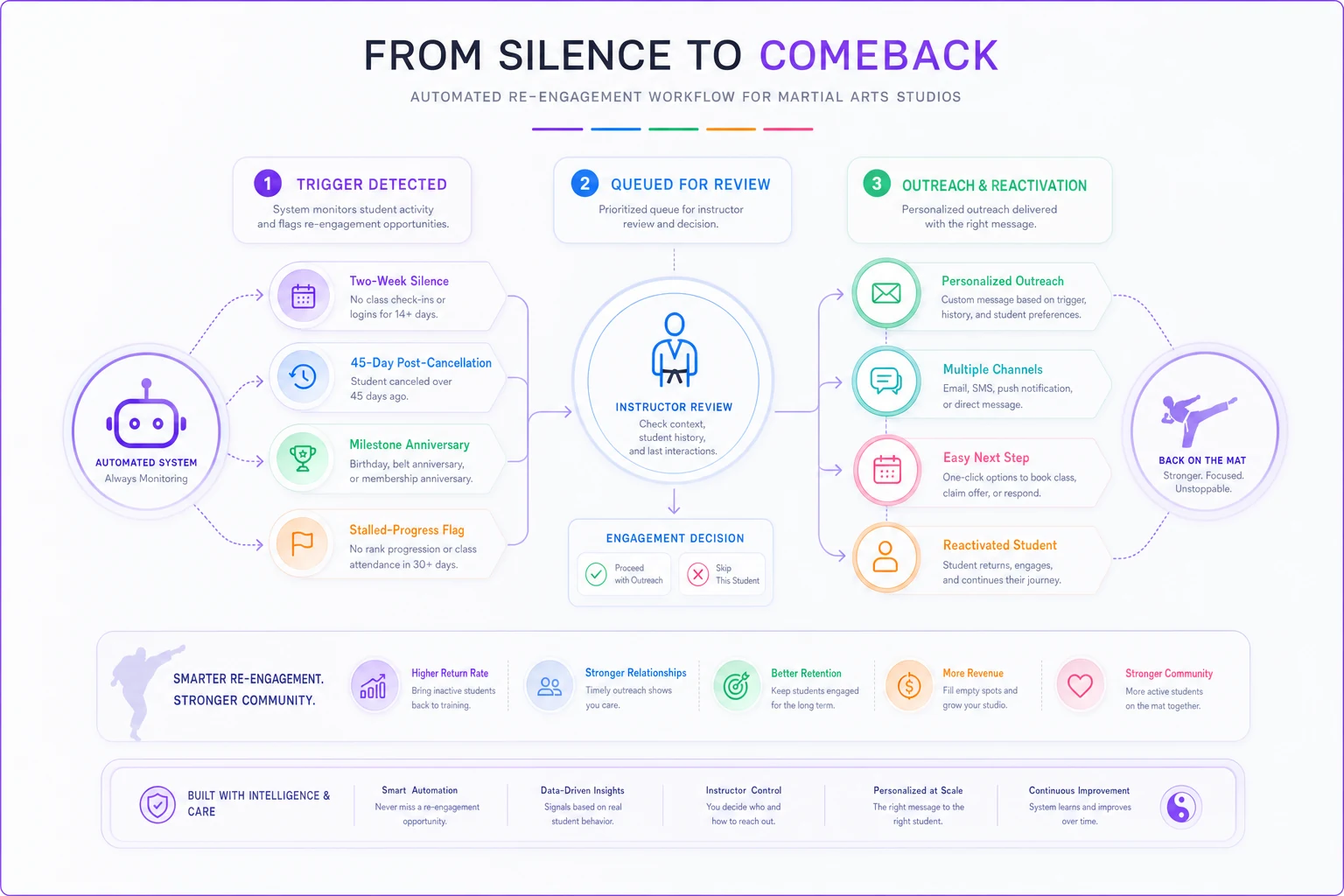
When the system surfaces "these five students went quiet this week," an instructor can send five genuine texts in ten minutes instead of never noticing at all. The technology handles the memory problem. The human handles the relationship.
Low‑effort revenue plays
Alumni programs are supposed to make money, not just fill rooms. The best plays generate revenue without adding much operational load. A few that punch above their weight:
-
Alumni-only technique classes. A monthly or quarterly session aimed at returning students who don't want to commit to full membership yet. Charge a modest drop‑in fee. It re‑acclimates people and often converts to full memberships within a couple months.
-
Alumni referral drives. Former students have networks full of people who trust their recommendation. A referral push aimed specifically at alumni tends to outperform general referral asks. If you want to run this cleanly with proper attribution and abuse checks, the referral operations breakdown here covers the mechanics.
-
Gift and family memberships in Q4. Parents of former kid students will buy a "return to the mat" gift package around the holidays. Sibling and spouse add‑ons work too — the family already knows your floor.
-
Seminar and guest‑instructor days. Alumni will pay a one‑off fee for a special seminar even when they're not enrolled. Low overhead, decent margin, and it keeps your name in their calendar.
These work because they lean on relationships you've already built. You're not manufacturing demand from scratch — you're reminding warm contacts that the door exists and giving them a small, specific reason to walk through it.
When this makes sense — and when it doesn't
It makes sense when you have at least a year or two of accumulated former students, a stable curriculum, and someone who can own the quarterly rhythm. You need a list to work with. A studio open eight months doesn't have alumni yet — it has recent trials, which is a different problem.
It's a bad idea when your front‑end retention is broken. If you're losing people in their first 90 days, fixing onboarding comes first. Pumping former students back into a leaky studio just recycles churn. Patch the front before you rebuild the back.
Who should skip this for now: any studio where the head instructor is already stretched thin with no one to hand the calendar to. This program is light, but light isn't zero. If nobody owns it, it quietly dies after the first quarter — and a half‑run alumni program looks worse than none.
A real scenario
A single‑location Brazilian jiu‑jitsu and kids' karate studio with roughly 180 active members had close to 400 former students sitting untouched in their system. No outreach, no structure. Just names.
They set up a simple version of everything above: a four‑touch quarterly calendar, a two‑week silence trigger for active members, and a 45‑day post‑cancellation check. The revenue plays were an alumni open mat each quarter and a Q4 family gift push.
Over the first three quarters, the results weren't explosive but they were steady. The silence trigger alone brought back somewhere between 8 and 12 wavering members who probably would've cancelled otherwise. The quarterly open mats reactivated around 20 lapsed students across the year. The Q4 gift and sibling push added a handful of new signups tied to former families. Net effect: a real dent in churn plus roughly $2k–$3k a month in recovered and new revenue that simply wasn't happening before — from a list they already owned and were ignoring.
The owner's own comment was the telling part: the work wasn't the hard part. Remembering to do it consistently was. Which is exactly why the calendar and the triggers matter more than any single clever offer.
Simple ROI tracking that won't eat your week
You don't need a complicated dashboard. You need to know whether the program pays for itself, and that comes down to a few numbers per quarter:
-
Alumni contacted (per trigger and per calendar event)
-
Responses / show‑ups (how many actually engaged)
-
Reactivations (rejoined or bought something)
-
Revenue from those reactivations (memberships + drop‑ins + gifts)
-
Time spent running it (be honest here)
Track these in a single sheet, one row per quarter, and the picture becomes obvious fast. If a quarter's alumni open mat pulled 30 people, converted 6, and those 6 are worth more than the pizza and a couple hours of work — keep it. If a touchpoint consistently produces nothing, cut it. The whole point of keeping tracking simple is that you'll actually maintain it, and a program you can measure is a program you can improve.
The takeaway
Your former students aren't gone. Most of them are one good reason and one well‑timed message away from coming back. What's missing at almost every studio isn't goodwill — it's the operational rhythm to act on it consistently.
A quarterly calendar gives people reasons to return. Triggers catch the ones slipping away before they're fully out the door. A couple of low‑effort plays turn that goodwill into revenue. And a five‑line ROI sheet tells you what's working so you can stop guessing. Build it once, assign an owner, let the reminders and triggers handle the timing, and keep the human touch where it counts. That's a martial arts alumni engagement program that actually locks retention instead of just talking about it.
Ready to elevate your dojo operations?
Join 500+ martial arts studios using Dojoyly to save time, reduce scheduling conflicts, and improve member engagement.