



You know that feeling when you discover three students claimed the same referral credit, or when your "bring a friend" promotion somehow gets exploited by the same family bringing their cousin's neighbor's dog walker? Yeah, me too.
Running martial arts referral program operations isn't about sending out generic "refer a friend" emails. It's about building attribution systems that track who actually brought in new students, stopping people from gaming your rewards, and designing cadences that keep referrals flowing without bleeding money.
Most studio owners start their referral programs with good intentions. Give existing students a month free for bringing someone new. Simple enough, right? Then reality hits. Student A says they referred Student B. Student C also claims they referred Student B. Student B's parent says they just found you on Google. Meanwhile, someone's created four trial accounts with slight email variations to claim multiple referral bonuses.
The operational mess that follows usually kills the program within six months.
Why referral attribution breaks down in martial arts studios
Traditional referral tracking fails because martial arts studios have unique relationship dynamics. Parents refer other parents at school pickup. Kids convince friends to join. Siblings sign up months apart. Adult students bring coworkers who then bring their own kids.
These overlapping relationships create attribution nightmares. One studio I worked with spent hours every month manually sorting through referral disputes. They'd check sign-up forms, cross-reference conversation logs, and sometimes just split credits to keep everyone happy. Not exactly scalable.
The real problem runs deeper than just tracking. Without clear attribution rules, you get delayed referrals causing confusion. Student refers a friend in January. Friend signs up in April. Original student switched to a different membership tier in March. Which reward applies? When does it activate? The manual tracking becomes impossible once you pass 200 active students.
Family gaming causing resentment becomes common. One family signs up multiple kids over several months, claiming referral bonuses each time. Technically following the rules, but other students see this and feel the system's unfair. Your best advocates stop referring because they think the program's rigged.
Instructor referrals muddy attribution too. Your instructor mentions a student recommended the studio during a trial class intro. The prospect signs up. Both the instructor and student expect credit. You're stuck choosing sides or paying double.
Building attribution rules that handle complex relationships
Solid martial arts referral program operations start with attribution rules that anticipate these scenarios. Not vague policies, but specific operational logic that can be tracked and automated.
Simplify class bookings and attendance tracking.
Dojoyly helps you schedule, confirm, and manage every class effortlessly.
- Unified class & student management
- Automated member notifications
- Instructor scheduling & availability
No credit card required
Here's the attribution framework that works best for multi-relationship environments like martial arts studios:
| Attribution Scenario | Primary Credit | Secondary Credit | Timeframe |
|---|---|---|---|
| Direct verbal referral | Referring student | None | 90 days from first mention |
| Trial class brought by friend | Friend who attended | None | Must attend together |
| Family member signup | First family member only | None | No credit for same household |
| Multiple referral claims | Earliest documented | None | Requires timestamp proof |
| Instructor-assisted referral | Original referring student | Instructor gets performance note | 60 days from introduction |
| Social media share leading to signup | Sharing student | None | 30 days from share date |
Each rule needs a clear data point for verification. Timestamp of first contact. Trial class attendance records. Household address matching. Social media post URLs with dates.
Without this structure, every referral becomes a potential dispute.
Designing reward cadences that sustain motivation
Generic referral programs dump all rewards at once. Refer someone, get a month free, done. This creates a spike of activity followed by nothing.
Better programs use reward cadences that maintain engagement over time. The operational complexity increases, but the sustained referral flow makes it worthwhile.
-
25% credit when referred student completes trial
-
25% credit when they sign up for membership
-
50% credit after referred student completes 90 days
This approach naturally filters out low-quality referrals while rewarding students who bring committed members. The operational tracking requires linking referee and referrer accounts with milestone triggers, but it cuts reward costs by roughly 40% while increasing referral quality.
Rotating between different reward types keeps the program fresh. Mix account credits with gear discounts, private lesson vouchers, and tournament entry fees. The variety prevents referral fatigue where students think "I already have three free months banked, why bother?" Each reward type needs different fulfillment operations, but the sustained engagement typically generates 2-3x more referrals annually.
Anti-abuse checks that don't feel invasive
The fastest way to kill referral enthusiasm is making legitimate referrers jump through hoops because someone else cheated the system. But without anti-abuse checks, you're basically printing money for scammers.
Build checks into the operational flow rather than as separate verification steps.
Someone creating multiple accounts usually leaves patterns. Similar email structures like john.smith1@, johnsmith2@, j.smith3@. Same IP address for multiple signups. Payment methods sharing last four digits. Sequential phone numbers.
These checks run automatically during signup. Flag suspicious patterns for review rather than blocking immediately. About 15% of flags end up being legitimate - families using same devices, workplace referrals from same building.
Set operational limits on referral frequency. Maximum 2 referrals per month per student. Maximum 5 referrals per year per student. Cooling period of 14 days between referrals from same referrer.
Use flags to queue quick manual reviews so legitimate families aren't penalized while you investigate suspicious clusters.
Legitimate referrers rarely hit these limits. When someone does, manual review usually reveals either exceptional circumstances (brought their whole soccer team) or attempted abuse (suddenly remembered six friends after you announced a bonus promotion).
Certain patterns suggest abuse. Referred student cancels immediately after referrer receives reward. Multiple referrals with no trial class attendance. Referrals signing up with minimal information. Payment method previously associated with chargebacks.
For these cases, hold rewards pending verification. A quick phone call usually clarifies whether it's legitimate. Flag the right behaviors without creating false positives that frustrate real advocates.
A/B testing frameworks with ledger tracking
Most referral programs fail operationally because they never test variations, so they never improve. You need structured A/B tests with clear ledger tracking to understand what actually drives referrals.
Testing reward amounts seems obvious but rarely happens systematically. Studios just pick a number and stick with it. Small variations can dramatically change program economics.
I've seen test groups where $30 credit per referral generated 23 referrals per month at $690 monthly cost, with 31% converting to long-term members. Bumping to $50 credit generated 28 referrals monthly but cost $1,400 with only 29% conversion rate.
The higher reward generated more referrals but lower quality, resulting in worse unit economics. Without ledger tracking at the cohort level, you'd never spot this pattern.
Beyond reward amounts, test operational elements. Referral claim windows (30 vs 60 vs 90 days). Verification requirements (immediate vs manual review). Reward types (credits vs merchandise vs experiences). Communication cadence (weekly vs monthly reminders).
Each test needs isolated ledger tracking. Create separate tracking codes for each variant. Monitor not just referral volume but quality metrics - trial attendance, conversion rates, 6-month retention of referred students.
The ledger architecture that makes this manageable
Manual tracking breaks around 50 active students. Spreadsheets fail at 100. You need proper ledger architecture that connects referrals, rewards, and student lifecycles.
The operational structure needs referral ledger entries with timestamp of referral initiation, referrer ID and current status, referee ID and signup metadata, attribution method and verification, reward calculation and schedule, plus payment/credit application status.
Link referral ledgers to broader student lifecycle tracking systems. When referred students hit retention milestones, trigger reward releases. When referrers change membership status, adjust reward eligibility.
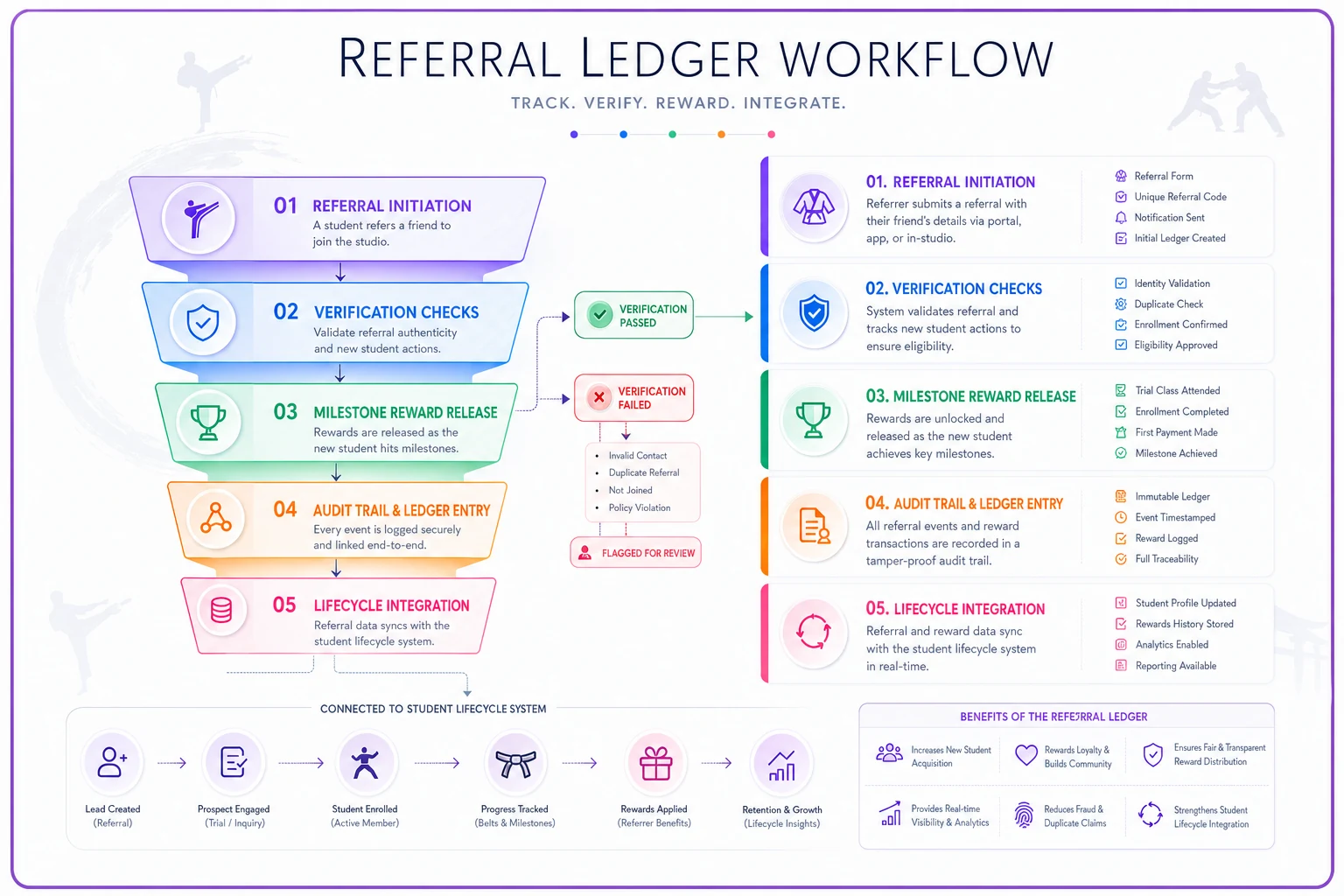
A simple visual helps operations teams follow the ledger flow and audit decisions.
Every attribution decision, reward calculation, and anti-abuse flag needs an audit trail. When someone questions why they didn't get credit three months ago, you need the data to investigate without spending hours.
Common attribution disputes and their operational fixes
Even with solid rules, disputes happen. The difference between a sustainable program and chaos is having operational procedures for common scenarios.
"I told them about you months ago" is the classic delayed attribution claim. Your operational fix: require documented touchpoint within attribution window. Email introduction, social media tag, or trial class attendance together. Verbal mentions without documentation don't count after 30 days.
When multiple students claim the same referral, first documented contact wins, but create a "assist bonus" for secondary referrers. Maybe 10% of standard reward. Acknowledges their contribution without doubling your costs.
Sometimes prospects name-drop students they barely know to get trial discounts. Verify with referring student before applying rewards. If they don't confirm the relationship, no reward issues and flag the prospect for potential abuse patterns.
Budget controls and financial guardrails
Runaway referral costs kill programs faster than fraud. You need operational controls that prevent budget overruns while maintaining program momentum.
Set monthly caps with overflow rules. Hard cap at 3% of revenue for referral rewards. When approaching cap, extend reward timelines rather than denying. Create waiting list for rewards if cap is hit. Priority processing based on referral history and student tenure.
Track reward liability separately from issued rewards. You might have $2,000 in pending rewards based on referrals made but only $800 actually issued based on verification and milestones. Understanding this gap helps predict cash flow impact.
Build in automatic program suspension triggers. Reward costs exceed 5% of revenue for two consecutive months. Fraud rate exceeds 20% of referral attempts. Referral quality (6-month retention) drops below 40%.
These triggers force program review rather than letting broken systems run indefinitely.
Technology stack for referral operations
The software infrastructure for solid martial arts referral program operations isn't complicated, but it needs the right connections. Manual tracking fails. Generic referral apps miss martial arts-specific needs.
Core components include attribution tracking with multi-source verification, ledger system with milestone-based releases, anti-abuse monitoring with pattern recognition, A/B testing framework with cohort isolation, and financial controls with budget enforcement.
Modern AI automation handles the complex parts - pattern matching for fraud detection, attribution logic for edge cases, and reward optimization based on historical data. Choose platforms that understand martial arts operations, not generic referral tools that assume simple e-commerce relationships.
For studios running integrated operations, platforms that combine onboarding workflows with referral tracking see better results. When your system knows a referred student just hit their 30-day milestone, it can automatically trigger the appropriate reward release while sending celebration messages to both parties.
This integration eliminates the operational gaps that usually cause referral programs to break down after a few months.
When referral programs actually hurt your studio
Not every studio should run aggressive referral programs. Sometimes they create more problems than growth.
Skip referral programs if your retention rate is below 70% (fix retention first), you're at facility capacity (referrals create waiting list frustration), your instructor team is unstable (referrals amplify service inconsistency), or you lack operational bandwidth for dispute resolution.
Some studios do better with simple word-of-mouth appreciation rather than formal programs. A handwritten thank you note and occasional surprise reward often generates more goodwill than complex point systems.
The compound effect of clean operations
When attribution rules are clear, rewards are timely, and anti-abuse checks run smoothly, something interesting happens. Your students stop thinking about gaming the system and start thinking about who would genuinely benefit from training with you.
Studios can triple their referral rates not by increasing rewards but by removing operational friction. When students trust the system, they use it. When they know their referral will be tracked properly and rewarded fairly, they actively look for opportunities.
The real value isn't the individual referrals. It's building a culture where students feel invested in growing the community. That only happens when your operational foundation is solid enough that people focus on relationships, not rules.
Clean martial arts referral program operations become invisible. Students refer friends because they want them to train together. Parents recommend your studio because they trust your systems. The attribution, anti-abuse checks, and reward cadences run in the background, supporting growth without creating administrative burden.
That's when you know you've built something sustainable. Not just a referral program, but an operational system that amplifies your studio's natural community growth. The technology and processes simply make it easier for people to do what they already want - share something valuable with people they care about.
Ready to elevate your dojo operations?
Join 500+ martial arts studios using Dojoyly to save time, reduce scheduling conflicts, and improve member engagement.