

Most studios stumble into a leadership program by accident. A parent asks if their 14-year-old can "help out" on the mats. You say yes because the kid is talented and you're short-staffed on Tuesday nights. Six months later you've got four teenagers loosely scattered across your schedule, no clear rules about what they can and can't do, nobody sure who's actually supervising them, and a nagging worry about what happens if one of them corrects a white belt's armbar and someone gets hurt.
That's not a leadership program. That's unpaid labor with liability attached.
A real martial arts student leadership program operations system does three things at once: it develops your best students into people who stay for years, it takes genuine load off your paid instructors, and it does both without creating a legal or safety mess. The savings are real — a well-run leader team can absorb warm-ups, line drills, beginner form corrections, and equipment setup that would otherwise eat 6–10 paid instructor hours a week. But those savings only show up if the program is built like an operation, not a favor.
This post is about the parts that actually break: who you pick, what you let them do, how you supervise, how you roster them, and how you keep the whole thing from turning into a liability. Not the feel-good stuff about "building confidence." The operational spine underneath it.
Start with selection, because bad picks cost you twice
The instinct is to pick your most skilled students. That's the most common mistake. Technical skill is maybe 30% of what makes a good junior leader. The other 70% is temperament — patience, reliability, the ability to correct a 7-year-old without embarrassing them, and showing up when they said they would.
What tends to be true across studios that run this well: the best leaders are often the second-tier technical students. The natural athletes who breeze through belts sometimes make impatient teachers because everything came easy to them. The kid who struggled through their blue belt and remembers exactly what confused them tends to explain things better.
Here's a selection framework that actually filters:
| Criteria | Weight | What you're actually checking |
|---|---|---|
| Attendance consistency (last 6 months) | High | Will they reliably show up for a roster slot? |
| Behavior with younger students | High | Do beginners already gravitate to them? |
| Emotional regulation under pressure | High | How do they handle losing or being corrected? |
| Technical competence for their belt | Medium | Can they demonstrate cleanly, not perfectly? |
| Communication clarity | Medium | Can they explain a concept two different ways? |
| Parent buy-in | Medium | Will a parent support the time commitment? |
Notice technical skill isn't at the top. A leader who shows up 95% of the time and calms down a nervous 6-year-old is worth far more operationally than a phenom who ghosts you every third week.
One filter people skip: a short trial period before formally admitting anyone. Two or three shadowing sessions where they help under close watch and you just observe. Roughly a third of the students you think will be great turn out to freeze up or get bored the moment it's real work. Better to find that out in a trial than after you've printed them a leadership uniform.
Who should NOT be in the program
-
Students under a maturity threshold you set (age is a poor proxy — some 12-year-olds are ready, some 16-year-olds aren't)
-
Anyone with an ongoing behavior pattern you're still correcting
-
Students whose parents see it primarily as a discount lever
-
Kids who want the badge but not the work
Saying no is part of running the program. A leadership title handed out too freely stops meaning anything, and the students notice fast.
Define the role in writing — vague roles are where liability lives
The biggest source of risk in these programs is ambiguity about what a junior leader is actually allowed to do. If a 15-year-old is verbally coaching a beginner through a takedown with no adult within earshot, and that beginner lands wrong, you have a problem that a written scope would have prevented.
Simplify class bookings and attendance tracking.
Dojoyly helps you schedule, confirm, and manage every class effortlessly.
- Unified class & student management
- Automated member notifications
- Instructor scheduling & availability
No credit card required
Write two distinct role descriptions. Don't blur them.
Assistant (junior, earlier stage):
-
Sets up and breaks down equipment
-
Leads warm-ups and conditioning under instructor direction
-
Demonstrates techniques when asked
-
Partners with beginners for drilling, not correcting
-
Never runs a segment unsupervised
-
Never spars-teaches or corrects submissions/throws independently
Mentor (senior, proven stage):
-
Everything above
-
Corrects beginner-level form within a defined technique list
-
Runs a station within a class the head instructor is actively running
-
Helps track attendance and progress notes
-
Still never the sole adult-equivalent responsible for a group
The key line that belongs in both descriptions: a leader is always operating under a certified instructor's active supervision, never in place of one. That single sentence is your liability firewall. The moment a leader is functioning as the responsible adult on the mat, you've crossed from "student development program" into something your insurance almost certainly doesn't cover.
This is worth coordinating tightly with your instructor development system so the boundary between a paid, certified instructor and a student leader stays unmistakable. If you've built a competency ladder and pay-band structure for your actual instructors, the leadership program should sit clearly below the bottom rung of that ladder — a feeder path, not a parallel track. When the two blur, both parents and staff get confused about who's actually qualified.
Supervision: the checklist that keeps it from going sideways
Supervision isn't a vibe. It's a set of specific things that need to be true every time a leader is on the mat. Turn it into an actual checklist the running instructor confirms at the start of any class using leaders.
Pre-class supervision checklist:
-
[ ] A certified instructor is present and actively leading the class
-
[ ] Each leader knows their exact assignment for this class (which drill, which station, which age group)
-
[ ] Leaders are positioned where the instructor can see them without turning around
-
[ ] No leader is assigned to independently teach a high-injury technique (throws, submissions, live sparring instruction)
-
[ ] The instructor-to-total-bodies ratio still meets your minimum counting only certified staff
-
[ ] Any leader-to-student correction gets a quick verify from the instructor if it's more than basic
That fifth point matters more than it looks. Leaders make your class feel better staffed, but they should never let you drop below your real adult supervision minimum. If your ratio requires one certified instructor per 12 kids, three leaders on the mat don't change that number. They improve quality within the ratio; they don't replace it. Studios that forget this are the ones that quietly drift into understaffed classes because "we had plenty of help out there."
A practical pattern that holds up: assign each leader a named station rather than "float and help." Floating leaders end up clustered near their friends or standing around. A leader who owns the "beginner stance station" for the whole class has a clear job, is easy to supervise, and gives you a clean point of accountability.
Here's a quick visual of the supervision workflow you can reference when training staff and leaders.
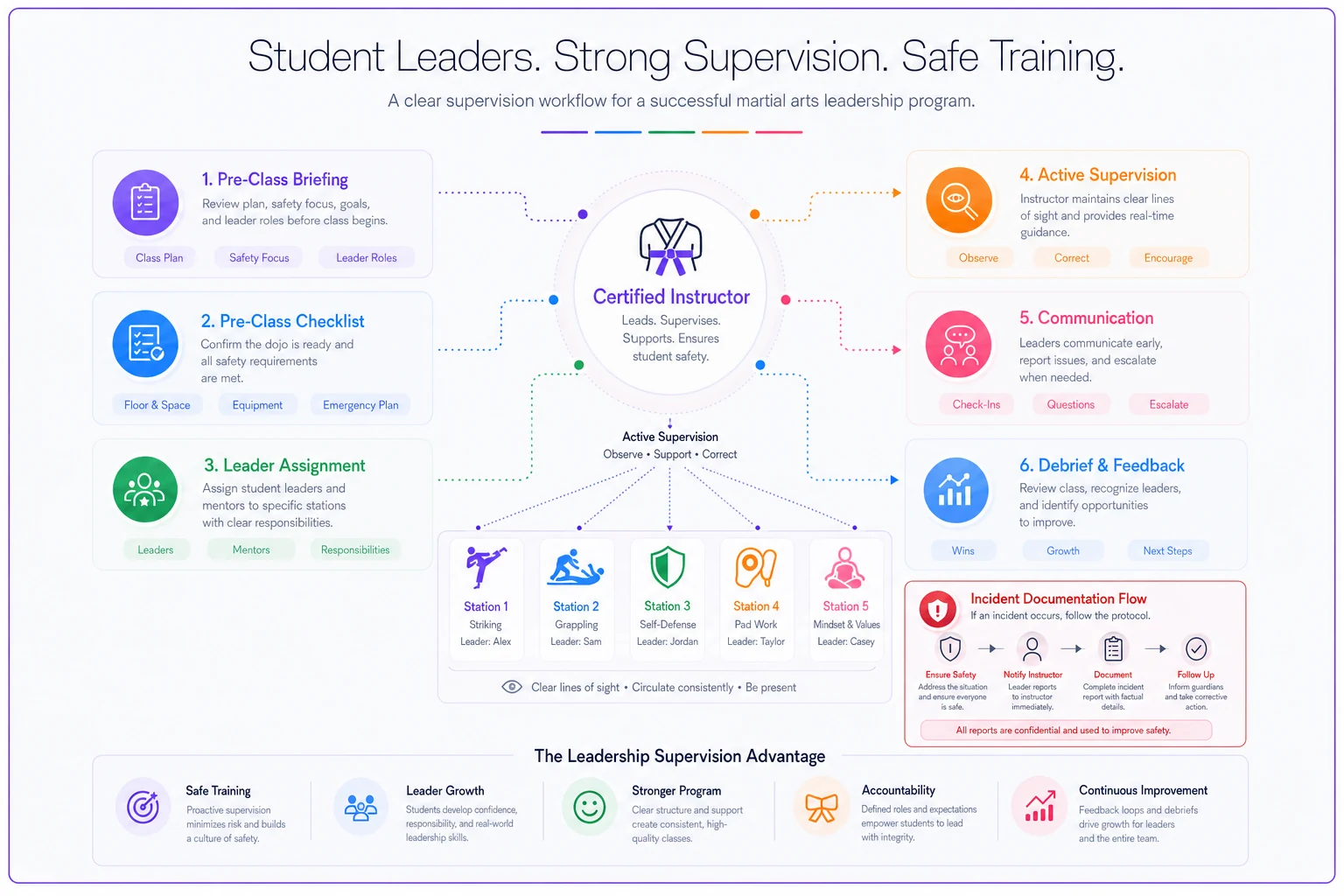
Use the workflow to train instructors on verifying supervision points before class and to orient leaders to their station responsibilities.
Rostering leaders like the operational resource they are
Once you have more than two or three leaders, informal "come whenever" scheduling falls apart. You get four leaders on the easy Saturday class and none on the chaotic Wednesday beginner rush. Roster them deliberately.
-
Map your coverage gaps first. Which classes are hardest to run solo? Beginner kids' classes and large mixed-level sessions usually top the list. Those get leaders first.
-
Set a commitment expectation. A leader signs up for a fixed number of slots per week or month, not "whenever I feel like it." Even two guaranteed slots is better than five unreliable ones.
-
Cap leaders per class. More than two or three leaders in a single class is usually counterproductive — they socialize, and supervision gets diluted. Spread them across the week.
-
Build in a backup rule. If a leader can't make their slot, they message a group thread by a set deadline, same as you'd expect from paid staff.
-
Review the roster monthly. Attendance and reliability drift. Pull the data, see who's actually showing up, and adjust.
The reliability piece connects directly to how you handle staff gaps generally. When a leader flakes on a slot you'd planned around, the fix looks a lot like your broader approach to covering last-minute absences — a clear chain of who gets contacted, a deadline, and a fallback so a missing helper never leaves an instructor stranded. Treating leaders as part of your coverage planning rather than a bonus that appears randomly is what turns them from a nice extra into a genuine staffing lever.
Keep leaders on named stations and visible assignments — it dramatically simplifies supervision and accountability.
Tracking roster attendance and spotting reliability drift eats admin time if you do it on paper. A shared schedule your leaders can see, automatic reminders before their slots, and a simple attendance log showing who's actually reliable over three months — that's where operational software helps quietly. Nothing fancy. Just the difference between chasing teenagers over text and having the schedule mostly run itself.
Liability controls you can't skip
This is the section studio owners least want to think about and most need to. Minors helping teach other minors is a real liability surface. A few controls handle most of it:
-
Waivers and parental consent specific to the leadership role, separate from the general membership waiver. Parents should sign off that their child is participating as a student-leader, understand the activities involved, and acknowledge the supervised nature of it.
-
Confirm insurance coverage explicitly. Call your insurer. Ask directly whether student leaders assisting under instructor supervision are covered, and whether there are age or activity restrictions. Get the answer in writing. Don't assume.
-
Background-check thresholds for anyone crossing a line. If a leader turns 18 and keeps helping, the situation changes legally and you may need adult-level checks.
-
No unsupervised contact rules. A leader is never alone with a student — not in a back room, not during private make-ups, not walking a kid to the parking lot. Two-adult and open-floor rules protect everyone, including the leader.
-
Incident documentation. If a correction leads to a tweak or a bump, it gets logged the same as any injury, with the supervising instructor's name on it.
None of this is optional if you want the program to survive its first real incident. The studios that get burned are almost always the ones that ran the program casually for two years and never wrote any of it down.
Tie it to retention and recognition, not just labor savings
The mistake that quietly kills leadership programs is treating them purely as free help. The moment leaders feel used rather than developed, your best ones burn out and leave — and they often take their motivation for training with them.
The programs that last tie leadership to two things: retention KPIs and recognition mechanics.
On retention: track how long leaders stay enrolled versus your general membership. Students in a well-run leadership track tend to stick around noticeably longer — they've got an identity in the school beyond just being a student. That retention lift is often worth more than the staffing savings. A leader who stays two extra years is real membership revenue you'd otherwise churn.
On recognition, keep it concrete:
-
Visible rank or badge progression within the leadership track (assistant → mentor → senior mentor)
-
Public acknowledgment at belt tests or events
-
First access to seminars, gradings, or advanced training
-
A modest tangible reward tied to reliability milestones, not just showing up once
-
A clear path toward becoming a paid junior instructor when they're old and qualified enough
The recognition doesn't have to cost much. What kills motivation isn't lack of money — it's leaders doing real work for months and getting no acknowledgment that it mattered.
A real scenario: the numbers on one mid-size studio
Consider a studio running around 220 active members across kids' and adult programs, previously staffing every class with paid instructors. They were spending roughly $2,800–$3,400 a month on instructor hours, a chunk of which went to warm-ups, line drills, and beginner hand-holding that didn't require a certified adult.
They built a proper leadership program: six leaders selected on temperament first, written assistant/mentor roles, a station-based supervision model, and a monthly roster with a two-slot minimum commitment.
Within a few months, leaders were reliably covering warm-ups and beginner stations across the busiest classes. The head instructor still ran every class — the ratio never dropped — but paid instructors could focus on the parts that actually needed them. Net effect was somewhere around 5–7 fewer paid instructor hours a week, which worked out to a bit under $900 a month in saved cost. Not life-changing on its own.
The bigger number was retention. Five of the six leaders were still enrolled 18 months later — a stretch where the studio's general kids' program was losing students at a normal clip. Those retained members, plus the two who eventually became paid junior instructors, mattered more to the bottom line than the hourly savings ever did.
When this makes sense, and when it doesn't
It makes sense when you have a stable base of students who've been with you long enough to develop temperament, at least one certified instructor who genuinely enjoys mentoring, and classes with repetitive segments a supervised leader can own. If your beginner classes are chaos and you're always one adult short on quality-of-attention, leaders help a lot.
It's a bad idea when you're understaffed on certified instructors and hoping leaders will patch the gap. They can't. That's the exact scenario where the program becomes a liability instead of an asset. Fix the staffing first. Leaders are a quality multiplier on top of adequate staffing, never a substitute for it.
It's also premature if you don't yet have written roles, a supervision standard, and insurance confirmation. Running it casually to "see how it goes" is how studios end up with the accidental version described at the top of this post.
The through-line
A student leadership program is only a staffing win when it's built like an operation. Selection based on temperament, not just skill. Written roles with a hard line between what a leader does and what a certified instructor does. Supervision as a checklist, not a feeling. Rosters that treat leaders as a scheduled resource. Liability controls in writing before you need them. And recognition that keeps your best students from feeling like free labor.
Get those pieces right and the program pays off twice — in the instructor hours it absorbs, and in the students who stay for years because they finally had a reason to be more than just another belt in line.
Ready to elevate your dojo operations?
Join 500+ martial arts studios using Dojoyly to save time, reduce scheduling conflicts, and improve member engagement.