



You've built something real at your first location. The culture feels right, students are progressing, instructors know what to do. Then you open location two, and suddenly everything that worked starts breaking down.
I watched this happen firsthand with a BJJ academy owner who expanded from one location in downtown Austin to three across the city. Within six months, his carefully built operation had turned into three completely different businesses sharing the same logo. The downtown location ran strict traditional classes. The north location had drifted into basically an MMA gym. The west location sat somewhere in between, with confused students wondering why their membership experience didn't match what they'd signed up for.
This playbook isn't about growth strategies or marketing. It's about the operational decisions that determine whether your second location becomes an asset or a constant headache.
The central vs local control matrix
Most studio owners approach multi-site expansion on gut instinct. They either micromanage everything from headquarters or let each location do whatever works locally. Neither approach holds up.
What works is a clear matrix that defines what gets controlled centrally and what stays local. Not as a philosophy exercise—as an operational necessity.
What must stay central
Curriculum progression needs central control. Not the day-to-day class content, but belt requirements, testing standards, and skill progressions. When a blue belt from your north location visits the south location, they should slot into class without friction.
Studios that let each location develop their own curriculum end up with a real mess. One location leans sport, another focuses on self-defense, a third goes heavy on forms. Within a year, students can't transfer between locations without basically starting over. They feel cheated, and honestly, they're right to.
Pricing structure belongs at headquarters too. Different locations can have different rates based on local economics—that's fine. But the structure itself, how you handle family discounts, multi-class packages, annual contracts, needs to be consistent. Otherwise you'll have members driving across town to sign up at the cheaper location and training at the convenient one.
Brand standards obviously stay central. Uniform requirements, logo usage, core values. But it goes deeper than visuals. How a parent experiences enrollment, how belt ceremonies are handled—these define your brand more than any logo.
What should stay local
Class schedules need local flexibility. Your downtown location might do well with 6am classes for working professionals. Your suburban location probably needs after-school programs at 3:30pm. Forcing identical schedules across locations ignores local demand and caps growth for no good reason.
This is where a lot of studio owners get it wrong—they go all-in on central control or give complete autonomy. The middle ground works better. Set central parameters: minimum class offerings per belt level, maximum class sizes, instructor-to-student ratios. Then let locations optimize within those boundaries.
Community events and local partnerships belong at the location level. Your north-side studio might partner with a nearby elementary school for anti-bullying programs. Your west-side location might run corporate wellness for local tech companies. These opportunities require local knowledge and relationships that headquarters simply doesn't have.
Instructor hiring can split. Set central minimum qualifications, background check requirements, and training standards. But let location managers make the actual hiring calls. They know whether that brown belt who just relocated will fit their community.
Replication templates that actually work
Templates fail when they're too rigid or too loose. The ones that hold up recognize that different parts of your operation need different levels of standardization.
Simplify class bookings and attendance tracking.
Dojoyly helps you schedule, confirm, and manage every class effortlessly.
- Unified class & student management
- Automated member notifications
- Instructor scheduling & availability
No credit card required
Schedule replication framework
Your schedule template shouldn't be a carbon copy across locations. Build a framework with required elements and flexible zones.
Required elements might include:
-
Minimum two beginner classes per day
-
At least one advanced class daily
-
Kids classes at least four days per week
-
Open mat or practice time weekly
Flexible zones allow for:
-
Exact class times based on local patterns
-
Special interest classes (competition team, weapons, women's self-defense)
-
Instructor specialization offerings
The framework ensures every location covers core student needs while adapting to local demand. A suburban location might run five kids classes on Saturday. An urban location might skip Saturday kids entirely in favor of adult workshops. Both can be the right call.
Curriculum delivery templates
A curriculum isn't just a list of techniques per belt. You need delivery templates that ensure consistent quality while leaving room for instructor personality.
Create class structure templates, not scripts. A fundamentals class template might specify: 10-minute warm-up with specific movements, 20 minutes of technique instruction with partner drills, 20 minutes of controlled sparring or application, 10-minute cooldown with flexibility work. Within that structure, instructors choose specific techniques based on the monthly focus. It balances consistency with the reality that different instructors teach differently.
Document one example week for each class type to make instructor onboarding faster.
Testing and evaluation templates matter even more. Every location needs identical testing requirements, but the format can vary. Some locations run formal Saturday testing. Others evaluate students during regular classes over a week. The criteria stays constant—the delivery adapts.
Transfer and proration SOPs nobody talks about
Students will transfer between your locations. They'll move, change jobs, find classes that fit their schedule better. Without clear SOPs, transfers create billing headaches, frustrated students, and staff making it up as they go.
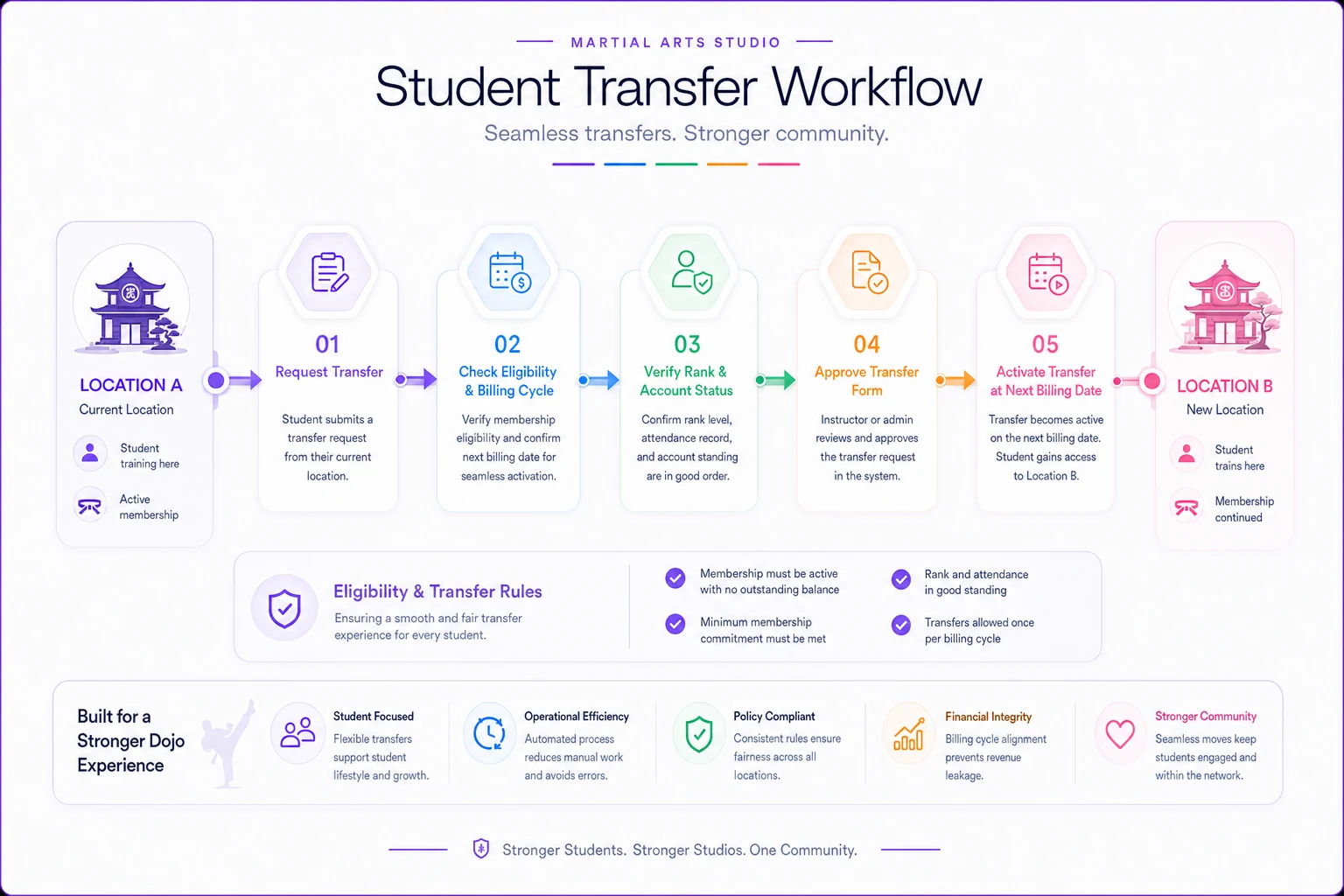
The transfer workflow that prevents confusion
Start with eligibility and timing rules. Can students transfer anytime or only at billing cycles? Monthly transfer windows tend to work best—students request transfers that activate at their next billing date.
Here's where things usually break: a student mid-contract at location A wants to transfer to location B, which has different pricing. Do they keep their original rate? Pay the difference? Start a new contract?
The cleanest approach is to maintain current contract terms including price, with adjustments only at renewal. If location B costs more, the student can pay the difference or wait until renewal. It prevents gaming the system and keeps things simple for staff.
Document verification becomes critical. The receiving location needs to verify rank, account standing, and any restrictions or medical notes. This can't be verbal—you need a transfer form that captures current rank, last testing date, account status, and relevant notes.
Here's a simple visual to map the steps so staff follow the same process every time.
Proration rules that scale
Multi-site proration gets complicated fast. A student joins location A on the 15th, adds classes at location B on the 22nd, then drops location A on the 3rd of the next month. Without clear rules, your staff will make a different call every time.
Mid-month additions: Prorate based on remaining classes in the month, not calendar days. If they're joining on the 20th and there are 8 classes left that month, charge for 8 classes.
Location switches: No proration for switching between locations at equal price. For upgrades, prorate the difference. For downgrades, credit applies at the next billing cycle.
Multi-location memberships: These need their own pricing tier, not just location A plus location B. Usually priced around 1.5x single location rate—gives students a reason to commit while preventing revenue loss from cherry-picking cheaper locations.
Consolidated reporting that shows what's actually happening
Individual location reports don't tell you much about a multi-site operation. You need consolidated views that surface patterns and problems across locations.
The three dashboards you actually need
Daily operations dashboard: Current enrollment by location, today's scheduled classes and instructor coverage, any flagged issues (missing instructors, equipment problems, student complaints). Not historical data—managing today across all locations.
Weekly performance comparison: Attendance trends, trial conversion rates, and collection rates by location. Not just numbers—trends and ratios. Is location A's attendance dropping? Is location B converting fewer trials? Are payment failures spiking somewhere?
Monthly strategic view: Financial performance, student progression metrics, instructor utilization. This answers the strategic questions: Which location has the highest student lifetime value? Where are students stalling in their progression? Which instructors are overloaded or underutilized?
| Dashboard | Description |
|---|---|
| Daily operations dashboard | Current enrollment by location, today's scheduled classes and instructor coverage, any flagged issues (missing instructors, equipment problems, student complaints). |
| Weekly performance comparison | Attendance trends, trial conversion rates, and collection rates by location; focus on trends and ratios. |
| Monthly strategic view | Financial performance, student progression metrics, instructor utilization to answer strategic questions. |
Making reports actionable
Reports without context are just noise. Your consolidated reporting needs built-in benchmarks and action triggers.
Set thresholds that actually matter. Not "enrollment dropped 2%," but "enrollment dropped 10% month-over-month" or "trial conversion below 40% for two consecutive weeks." These triggers should map to specific actions: schedule review, instructor retraining, pricing analysis.
Connect reporting to your scheduling decisions. If Tuesday evening classes are packed at every location, that's an expansion signal. If Saturday kids' classes are empty everywhere except location B, find out what B is doing differently.
The technology foundation for multi-site sanity
Spreadsheets hit their limit somewhere around 1.5 locations. Not because they can't hold the data, but because keeping everything synchronized turns into a full-time job on its own.
The challenge isn't just data management—it's workflow coordination. When a parent calls location A to enroll their kid at location B, your system needs to handle that without a headache. When an instructor calls in sick at the north location, the south location manager needs to know quickly whether they have qualified coverage.
AI-powered operational software genuinely changes how multi-site management works. Instead of manually updating spreadsheets and hoping everyone's on the same page, modern platforms maintain a single source of truth across locations automatically.
The routine coordination tasks that eat up management time—transfer requests, account verification, proration calculations, record updates—can be handled automatically. What used to require three phone calls and two emails gets resolved without anyone manually touching it.
These platforms also surface patterns that are easy to miss when you're managing across multiple sites. Location A consistently needing substitute instructors on Thursday nights. Location B's retention dropping whenever a specific instructor teaches beginners. Pricing confusion spiking around certain promotions. These patterns exist in the data—they just need a system that can actually surface them.
Beyond two locations: when systems really matter
The jump from one to two locations feels significant. The jump from two to four is where bad systems fall apart entirely.
At two locations, you can still force coordination through constant communication. Owners can talk daily, manually sync decisions, handle exceptions personally. At four, that breaks down. You need systems that work without the owner holding everything together.
Studios that successfully scale past three locations tend to share the same traits. They've turned routine decisions into documented SOPs. They've built reporting that surfaces problems before they become crises. They've given location managers real authority within clear boundaries—so managers aren't constantly waiting for approval on things that shouldn't require it.
And they've accepted that perfect consistency across locations isn't actually the goal. Your downtown location might become known for competition training. The suburban location might be the best kids' program in the area. That's not a failure of consistency—it's market adaptation within your operational structure.
The expansion decision checklist
Before opening another location, check your operational readiness:
Systems readiness:
-
[ ] Central vs local control matrix documented
-
[ ] Schedule framework tested and proven
-
[ ] Curriculum delivery templates in use
-
[ ] Transfer/proration SOPs written and trained
-
[ ] Consolidated reporting operational
-
[ ] Technology platform handles multi-site workflows
Team readiness:
-
[ ] Current location runs smoothly without daily owner presence
-
[ ] Location manager trained and proven
-
[ ] Instructor pipeline produces qualified candidates
-
[ ] Administrative staff handle exceptions using SOPs
-
[ ] Coverage system works without scrambling
Financial readiness:
-
[ ] Current location profitable for 6+ months
-
[ ] 6 months operating expenses in reserve
-
[ ] Equipment and buildout budget secured
-
[ ] Marketing budget allocated for launch
-
[ ] Buffer for 12 months of potential losses
[ ] Buffer for 12 months of potential losses
Building your martial arts multi-site operations playbook
Expanding from one location to multiple isn't about copying what works—it's about building systems that scale. The studios doing this well didn't just replicate their first location. They built operational infrastructure that maintains quality while allowing each site to adapt locally.
Start documenting your systems before you need them. Build your central vs local control matrix. Create schedule templates that balance consistency with flexibility. Write transfer and proration SOPs your staff can actually follow. Set up reporting that tells you what's really happening across locations.
Multi-site success or failure usually comes down to operational discipline, not market opportunity or marketing budget. Studios that build their playbook before expanding avoid the chaos that kills most second locations. Those that expand first and systematize later spend years trying to retrofit consistency into operations that have already drifted.
Your student lifecycle framework needs to work consistently across locations. Your scheduling system needs to coordinate between sites. Your billing needs to handle the complexity of transfers and multi-site memberships. These aren't problems to solve after you've opened the second location—they're prerequisites for making it work.
The playbook you build now determines whether your next location becomes a growth accelerator or an operational anchor.
The playbook you build now determines whether your next location becomes a growth accelerator or an operational anchor.
Your student lifecycle framework needs to work consistently across locations. Your scheduling system needs to coordinate between sites. Your billing needs to handle the complexity of transfers and multi-site memberships. These aren't problems to solve after you've opened the second location—they're prerequisites for making it work.
Ready to elevate your dojo operations?
Join 500+ martial arts studios using Dojoyly to save time, reduce scheduling conflicts, and improve member engagement.