



Most studio owners can tell you their total monthly revenue down to the dollar. Ask them which class type actually makes money after instructor pay, mat space, and the admin time it eats up — and things get fuzzy fast. Kids classes feel profitable because they're packed. Adult evening classes feel profitable because those members pay the most. The intro class feels like a loss but "it brings people in." Feelings are not a P&L.
The problem with running class profitability decisions on gut is that the three main class buckets — kids, adults, and lead‑gen/intro — behave completely differently on cost. Different staffing ratios, different fill curves, different conversion value, wildly different break‑even points. Blending them into a single studio‑wide margin just hides whichever class is dragging everything down.
This is a build‑it‑yourself piece. By the end you'll have a per‑class P&L you can drop into a spreadsheet, break‑even occupancy formulas for each class type, and a set of decision rules for when to re‑price, re‑staff, or kill a time slot. There's also a 30/90‑day experiment plan at the end so you're not making permanent decisions based on one bad month.
Why blended margins lie to you
A studio doing $45k–$50k a month can look healthy on paper and still have two or three class slots running at a loss. The reason is simple: averaging.
Say your kids program runs at a strong margin because one instructor handles 22 kids. Your adult BJJ fundamentals at noon runs with the same instructor cost but only 5–6 people on the mat. Average them together and the studio "makes money per class." But the noon slot is being subsidized by the kids program, and you'd never know unless you split them apart.
The pattern shows up constantly: owners protect low‑performing adult classes emotionally ("those are my loyal guys") while the real profit engine — the kids pipeline — gets under‑resourced because it feels like babysitting. The numbers almost never agree with the sentiment until you force each class type onto its own row.
One quick note before we build: if your overall studio P&L isn't clean yet, the per‑class version won't help much. It's worth getting the foundation right first — this studio financial operations playbook covers the weekly cashflow cadence and overall P&L structure that everything below sits on top of.
The per‑class P&L: what actually goes on each row
The trick with a per‑class P&L is figuring out how to handle shared costs. Rent, insurance, software, front‑desk pay — none of that belongs to a single class. If you dump all of it onto every slot, everything looks unprofitable and you learn nothing.
Simplify class bookings and attendance tracking.
Dojoyly helps you schedule, confirm, and manage every class effortlessly.
- Unified class & student management
- Automated member notifications
- Instructor scheduling & availability
No credit card required
The cleaner method: separate direct costs (things that only exist because that class runs) from allocated overhead (shared costs split by mat‑hours used).
Here's the structure for a single class slot, measured per session:
| Line item | Type | How to calculate |
|---|---|---|
| Revenue attributable | — | (Active members assigned to slot × avg monthly fee) ÷ classes per month |
| Instructor pay | Direct | Hourly or per‑class rate + any assistant |
| Variable supplies | Direct | Belt/gear wear, water, cleaning — usually small |
| Mat‑hour overhead | Allocated | (Monthly rent + insurance + utilities) ÷ total monthly mat‑hours × slot length |
| Admin/front‑desk share | Allocated | Front‑desk monthly cost ÷ total weekly class count |
| Contribution margin | — | Revenue − direct costs |
| Net per class | — | Contribution margin − allocated overhead |
The two numbers that matter most are the bottom two. Contribution margin tells you whether the class is worth running at all — if it can't cover its own instructor, it's bleeding cash on every session. Net per class tells you whether it's pulling its weight against fixed costs.
Use a rolling 60–90 day attendance window to attribute revenue across classes.
Here's a quick workflow showing how to attribute revenue and allocate overhead per session.
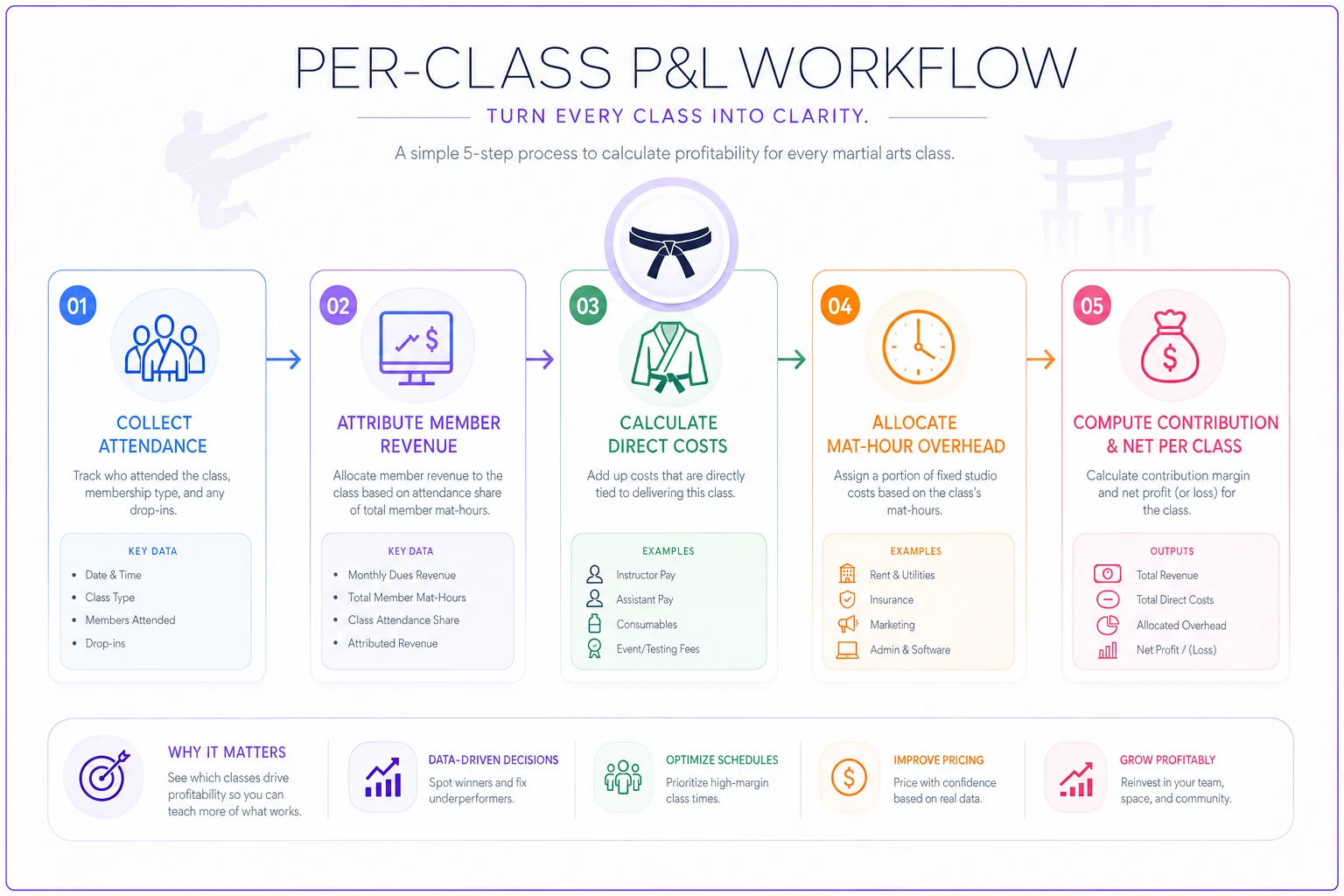
A class can have a positive contribution margin but a negative net, and that's fine if it's a lead‑gen class. It's a real problem if it's a flagship adult class. Context changes the verdict, which is exactly why you need to look at class type separately.
Attributing revenue fairly
This trips people up. A member who trains three times a week across two class types — how do you split their fee? The practical method is to divide it across sessions based on actual attendance over a trailing 60–90 days. If someone shows up to adult fundamentals 70% of the time and open mat 30%, their monthly fee splits 70/30.
Not perfect, but directionally honest. And it stops the inflated "every class is full of paying members" illusion that blended revenue creates.
Break‑even occupancy by class type
Once the P&L structure exists, break‑even becomes a formula instead of a guess. The core question: how many students does this specific class need before it stops losing money?
``\nBreak-even students = (Instructor cost + Allocated overhead per session)\n ÷ Per-student revenue per session\n``
Where per‑student revenue per session is the member's monthly fee divided by how many sessions they attend that month.
Now plug in real numbers for each type.
Adult evening class example
-
Instructor pay
$45/session
-
Allocated overhead
$25/session
-
Avg member fee
$160/month, attending ~8 sessions/month → $20 per session value
``\nBreak-even = (45 + 25) ÷ 20 = 3.5 → round up to 4 students\n``
So that noon adult class with 5–6 people? It's actually clearing break‑even. The one running with 3 is underwater by about $10 per session — roughly $500 a month bleeding out of one recurring slot.
Kids class example
-
Instructor pay
$40/session (plus a $15 assistant for larger groups)
-
Allocated overhead
$25/session
-
Avg kids fee
$130/month, attending ~8 sessions → $16.25 per session value
``\nBreak-even (with assistant) = (55 + 25) ÷ 16.25 ≈ 5 students\n``
Kids classes break even fast because they scale. One instructor plus an assistant can safely run 20+ students. The margin after that point climbs steeply, which is why the kids program is usually your real profit engine even though individual fees are lower.
Lead‑gen / intro class example
This one needs a different formula entirely, because its job isn't per‑class profit — it's conversions.
``\nMax acceptable loss per intro class = (New members converted per month × avg member LTV contribution)\n ÷ intro classes per month\n``
If your intro slot converts around 6 new members a month, each worth roughly $900 in contribution over their lifetime (conservative), that's $5,400 of downstream value. Spread across 12 intro sessions a month, you can absorb up to about $450 of loss per session and still come out ahead — if conversions hold. In practice most studios run intro near break‑even, but the ceiling is set by conversion rate, not headcount.
The mistake owners make: applying adult break‑even logic to intro classes and killing a slot that was quietly feeding the whole funnel.
Decision rules: re‑price, re‑staff, or cut
Formulas don't make decisions. Rules do. Here's the logic to apply after a class type has 60+ days of clean data.
-
Contribution margin negative for 6+ weeks → the class can't cover its own instructor. Re‑staff first (cheaper instructor, drop the assistant, or combine with an adjacent slot) before cutting.
-
Positive contribution, negative net, and it's a flagship adult class → pricing or fill problem, not a kill decision. Test a small rate increase or a schedule move before touching the slot.
-
Consistently at or above 80% of mat capacity → pricing signal. Full classes that still feel like a bargain to members mean you have room to raise rates.
-
Below break‑even headcount AND below 40% capacity for 8+ weeks → schedule problem, not a demand problem. Move the slot before you cut it.
-
Lead‑gen class below its conversion target two months running → the issue is the follow‑up workflow, not the class economics. Fix the conversion process first.
When cutting a class actually makes sense
-
The slot has failed both rules 1 and 4 — negative contribution and chronically empty.
-
You've already tested a time move and it didn't fill.
-
Instructor cost can't be reduced without hurting quality.
-
There's a nearby slot the members can realistically shift into.
When cutting is a mistake
-
It's a lead‑gen class being judged on per‑session profit.
-
It's negative net but positive contribution and it anchors member retention.
-
You've only got one bad month of data.
-
The low attendance lines up with a seasonal dip you already know about.
Rule 4 is the one most owners skip. They look at an empty Tuesday 2pm and conclude "nobody wants adult daytime training," when really it's the time that's wrong, not the demand. Before cutting anything, it's worth reading through this playbook on when your schedule is capping growth — a large chunk of "unprofitable" classes are just poorly placed on the calendar.
A real scenario: the $600‑a‑month daytime slot
A single‑location studio with around 180 members ran three adult daytime classes — 10am, noon, and 2pm. The owner was convinced daytime was dead weight and wanted to cut all three to free up instructor time for admin work.
Splitting them into per‑class P&Ls told a different story. The 10am averaged 9 students and cleared about $90/session in net — solidly profitable. The noon ran 5–6 and sat just above break‑even. The 2pm averaged 2–3 students and was losing roughly $35 a session, close to $600 a month on that one slot.
Instead of cutting all three, they killed only the 2pm, moved those instructor hours into a second 6pm kids slot (which had a waitlist), and nudged the two 2pm regulars into the noon class. Net swing landed somewhere around $900–$1,100/month once the new kids slot filled — and they kept both profitable daytime classes the owner had nearly scrapped.
The lesson isn't "daytime is good" or "daytime is bad." It's that "daytime adult" was three different businesses wearing one label, and only the P&L split made that visible.
The 30/90‑day experiment plan
Don't make a pricing or schedule change and call it based on one month. Classes fluctuate seasonally — a cold January tells you almost nothing about a normal April. Run changes as timed experiments.
Days 0–30: baseline and single change
-
Pull 60–90 days of trailing attendance and build the per‑class P&L for every slot.
-
Pick one change per class type — a price test, a time move, or a staffing adjustment. One variable, or you won't know what worked.
-
Document current break‑even headcount and average fill before touching anything.
Days 30–60: hold and observe
-
Make zero further changes. This is the hardest part — owners get twitchy and tweak again before the data settles, which ruins the read.
-
Track weekly fill against break‑even for each affected slot.
-
Watch for member complaints, but separate noise ("I liked the old time") from actual attrition tied to the change.
Days 60–90: measure and decide
-
Compare the new net‑per‑class against the pre‑experiment baseline.
-
Apply the decision rules above with fresh data.
-
Keep, revert, or escalate to a second change — but still only one at a time.
Pre‑experiment checklist
-
- [ ] Trailing 60–90 days of attendance data per slot
-
- [ ] Each class assigned to a type (kids / adult / lead‑gen)
-
- [ ] Mat‑hour overhead rate calculated for the whole studio
-
- [ ] Per‑student revenue per session worked out by class
-
- [ ] A single defined change per class type
-
- [ ] A clear metric that decides success before you start
-
- [ ] A commitment not to touch anything for the middle 30 days
That last box is doing most of the work. Building the spreadsheet is the easy part. The discipline to wait is what separates a real result from another guess.
Where this leaves you
The whole point of a class‑type profitability map is to stop treating your schedule like one undifferentiated blob of revenue. Kids classes, adult classes, and lead‑gen classes earn money in completely different ways, break even at completely different headcounts, and need completely different decision rules. Averaging them together is how studios keep a quietly unprofitable slot alive for years without realizing it.
Build the per‑class P&L once, run break‑even numbers per type, and let the rules — not the sentiment — tell you what to re‑price, re‑staff, or move. Validate every change over a full 90 days rather than reacting to one slow month. Most owners find they don't actually need to cut much. They need to relocate a couple of slots and re‑price the two classes that have been quietly full for a year. That alone usually recovers more than any dramatic schedule overhaul would.
Ready to elevate your dojo operations?
Join 500+ martial arts studios using Dojoyly to save time, reduce scheduling conflicts, and improve member engagement.