



Most studio events fail on paper before they fail in the room. The instructor picks a date, throws up a signup form, and figures the rest out as it goes. Then belt promotion day arrives and there are 84 families crammed into a space rated for 50, one camera guy who's also supposed to be checking people in, and a photographer nobody paid who leaves after 20 minutes. Somebody forgot to order the certificates. The seminar guest doesn't have a mic. And by Monday, when you actually tally what came in versus what went out on rentals, food, and staff hours, the whole thing barely broke even — or lost money you didn't notice because it never hit a clean line on your P&L.
The frustrating part is that martial arts event operations are one of the most predictable things in a studio. Same beats every time. Registration, staffing, room flow, gear, revenue capture, follow-up. What separates a profitable seminar from a chaotic one isn't talent or luck — it's whether someone wrote the boring stuff down before the day started.
This is the runbook I'd hand a studio owner who's tired of dreading their own events.
Start with the money math, not the theme
Almost everyone designs the event first and prices it later. You decide you want a nunchaku seminar with a visiting sensei, get excited, and then work backward to justify a ticket price. That's how you end up charging $45 a head to cover a $600 guest fee, $200 in rentals, and four staff hours — and needing 30+ people just to stop bleeding.
Flip it. Before anything else, build the break-even.
Here's a realistic seminar cost stack for a mid-size studio:
| Line item | Cost |
|---|---|
| Guest instructor fee + travel | $650 |
| Extra floor space / mat rental | $180 |
| Staff (2 people × 5 hrs @ $22) | $220 |
| Printed materials + certificates | $90 |
| Snacks / water | $70 |
| Payment processing (~3%) | ~$60 |
| Total fixed + variable | ~$1,270 |
At a $55 ticket, you break even around 23 attendees. That single number changes everything about how you plan. If your studio realistically pulls 30–40 people to an event, you've got a workable margin. If you struggle to get 20 into a special class, this seminar is a vanity project unless you restructure it.
The number people forget: the guest fee is fixed but the room isn't. Once you've paid the sensei, every additional seat past break-even is almost pure margin. That's the whole argument for tiered pricing. Fill the room and a seminar that limps to $1,300 gross becomes a $2,800 day with barely any added cost.
Ticketing and pricing tiers that actually raise revenue per head
A flat ticket price leaves money everywhere. The people who'd happily pay more can't, and the people on the fence don't get a reason to commit early. Tiering fixes both.
Simplify class bookings and attendance tracking.
Dojoyly helps you schedule, confirm, and manage every class effortlessly.
- Unified class & student management
- Automated member notifications
- Instructor scheduling & availability
No credit card required
For a belt ceremony or seminar, three tiers usually covers it without overcomplicating checkout:
-
Early bird (closes 10 days out) cheapest option, drives commitment while you still have time to plan staffing around real numbers. Price it to feel like a genuine deal — maybe 20% under standard.
-
Standard your true target price, calculated off the break-even math above.
-
At-door / late a deliberate premium. Not to punish people, but to protect your headcount planning. When walk-ins cost more, more people register ahead of time, and you stop guessing how many certificates to print.
For events with add-ons, tiering gets more interesting. A belt ceremony isn't just the ceremony — there's photography, video, a printed certificate frame, a group photo print, sometimes a small reception. A pattern that works:
-
Base attendance (free for testing students, small fee for extra family guests over a set limit)
-
Photo package — digital gallery access
-
Premium package — framed certificate + printed group photo + priority seating
One studio running belt promotions four times a year had been giving everything away free and eating the print costs. They added a $35 photo/frame package, sold it to roughly a third of their 60 promoting families, and pulled in around $700 per ceremony they used to spend money on. Same event, same work, just captured value that was already sitting there.
One rule that matters: make the family-guest limit explicit. "Two guests included, additional guests $10" prevents the room from silently ballooning to triple capacity and blowing up your seating and safety plan. People don't abuse a clear policy. They abuse a vague one.
The staffing roster — assign roles, not vibes
The single biggest source of day-of chaos is that everyone knows they're "helping" but nobody owns a specific job. The camera person drifts over to help with check-in, check-in falls behind, the line spills into the mat area, and now the seminar starts 15 minutes late with the guest instructor watching your studio look disorganized.
Fix it with named roles on a written roster. Not "the team" — actual names next to actual responsibilities.
-
Event lead (you or a senior instructor) owns the run sheet, makes the call on timing, the only person who talks to the guest instructor about logistics
-
Check-in / registration table, roster, name tags, waiver verification, handling walk-in payments
-
Floor coordinator manages transitions, keeps water accessible, resets space between segments
-
Media photo and video, and only that — this person does not get pulled onto anything else
-
Runner / float the person who handles whatever breaks — mic died, ran out of forms, a parent needs directions
For a tournament, you scale this into more stations: scorekeeping per ring, a bracket/results desk, a first-aid point, and someone owning spectator flow. The principle holds either way — every station has one name, and that name knows exactly when they start and stop.
Understaffing check-in and media is what people regret most. Those two are where a smooth event and a shambolic one visibly diverge. A guest who hits a fast, warm check-in line assumes the whole operation is tight. A backed-up line at the door sets a different tone for everything that follows.
The day-of run sheet
This is the document that makes or breaks the actual day.
A run sheet is a minute-by-minute (or block-by-block) timeline that says what's happening, who's responsible, and what needs to be ready before it starts.
A belt ceremony run sheet block might look like this:
-
8
30
— Staff arrive. Event lead walks the room. Media checks camera batteries and card space. Check-in table set with rosters, name tags, waivers. -
9
00
— Doors open. Check-in live. Floor coordinator seats families, enforces guest limits. -
9
30
— Doors "soft close." Runner does a final sweep for stragglers. -
9
40
— Opening remarks. Media in position for the group shot before anyone's uniform is wrinkled. -
9
50–10:40
— Testing / demonstrations by rank group. -
10
40
— Certificate presentation. Runner has certificates pre-sorted in presentation order (this is the step everyone skips and everyone regrets). -
10
50
— Group photo. Premium-package families flagged for individual shots. -
11
00
— Reception / mingling. Check-in table pivots to selling any remaining photo packages. -
11
45
— Wind down. Floor coordinator resets space for normal classes.
Two details that quietly save the day: pre-sorting certificates in presentation order, and positioning media before segments start rather than scrambling when the moment's already happening. You can't reshoot a kid's first black belt bow.
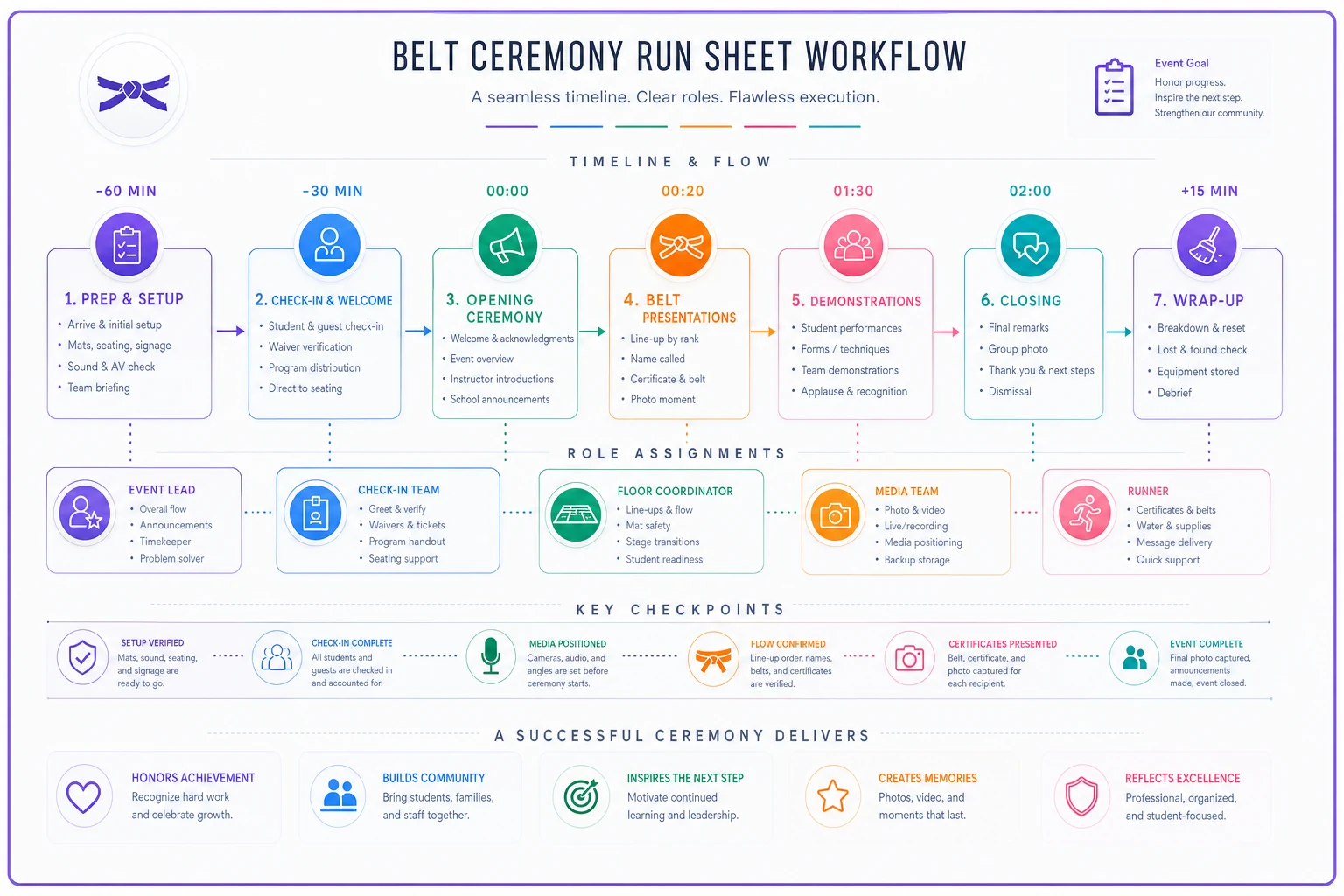
A quick visual guide to the run-sheet workflow.
Sponsorship checklists for tournaments
Tournaments are the one event where outside money is realistic — and the money most studios leave completely untouched. Local businesses will sponsor if you make it easy and specific. The failure is treating sponsorship as "we'll ask around" instead of a defined package with a clear checklist.
A workable sponsorship tier structure:
-
Banner sponsor ($150–$300) logo banner at the venue, mention in the event program
-
Ring sponsor ($300–$500) their name on a specific ring, banner, social mention, logo on scorecards
-
Title sponsor ($800+) event named alongside them, prominent placement, announcer mentions, logo on participant shirts
The operational checklist that makes sponsorship actually happen:
-
Lock the event date and expected attendance number (sponsors want reach figures)
-
Build a one-page sell sheet with tiers and what each includes
-
Set a hard deadline for logo submission — anything printed needs a real cutoff
-
Assign one person to sponsor communication (not five people half-doing it)
-
Confirm deliverables before the event
banners printed, logos placed, mentions scripted
-
Photograph the fulfilled deliverables during the event — banner up, logo visible on the ring
-
Send a post-event recap with those photos and attendance numbers within a week
That last step is the one nobody does, and it's the whole reason sponsors come back. Give a business owner a photo of their banner in a packed gym plus "180 families attended" and they'll re-up next year without a second conversation. Skip it and you're cold-pitching from scratch every single time.
The part everyone forgets: post-event retention
This is where studios lose the most, and it's invisible because it happens after the event feels "over." A seminar or ceremony creates a genuine spike of energy and goodwill — and then nothing captures it. The buzz decays over the next 72 hours and by the following week it's like the event never happened.
Events are retention tools disguised as one-off days. A belt ceremony reinforces why a family is spending money with you. A seminar reminds people their training has real depth. That emotional peak is exactly when re-engagement lands best, and it connects directly to the broader lifecycle work that keeps students around long-term — the same thinking behind turning trials into lifelong members.
A simple post-event retention flow:
-
Within 24 hours send the photo/video gallery to attendees. This is your highest open-rate message of the quarter — people want to see themselves.
-
Day 2–3 for any guests or trial students who attended, a personal follow-up with a specific next step (next intro class, a limited-time enrollment offer).
-
Day 5–7 the sponsor recap for tournaments, and a "save the date" for the next event to ride the momentum.
-
Ongoing feed event no-shows and lapsed families into your normal re-engagement track, the same way you'd handle absences through a class no-show recovery workflow.
The revenue math here is quiet but real. If a belt ceremony gets 15 non-member guests in the room and your follow-up converts even three or four into trials, and one of those becomes a paying member at around $150/month, that single event throws off well over a thousand dollars of annual value that has nothing to do with ticket sales. Most studios never see that number because they never track the guest-to-member path from events at all.
Where the manual work quietly piles up
Everything above is doable on spreadsheets and printed sheets, and plenty of studios run solid events that way. But it's worth being honest about where the hours actually go: rebuilding the same registration form every time, chasing waivers manually, printing name tags off a list, sorting who bought which photo package, then piecing together a follow-up sequence by hand while you're exhausted the day after.
Studio management platforms with built-in automation earn their keep here — not by running the event for you, but by handling the repetitive scaffolding. Registration and tiered ticketing tied to your existing member database, waivers verified at signup, gallery delivery and follow-up messages triggered automatically once the event closes. The point isn't the technology. It's that the run sheet, the roster, and the retention flow only work if they actually get executed — and the parts most likely to get dropped when you're slammed are exactly the parts software won't forget.
When bigger events make sense — and when they don't
A seminar or ceremony makes sense when you have a base that reliably shows up to special classes, you can hit break-even attendance without straining, and you have at least four people who can staff distinct roles.
A large tournament is a bad idea when you're a solo instructor with no reliable volunteer bench, when you haven't run a smaller event cleanly first, or when you're hoping the event will fix a retention problem. Events amplify whatever your operation already is. A studio that's chaotic day-to-day will run a chaotic event — just louder and in front of more people.
Studios under a year old with thin membership should skip ambitious events entirely. Get your day-to-day operations and retention working first. An event that flops in front of prospective members does more damage than never running one.
The takeaway
Run your next event backward from the math and forward from the paper. Know your break-even before you pick a theme. Tier your tickets so the room fills and the people who want more can pay for more. Give every job a name. Print the run sheet. Chase sponsors with a real checklist and pay them back with a recap. Treat the 72 hours after the event as seriously as the event itself — because that's where the retention and most of the real money actually lives.
Do that consistently and the weekend you used to dread becomes one of the more predictable, profitable things on your calendar.
Ready to elevate your dojo operations?
Join 500+ martial arts studios using Dojoyly to save time, reduce scheduling conflicts, and improve member engagement.