


Most studios don't refuse neurodiverse or mobility‑challenged students on purpose. What happens is quieter and messier: a parent calls asking whether their autistic 8‑year‑old can join, the front desk person doesn't know what to say, the answer comes out as a vague "we'll see how it goes," and the family never books a trial. Or a student with cerebral palsy signs up, gets placed in a standard class, the instructor improvises for three weeks, and the family quietly disappears when the improvising stops working.
That's not a values problem. It's an operations gap. Inclusive martial arts class operations aren't about being a nicer person — they're about having intake, adaptation, staffing, pricing, and communication systems that make inclusion repeatable instead of dependent on whichever instructor happens to be good at it that day.
This post is a set of practical SOPs. Intake checklists, adaptation rubrics, staff training modules, pricing guidance for accommodations, and family communication templates. The goal is a studio where the answer to "can my kid join?" is a confident yes with a clear plan attached.
Why "we'll figure it out" quietly costs you families
The default approach at most studios is reactive. A student shows up, and the instructor adapts on the fly. This works for a while, and then it breaks in predictable ways.
A typical example: a studio takes on a student with sensory processing differences. The Tuesday instructor learns that loud kiai drills trigger a meltdown, so he skips them. Thursday's instructor doesn't know that, runs the drill, and the kid has a rough class. The parent watches from the lobby, decides the studio "isn't set up for this," and cancels. Nobody did anything wrong exactly — the knowledge just lived in one instructor's head instead of in a system.
-
Knowledge doesn't transfer between instructors. What works for a student is discovered once and then forgotten by everyone except the person who discovered it.
-
Intake promises don't match class reality. The front desk oversells ("oh yeah, totally, we handle everything") and the mats underdeliver.
-
No one owns the accommodation. When it's everyone's job to adapt, it's no one's job, and it degrades over the first month.
The families most affected by this are exactly the ones with the strongest word‑of‑mouth networks. Parents of neurodiverse kids talk to each other constantly — support groups, school communities, therapy waiting rooms. A studio that gets this right becomes the recommended place. A studio that fumbles it gets a quiet warning passed around instead.
The intake checklist: what you actually need to know before day one
The intake conversation is where most of the damage or the win happens. The mistake studios make is treating it like a standard trial signup with a couple of extra questions bolted on. It needs to be its own process.
Simplify class bookings and attendance tracking.
Dojoyly helps you schedule, confirm, and manage every class effortlessly.
- Unified class & student management
- Automated member notifications
- Instructor scheduling & availability
No credit card required
The point of a good intake isn't to collect a medical file. It's to gather the handful of operational facts that change how you run a class. You don't need a diagnosis. You need to know what to do differently.
-
What does a good day look like for your child in a structured setting? (Open‑ended — parents will tell you more here than any checkbox.)
-
What tends to trigger frustration or shutdown? Specific triggers: noise, physical contact, transitions, waiting, being corrected in front of others.
-
What helps them reset? A quiet corner, a specific phrase, a five‑minute break, water, a fidget item.
-
Physical considerations. Mobility aids, range‑of‑motion limits, balance, fatigue patterns, seizure history the instructor must know about.
-
Communication style. Verbal, non‑verbal, uses AAC device, responds better to demonstration than instruction, needs single‑step vs multi‑step cues.
-
What's worked and not worked in other activities? School PE, swim class, prior martial arts — gold mine of information.
-
Goals. Is this about focus, social skills, physical therapy support, confidence, or actual competition? Wildly different programs follow from the answer.
-
Who's the point of contact and how do they prefer to hear from you? Text, email, quick chat at pickup.
The operational insight here: capture this in a structured student profile that every instructor can see before the student walks in, not in a note buried in a signup form. If the Thursday sub can't pull up "no surprise loud drills, gives a thumbs‑up when overwhelmed, needs the mat closest to the door," the intake was pointless.
The adaptation rubric: turning "adapt on the fly" into a decision system
This is the piece almost nobody has. An adaptation rubric is a simple framework instructors use to modify a drill in real time without guessing. Instead of "figure something out," it gives them a menu.
The best rubrics break adaptations into four levers instructors can pull for any technique:
| Lever | What it means | Example modifications |
|---|---|---|
| Physical demand | Adjust the body requirement | Seated version, reduced range, supported stance, wall for balance, shorter reps |
| Sensory load | Manage input intensity | Lower volume drills, remove group counting, one‑on‑one corner, noise‑dampening allowed |
| Cognitive/sequence load | Simplify the mental steps | Break combo into single moves, visual cards, demonstrate‑then‑do, remove time pressure |
| Social exposure | Control the group dynamic | Practice with instructor first, partner with a patient senior student, correct privately |
In practice: an instructor teaching a front kick to a student with limited lower‑body mobility doesn't stop and panic. They look at the "physical demand" lever, choose the seated or supported version, keep the technical intent (chamber, extend, retract), and the student is doing real martial arts adapted to their body. Same for a neurodiverse student overwhelmed by a fast partner drill — pull the "sensory load" and "social exposure" levers, and the drill becomes doable.
A quick workflow diagram can help instructors remember the steps in the heat of class.
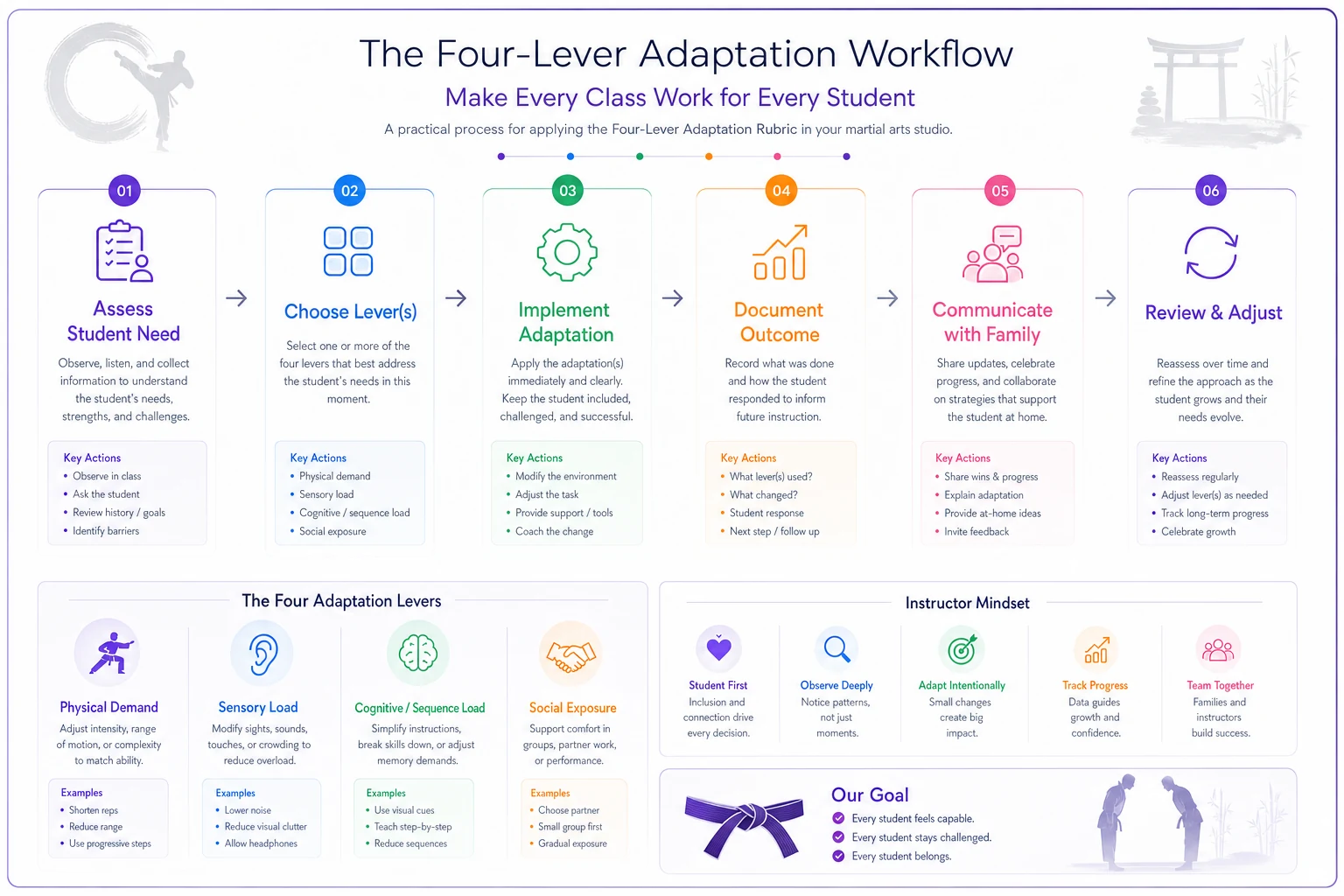
The rubric matters because it protects curriculum integrity. Adaptation isn't lowering the standard — it's finding the version of the standard the student can actually train. A student who earns a belt through adapted requirements should have those requirements documented and consistent, which ties directly into how you structure your student lifecycle and curriculum progression. Belt criteria should have a documented adapted track, not a case‑by‑case judgment call that changes depending on who's grading.
Staff training: the modules that actually change behavior on the mat
You can't hand an instructor a rubric and expect it to stick from reading alone. Training has to be short, repeatable, and role‑played, because the skill is applied under pressure with 15 other kids on the mat.
Keep it to a few focused modules rather than one overwhelming seminar:
-
Module 1 — Reading a student before it escalates. Recognizing early signs of overload (a kid drifting, covering ears, going rigid) and responding before a meltdown, not during one. Role‑play the reset, not just the theory.
-
Module 2 — Using the adaptation rubric live. Give instructors a technique and a student profile card, have them call out which levers they'd pull. Ten minutes, done at staff meetings.
-
Module 3 — Language and correction. How to correct without singling out. How to give a win to a student who needs three tries. What not to say.
-
Module 4 — Physical assistance and safety. For mobility‑challenged students: safe spotting, transfer awareness, when to stop, what requires a parent's sign‑off.
-
Module 5 — Documentation discipline. How to add a two‑line note after class so the next instructor isn't starting from zero.
Keep a laminated copy of the adaptation rubric and a stack of student profile cards in the staff room for quick reference during transitions.
The instructors who resist this training usually aren't unwilling — they're afraid of doing it wrong and making a student's day worse. Framing it as "here's exactly what to do so you don't have to improvise" lowers the resistance fast. Confidence comes from having a plan, not from being told to care more.
One more thing: the note‑taking habit (Module 5) is the one that decays first and matters most. If an instructor writes "great class, tried the seated kick variation, worked well — do again" after every session, six weeks later you have a real training record and the student never gets whiplash from inconsistent handling. Without it, you're back to knowledge living in one head.
Pricing and discount policy: charging fairly without underpricing the work
Studios avoid this section because it feels uncomfortable, so decisions get made emotionally and inconsistently. One family gets a quiet discount, another pays full rate for a harder‑to‑serve situation, and eventually it's a mess nobody can explain.
Get clear on the distinction first: an accommodation is not automatically a discount. A student who trains in the regular class with a few rubric‑based modifications costs you essentially nothing extra and should pay the standard rate. Charging them less isn't generosity — it's implying their participation is worth less, which parents notice.
| Service level | What's included | Pricing approach |
|---|---|---|
| Standard class + rubric adaptations | Regular class, instructor modifies as needed | Standard membership rate |
| Standard class + shadow support (first weeks) | Extra staff member for onboarding period | Standard rate + short‑term support fee, or absorbed as onboarding cost |
| Small‑group adapted class | Lower ratio, specialized instructor | Premium tier, clearly priced |
| Private adapted sessions | 1‑on‑1 | Private lesson rate |
For genuine financial‑hardship discounts, make them a separate decision from the accommodation. A scholarship or sliding‑scale policy is a real thing you may choose to offer — but base it on need, apply it consistently, and document who qualifies. If you're building out accommodation‑related pricing, small‑group tiers, or short‑term support fees, get the mechanics right so mid‑cycle changes and prorated support fees don't turn into billing confusion — the same discipline covered in this breakdown of proration, mid‑month signups and discount rules applies directly here.
Family communication templates: keep parents informed without extra work
Parents of neurodiverse and mobility‑challenged kids live with a lot of uncertainty about whether an environment is actually working for their child. The studios that keep these families longest are the ones that communicate proactively — not with long reports, but with short, consistent touchpoints.
Three templates cover most of what you need:
1. Post‑intake plan summary (sent after signup):
> "Thanks for the conversation about [student]. Here's the plan for their first few weeks: [instructor] will be their main coach, we'll start with [approach], and we've noted that [key trigger] and that [reset strategy] helps. We'll check in with you after week two. Text [contact] anytime."
This single message does more for retention than almost anything — it proves you listened and turned the conversation into a plan.
2. Quick weekly touchpoint (first 30 days):
> "Quick update on [student] this week — worked on [skill], had a good moment when [specific win]. One thing we're adjusting: [small note]. Overall a solid week."
Specific wins matter more than general praise. "Held the stance for a full count today" lands differently than "did great."
3. Adjustment / heads‑up message (when something didn't work):
> "Wanted to flag that [drill] was tough for [student] today — we backed off and tried [alternative], which went better. Nothing concerning, just fine‑tuning what works. Anything you've noticed at home that helps in moments like that?"
That last question turns the parent into a partner instead of a customer waiting for a problem.
The rhythm matters more than the length. A family that hears something small every week never wonders whether their kid is falling through the cracks. Silence is what parents in this position interpret as things going wrong.
A real scenario: what changing the system actually does
A mid‑sized studio — roughly 180 active students, two locations — kept losing neurodiverse trial students. Not all of them, but the pattern was clear: strong intake calls, and then trials that didn't convert or memberships that quietly lapsed inside the first two months. They estimated they were losing around 6–8 of these families a year, most of whom had come in genuinely wanting it to work.
The fix wasn't dramatic. They built a structured intake profile visible to all instructors, adopted the four‑lever adaptation rubric, ran the training modules over two staff meetings, and set up the three communication templates as a standing part of onboarding. They also cleaned up pricing so accommodation‑only students paid standard rate and small‑group adapted classes became a proper, priced tier.
Over the following two quarters, conversion on these trials climbed noticeably and, more importantly, the early lapses mostly stopped. The adapted small‑group class — which they'd never have offered before because it felt too hard to run — filled up largely through referrals from the first few families. Roughly a year in, that specialized program was adding somewhere around $2k–$3k in monthly revenue that simply didn't exist before, from students the old "we'll see how it goes" approach was pushing away.
The number that mattered most to the owner wasn't the revenue, though. It was that instructors stopped dreading these students and started volunteering for the adapted class, because they finally had a system that told them what to do.
When this makes sense — and when it doesn't
This isn't a fit for every studio at every stage. If you're a solo instructor teaching four classes a week and barely keeping the lights on, building a full adapted small‑group program is premature. Start with just the intake checklist and the adaptation rubric — those cost you nothing and immediately improve how you serve the students already walking in.
The full system — training modules, tiered pricing, a dedicated adapted class — makes sense once you have multiple instructors, because that's when knowledge transfer breaks. Or once you're getting more than the occasional inquiry from families needing accommodations. The signal to build it out is when you find yourself improvising the same solutions repeatedly. That repetition means a system should exist.
One strong caution: any studio that markets itself as inclusive without actually training staff is in a worse position than one that says nothing. Advertising "all abilities welcome" and then having instructors freeze on the mat confirms exactly what these families were afraid of. Build the operations first, market it second.
Bringing it together
Inclusive martial arts class operations come down to removing the guesswork. The intake checklist captures what changes how you teach. The adaptation rubric turns improvisation into decisions. The training modules give instructors confidence instead of fear. The pricing policy keeps you fair and solvent. And the communication templates keep families from wondering whether it's working.
None of this requires you to become a therapist or a special‑needs specialist. It requires treating inclusion the way you treat everything else that runs well in your studio — as a set of documented, repeatable processes that don't fall apart when a different instructor is on the mat. Studios that build these systems don't just serve more students. They tend to build the kind of reputation that fills classes without a marketing budget, because the families they serve well don't stay quiet about it.
Inclusive martial arts class operations come down to removing the guesswork. The intake checklist captures what changes how you teach. The adaptation rubric turns improvisation into decisions. The training modules give instructors confidence instead of fear. The pricing policy keeps you fair and solvent. And the communication templates keep families from wondering whether it's working.
None of this requires you to become a therapist or a special‑needs specialist. It requires treating inclusion the way you treat everything else that runs well in your studio — as a set of documented, repeatable processes that don't fall apart when a different instructor is on the mat. Studios that build these systems don't just serve more students. They tend to build the kind of reputation that fills classes without a marketing budget, because the families they serve well don't stay quiet about it.
Ready to elevate your dojo operations?
Join 500+ martial arts studios using Dojoyly to save time, reduce scheduling conflicts, and improve member engagement.