

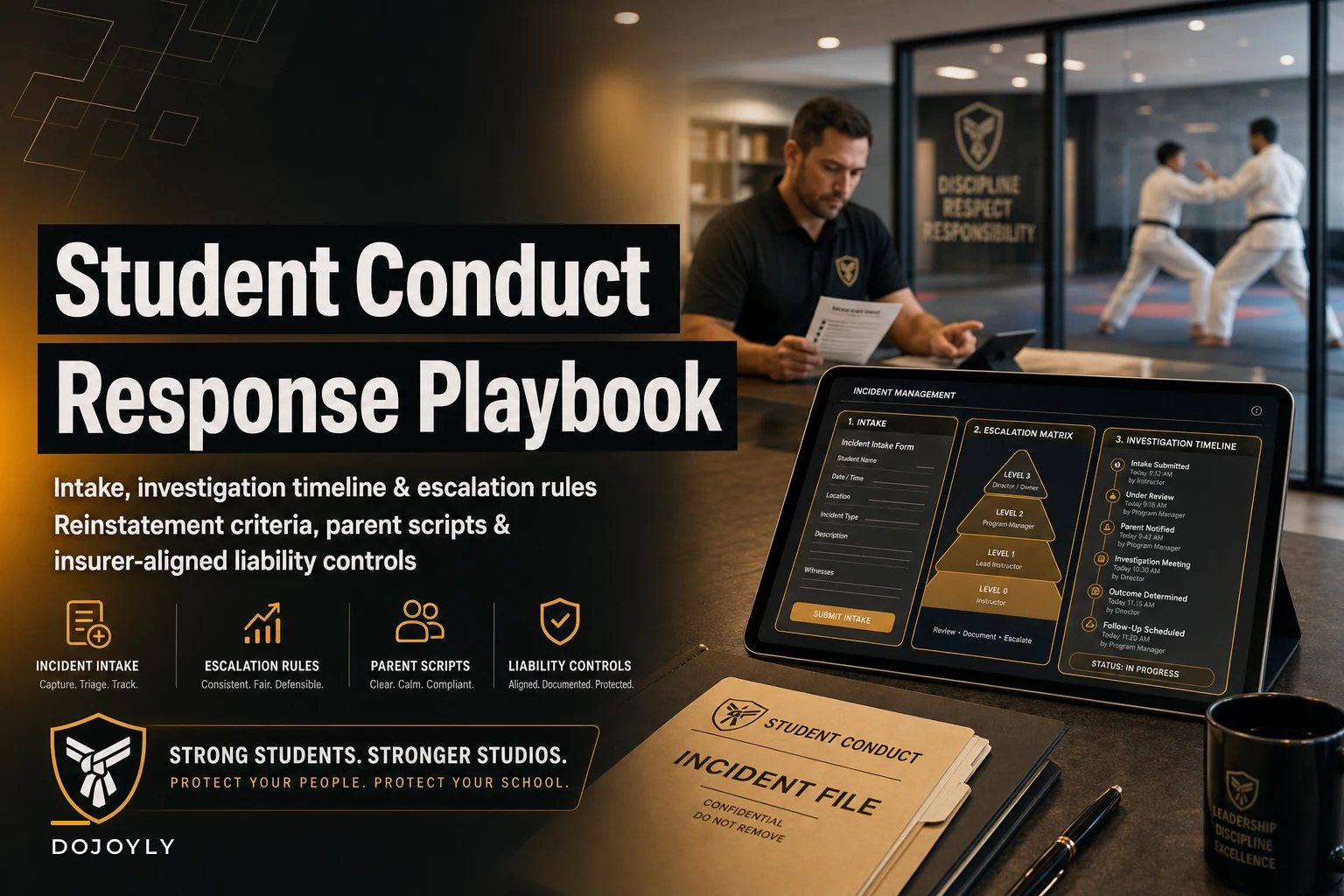

Most studios don't have a conduct problem. They have a documentation problem. The incident itself—two kids shoving each other during sparring, a parent screaming at a front-desk teen, an adult student making another student uncomfortable—is almost never what gets a studio sued or damages its reputation. What does the damage is the gap between when the thing happened and when someone wrote it down, decided who handles it, and told the parent something that didn't contradict what the instructor said an hour earlier.
That gap is where a 10-minute problem becomes a 3-week ordeal. This is a tight walkthrough of a martial arts student conduct workflow built around one goal: close that gap so incidents get recorded, routed, and communicated the same way every time—especially when your insurer or a lawyer eventually asks what happened and what you did about it.
The failure mode nobody plans for
An incident happens during a 6pm class. The instructor is mid-session, so they file it mentally as "I'll tell the owner later." They forget, or they mention it in passing while locking up. The parent hears a version from their kid in the car. By the next morning there are three competing stories: the kid's, the instructor's half-remembered one, and whatever the parent has already decided happened.
Now the owner is reconstructing an event they didn't witness, from people who are emotional, days after it occurred. No timestamp, no witness list, no note on whether anyone was hurt. If this is a shoving match between 9-year-olds, it's annoying. If it's an allegation that an adult instructor touched a minor inappropriately, the absence of a clean intake record is a genuine legal exposure—because your defense, your insurance claim, and your license all depend on being able to show a reasonable, consistent response.
The core issue: conduct incidents are rare enough that nobody builds muscle memory around them, but serious enough that improvising is dangerous. You can't rely on people "handling it well in the moment." You need a rail they slide onto automatically.
Start with intake, because everything downstream depends on it
The intake form is the foundation, and most studios either don't have one or have a generic "incident report" designed for slip-and-fall injuries. Conduct needs its own capture, and it needs to be fillable in under three minutes on a phone—because an instructor who has to find a paper form and a pen will simply not do it.
Simplify class bookings and attendance tracking.
Dojoyly helps you schedule, confirm, and manage every class effortlessly.
- Unified class & student management
- Automated member notifications
- Instructor scheduling & availability
No credit card required
-
Date, time, and exact location (which mat, which room—"the studio" is useless later)
-
Who was involved, by full name, plus their role (student, parent, staff, guest)
-
Who witnessed it, including students, and whether they're minors
-
A factual description with a hard rule
what was seen and heard, not what it "meant." "Student A pushed Student B who fell backward"—not "Student A was being aggressive and disrespectful."
-
Injury status
any physical harm, any first aid given, whether a parent was notified that day
-
Immediate action taken
separated students, ended the class early, asked the adult to leave
-
Severity flag
the person filing picks a tier (more on that below)
The most common intake mistake is mixing observation with interpretation. When an instructor writes "he's always had an attitude problem," that one sentence can become the centerpiece of a discrimination or defamation claim. Train staff to write like a security camera: timestamps and physical actions. The judgment calls happen later, by someone with more context, in a separate field.
Make the form auto-record who filed it and when so you capture day-zero awareness without relying on memory.
One detail that matters more than it looks: the form should auto-record who filed it and when. If your intake lives on paper, you lose this. If it lives somewhere with a timestamp, you've just created the first and most important piece of evidence—that the studio became aware and acted on day zero, not a week later.
The escalation matrix: who owns what, decided in advance
The reason incidents sit untouched is that nobody knows whose job it is. The instructor assumes the owner will handle it. The owner assumes it was minor because nobody flagged it urgently. An escalation matrix kills that ambiguity by tying severity tier to a specific owner and a specific response clock.
Here's a workable structure:
| Tier | Example | Owner | Response window | Notify insurer? |
|---|---|---|---|---|
| 1 – Minor | Kids roughhousing, minor verbal spat, single disruption | Lead instructor | Same session, verbal parent note | No |
| 2 – Moderate | Repeated disruption, minor injury, parent complaint about staff | Program director / owner | Within 24 hrs, documented | Log internally |
| 3 – Serious | Injury needing medical care, threat, harassment, bullying pattern | Owner | Same day | Likely yes |
| 4 – Critical | Any allegation involving a minor's safety, assault, abuse | Owner + legal/insurer | Immediate, before any parent conversation | Yes, first call |
The non-obvious piece is in Tier 4: the parent conversation is not the first call. Instinct says call the parent immediately to show you care. But for an abuse or serious-safety allegation, what you say in that first conversation can create admissions or promises you can't take back. For critical incidents, your insurer or attorney often has specific protocols, and in some jurisdictions you have mandatory reporting obligations that come before family notification. Knowing which tier triggers a "lawyer first, parent second" sequence is exactly the kind of thing you want decided on a calm Tuesday, not invented during a crisis.
The other thing a matrix fixes is the "everything feels like a Tier 1" bias. People under-rate severity to avoid the hassle of escalation. Define the tiers concretely enough that a part-time instructor can place an incident correctly without calling anyone. If they're genuinely unsure between two tiers, pick the higher one.
The investigation timeline
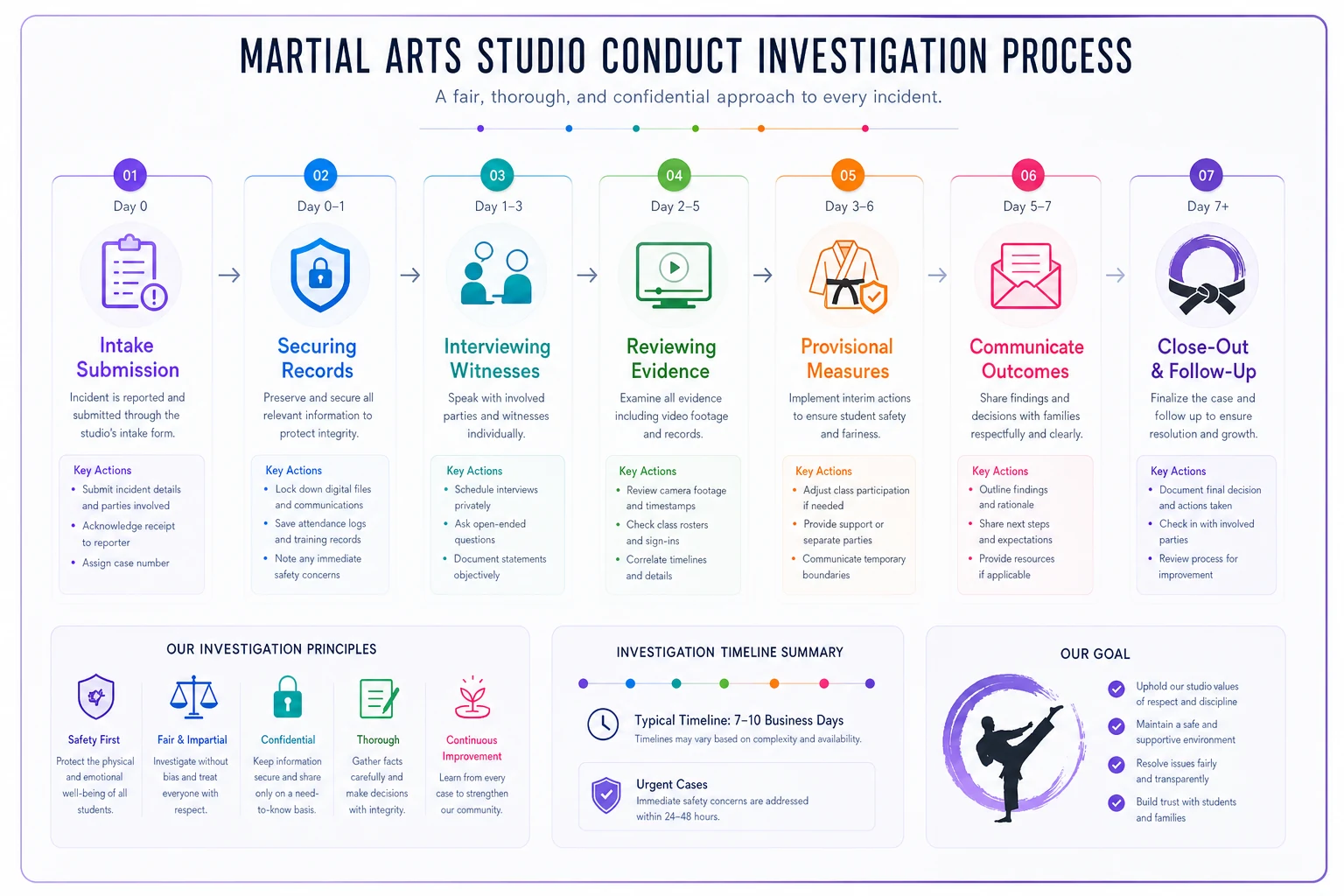
Once something lands at Tier 2 or above, it needs a timeline, not a vibe. An investigation that drags for two weeks because the owner is busy looks like negligence in hindsight. One wrapped up in an afternoon because the owner "just knew" looks like a cover-up. The point of a timeline is to show a reasonable, deliberate process.
-
Within hours
secure the intake record, confirm no ongoing safety risk, separate parties if needed.
-
Day 1
interview the filing instructor and any adult witnesses separately. Take notes with times. Do not interview minors without following your own child-safety policy—often that means a parent present or not at all.
-
Day 1–2
review any physical evidence—camera footage, sign-in logs, class rosters confirming who was present.
-
Day 2–3
make a provisional decision on interim measures (suspension, schedule change, supervision adjustment).
-
Day 3–5
communicate the outcome to affected families using your scripts, and log the resolution.
-
Close-out
record the final decision, the reasoning, and any follow-up review date.
Here's a simple visual of the investigation timeline to keep people aligned.
One thing worth flagging: studios with camera footage almost always resolve disputes faster and cleaner, but only if someone knows the retention window. Plenty of systems overwrite footage in 7–14 days. If your investigation stalls past that point, the one piece of neutral evidence is gone. Check your retention setting now, not when you need it.
Suspension and reinstatement rules
This is where emotion wrecks consistency. A well-liked family's kid gets a warning; a difficult family's kid gets suspended for the same behavior. That inconsistency is both a fairness problem and a legal one—it's exactly the kind of thing that shows up in a discrimination complaint.
-
Clear triggers
define what earns a warning, a probation period, a suspension, and a termination. "Physical aggression after a prior warning" is a trigger. "Being disruptive" is not—it's too vague to apply evenly.
-
Suspension terms in writing
length, conditions, and what happens to billing. Decide in advance whether a suspended member is still charged. This gets messy fast.
-
Reinstatement conditions
a meeting, a written agreement, a probationary period. Make it a real gate, not an automatic welcome-back after the clock runs out.
-
An appeal path
even a simple one. "Families may request a review in writing within 7 days." It signals fairness and gives you a structured way to handle pushback instead of a parking-lot argument.
One operational mistake that quietly causes chaos: suspending a student but forgetting to pause or document the billing side. The family keeps getting charged during a suspension, calls in furious, and now you've got a conduct dispute and a billing dispute fused into one much angrier conversation. Tie the suspension action to a billing action in the same step.
Parent communication scripts that don't make things worse
Scripts aren't about sounding robotic. They're about not saying the three or four things that convert a resolvable situation into a formal complaint. Under stress, people over-apologize in ways that sound like admissions of fault, or they get defensive and dismissive. Both are bad. A script gives the person a safe lane.
-
Acknowledge without assigning blame
"Thank you for telling me—I take this seriously and I want to make sure I understand exactly what happened."
-
State the process, not a conclusion
"Here's what we do when something like this comes up," then describe your steps.
-
Set a clear next contact
"I'll have an update for you by Thursday." Vague timelines are what make parents escalate—silence reads as stonewalling.
-
Document the conversation immediately after
what you said, what they said, what you committed to.
What to avoid, and why it matters: never speculate about another family's child by name, never promise a specific disciplinary outcome against another student, and never guarantee something you can't control. Each of those can become a liability or a defamation exposure. The script's job is to keep the person inside safe boundaries when their instinct is to say whatever calms the parent down.
For critical incidents, the script is shorter and firmer: acknowledge receipt, state that the studio is taking it seriously and following its safety procedures, and commit to a follow-up—without discussing details until you've spoken to your insurer or counsel. That restraint feels unnatural, but it's the version that protects everyone, including the family.
A real scenario
A two-location studio with roughly 300 students had a recurring friction point in its teen program—shoving and trash talk during sparring that occasionally spilled into locker-room conflicts. Incidents were handled verbally and inconsistently. One parent eventually filed a formal complaint claiming the studio ignored repeated bullying, and the owner had almost nothing in writing to show otherwise. It took weeks of back-and-forth, an uncomfortable call with their insurer, and the loss of two families to resolve.
After that, they built a one-page conduct intake, a four-tier matrix, and three parent scripts. The change wasn't dramatic—they were still logging maybe 8–12 incidents a month across both sites, most of them Tier 1. What changed was resolution speed and consistency. Disputes that used to drag on for a week or two were closing in a couple of days because the timeline and the record existed. Over the following year, conduct-related cancellations dropped noticeably, and when an insurer renewal came around, having a documented process actually came up as a favorable point. No magic. Just a rail that every incident now slid onto the same way.
When a formal workflow is overkill—and when it isn't
If you're a solo instructor with 40 students who all know each other, you don't need a four-tier matrix printed on the wall. But you still need the intake form, because the serious-but-rare incident doesn't care how small you are—a single abuse allegation at a tiny studio carries the same exposure as at a large one. The intake form is non-negotiable at any size.
The full matrix and investigation timeline start earning their keep once you have multiple instructors, part-time staff, or more than one location—basically the moment conduct decisions stop running through a single person's head. That's also when inconsistency creeps in, because different instructors apply different standards. If you've already dealt with instruction consistency across staff, you know the problem: without a shared standard, every person improvises, and improvisation is exactly what you can't afford here.
Who should not try to run this on sticky notes and memory: any studio with teens, any studio with adult and minor students sharing space, and any studio whose insurance explicitly requires incident documentation. Check your policy—many do, and non-compliance can void coverage.
Where the tooling fits
None of this requires special software to start. A shared form and a clear matrix beat nothing by a wide margin. But the weak point in a manual version is always the same: the intake that never gets filled because the form isn't handy, and the escalation that stalls because the owner didn't get notified.
That's the narrow place where operational software helps—not by making decisions, but by making capture frictionless (file from a phone in the moment), timestamping who logged what, routing a Tier 3 flag to the owner automatically, and tying a suspension to its billing change so nothing slips. If you ever move systems, incident history is one of those records you absolutely don't want to lose or scramble, which is worth keeping in mind during any data migration between platforms. The tool isn't the workflow. The workflow is the workflow. The tool just keeps people from skipping steps when they're busy, stressed, or hoping it'll blow over.
Don't try to build the whole system at once. Build the intake form first—one page, phone-fillable, observation-only language. Then write your four tiers with concrete examples your newest part-timer could apply. Everything else—timelines, suspension rules, scripts—can follow once capture and routing are solid, because a logged incident routed to the right person is already most of the protection you need. The studios that get burned aren't the ones with imperfect policies. They're the ones who had nothing written down when someone finally asked them to show their work.
Ready to elevate your dojo operations?
Join 500+ martial arts studios using Dojoyly to save time, reduce scheduling conflicts, and improve member engagement.