



Most studio owners don't discover they have a data problem. They discover they made a bad decision, and then trace it back to the data. The class you cut because "attendance was low." The instructor you almost let go because their retention "looked bad." The month you thought you grew when you actually shrank because a batch of failed charges hadn't reconciled yet.
By the time a number is wrong on a screen, the damage is already downstream. And the reason it happened is almost never the software. It's that nobody owns the number. Three systems each report attendance a little differently, two people enter data with slightly different habits, and there's no agreed-upon place where the real version of a metric lives.
That's what martial arts studio data governance actually is. Not a compliance binder. It's the set of rules that decides which number is true, who's responsible for keeping it true, and what happens when it stops being true. This post lays out the whole system — field maps, metric ownership, reconciliation, quality checks, and alert cadence — as one connected machine instead of a pile of best practices.
Why studio numbers drift in the first place
The core issue is that a studio doesn't have one data source. It has a scheduling and attendance system, a billing processor, sometimes a separate CRM or lead tracker, a POS for pro shop sales, and a pile of spreadsheets the front desk keeps "just to be safe."
Each of those tools has its own opinion about basic things. What counts as an "active member"? Your billing system says anyone with an active subscription. Your attendance system says anyone who checked in this month. Your CRM says anyone not marked "cancelled." Three tools, three different active-member counts — and none of them are technically wrong. They're just answering different questions with the same word.
That's the core of it: most bad studio data isn't inaccurate, it's ambiguous. The number is correct for the definition that tool uses. The problem is nobody agreed on which definition wins.
It gets worse when humans are entering data. One front desk person logs a trial as a "lead," another logs it as a "member" the moment they walk in the door. One instructor marks a no-show as absent, another leaves it blank. Multiply that by a few years and you have a dataset that reflects staff habits more than reality.
What breaks as you scale
At a single location with around 120 members, the owner is usually the human reconciliation engine. They just know that attendance looks high because a belt test inflated last week, or that revenue is down because two big families are on vacation hold. That knowledge lives in one head.
Add a second location, or hand the front desk to a manager, and that mental correction disappears. Now you have two locations reporting numbers that were never defined the same way, rolled up into a summary that looks authoritative and is quietly wrong. The report looks more professional the bigger you get — which is exactly why the errors get more dangerous. People stop questioning a clean-looking dashboard.
The four layers of a working governance system
Think of studio data governance as four layers stacked on each other. Skip a layer and the ones above it collapse.
Simplify class bookings and attendance tracking.
Dojoyly helps you schedule, confirm, and manage every class effortlessly.
- Unified class & student management
- Automated member notifications
- Instructor scheduling & availability
No credit card required
| Layer | What it defines | What breaks without it |
|---|---|---|
| Canonical field map | The single agreed definition and source for each field | Same word means different things in different reports |
| Metric ownership (RACI) | Who is responsible for each number being right | Everyone assumes someone else is checking |
| ETL & reconciliation rules | How data moves between systems and how mismatches get caught | Silent gaps between billing, attendance, CRM |
| Quality checks & alerts | Automated detection when a number goes wrong | You find out about the error after a bad decision |
The order matters here. You can't assign ownership of a metric you haven't defined, and you can't reconcile fields that don't have a canonical source. Build it bottom-up.
Layer 1: Canonical field maps
A canonical field map is a plain document that says, for every metric that matters, exactly one definition and exactly one system of record. Not "the definition we mostly use" — the one that wins when systems disagree.
If you've ever gone through a platform switch, you've already touched this. The same discipline covered in the software migration playbook with canonical field maps applies here even when you're not migrating. Migration just forces you to do it. Governance means doing it on purpose and keeping it current.
Here's what a real field map entry looks like:
-
Metric Active member
-
Canonical definition A person with an active recurring billing agreement OR a valid unexpired class pack with at least one class remaining, not currently on hold.
-
System of record Billing platform
-
Explicitly excludes Trials, leads, frozen/hold accounts, expired packs
-
Refresh cadence Daily
Assign one accountable person per metric to avoid ambiguity.
Notice the "explicitly excludes" line. That's the part everyone skips, and it's where most of the ambiguity hides. Defining what a metric is not does more work than defining what it is.
A few metrics that always need this treatment in a studio:
-
Attendance — is a checked-in-but-left student counted? Is a make-up class double counted?
-
Revenue — booked vs. collected. These are wildly different, and confusing them is how studios "feel rich" while cash runs thin.
-
Trial — starts when they book, or when they show up? Ends after one class or after 14 days?
-
Cancellation — the day they request it, or the day billing actually stops?
-
Retention — measured against beginning-of-month members, or trailing 12-month cohort?
Write these down once. Argue about them once. Then they stop being reargued in every staff meeting.
Layer 2: Metric ownership with a real RACI
A field map tells you what's true. Ownership tells you who keeps it true. Without this, every number is technically everyone's job, which means it's nobody's.
RACI is four roles per metric: Responsible (does the work of keeping it clean), Accountable (the one name on the hook if it's wrong), Consulted (weighs in on definition changes), Informed (needs to know but doesn't act).
Keep it boring and specific. Here's a workable ownership table for a mid-size studio:
| Metric | Responsible | Accountable | Consulted | Informed |
|---|---|---|---|---|
| Attendance accuracy | Instructors | Head instructor | Front desk | Owner |
| Lead & trial status | Front desk | Front desk manager | Sales/owner | Head instructor |
| Billing & collections | Bookkeeper | Owner | Front desk | — |
| Membership status changes | Front desk | Front desk manager | Bookkeeper | Owner |
| Monthly rollup reports | Ops manager | Owner | All leads | Staff |
The single most important cell in that whole table is the Accountable column, and the rule is: one name per row. The moment two people are accountable for the same number, neither is. If attendance is wrong, there is exactly one person whose job it was to make sure it wasn't.
Worth calling out: owners love making themselves Accountable for everything. Don't. If you're the fallback for every metric, you'll check none of them well, and the whole system quietly reverts to "the owner eyeballs it." Distribute accountability to the person closest to the data entry.
Layer 3: ETL and reconciliation rules
ETL sounds like an IT term, but for a studio it just means how data gets pulled out of one system, cleaned up, and matched against another. Reconciliation is where you catch the mismatches.
The most valuable reconciliations cross system boundaries, because that's where money and members leak.
The three reconciliations every studio should run:
-
Billing vs. membership status. Every active billing agreement should map to an active member, and every active member should map to an active agreement. Orphans on either side are the problem: someone paying who's marked cancelled (you'll be refunding an angry email eventually), or someone marked active who isn't being billed (free training you didn't authorize).
-
Attendance vs. active roster. People checking in who aren't on any active plan. Usually harmless — a returning alum, a comped guest — but sometimes it's an expired pass nobody caught, or a family member "just joining in" for months.
-
Booked revenue vs. collected revenue. The gap between these two is your real exposure to failed charges and holds. If it's widening month over month, you have a collections problem masquerading as a growth problem.
Here's a reconciliation template worth copying into a sheet:
-
Reconciliation name Billing–Membership match
-
Source A Billing platform (active agreements)
-
Source B Membership system (active members)
-
Match key Member ID or email
-
Exception type 1 Active agreement, no active member → flag to front desk
-
Exception type 2 Active member, no active agreement → flag to bookkeeper
-
Cadence Weekly
-
Acceptable exception count 0 (any mismatch is investigated)
The mindset shift here is that reconciliation isn't about the matches. Nobody looks at the 400 rows that lined up fine. Reconciliation exists to surface the exceptions — the three rows that don't. Design every reconciliation around the question "show me only what's broken."
A workflow, start to finish
Picture how a single membership cancellation should flow through a governed system:
A member requests cancellation at the front desk. Front desk logs the status change in the membership system. That change triggers the billing owner to stop the recurring charge. The weekly billing–membership reconciliation confirms both systems now agree: no active agreement, no active member. The monthly retention report picks up the change against the correct beginning-of-month baseline. At no point did anyone have to remember to "also update the other system," because the reconciliation catches it if they forget.
Now compare that to the ungoverned version: front desk marks them cancelled, forgets to tell the bookkeeper, billing keeps charging for two more months, member disputes the charge, you refund it, and the whole thing shows up nowhere until the chargeback email lands. Same event, completely different outcome — the only difference is whether the reconciliation existed.
Here's a simple visual of the cancellation-to-reconciliation workflow.
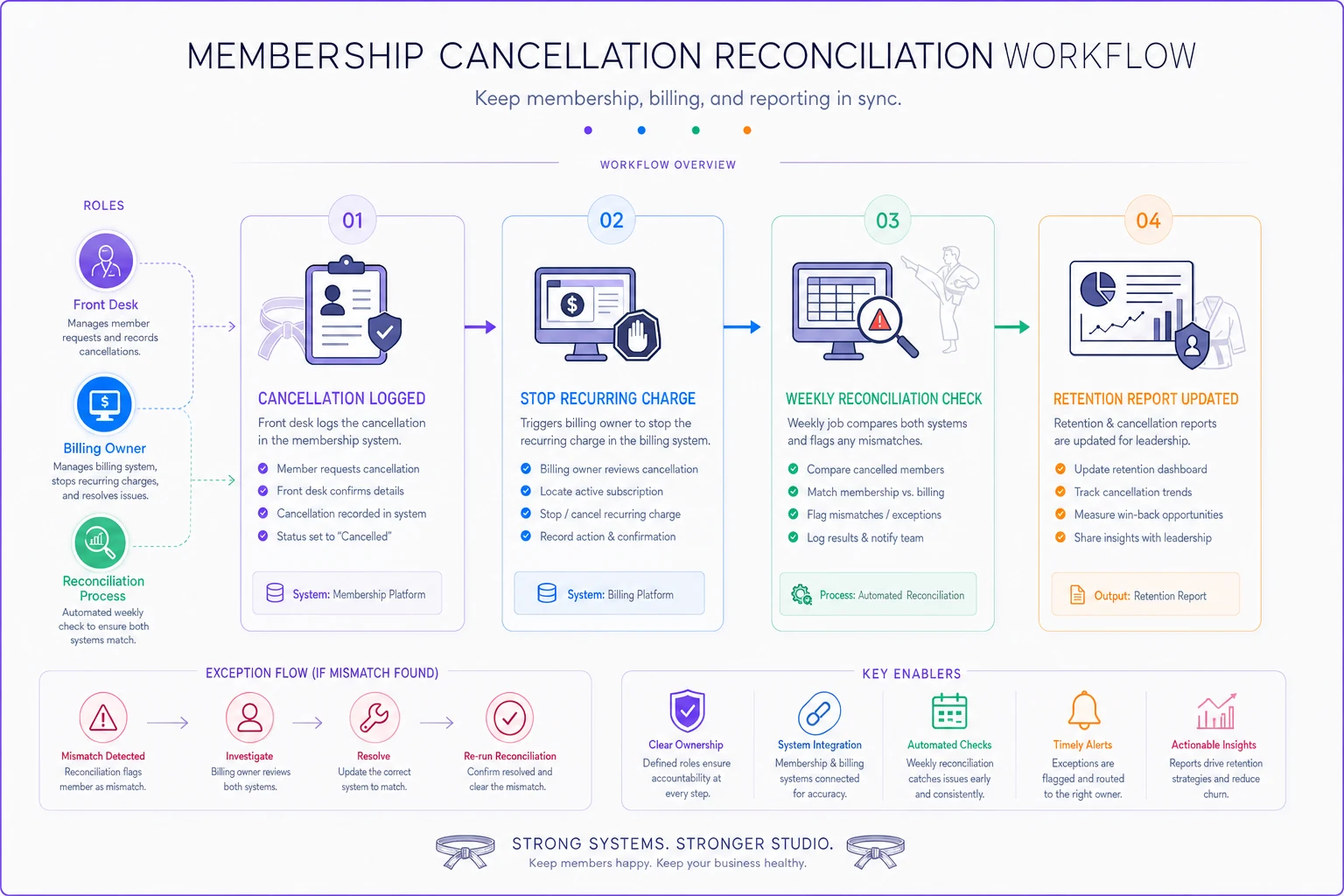
The visual shows who touches the event and where the automated check confirms alignment.
Layer 4: Data-quality checks and alert cadence
The first three layers are structure. This layer is the nervous system — it's what tells you fast when something's off, before the number ends up in a decision.
Quality checks fall into a few natural buckets:
-
Completeness — a class marked as taught with zero attendance logged. Almost always a missing entry, not an empty room.
-
Freshness — billing data hasn't synced in 36 hours. The dashboard looks fine, but it's showing yesterday's world.
-
Range/sanity — attendance suddenly three times normal (a belt test got logged as a regular class), or revenue posting negative.
-
Consistency — active member count differs by more than a small threshold across two systems.
The mistake most studios make once they start setting up alerts is alerting on everything. Within two weeks the alerts get muted, and muted alerts are worse than no alerts — now you have a false sense of coverage.
Match the alert speed to the decision speed.
| Check | Severity | Who gets it | How fast |
|---|---|---|---|
| Billing sync failed | High | Bookkeeper + owner | Same day |
| Active-member mismatch > 5 | Medium | Front desk manager | Weekly digest |
| Class taught, no attendance | Low | Head instructor | Weekly digest |
| Revenue posting negative | High | Owner | Immediate |
| Trial-status field blank > 24h | Low | Front desk | Weekly digest |
High-severity, money-touching problems interrupt someone's day. Everything else rolls into a weekly digest that gets reviewed in one sitting. If you interrupt people for low-severity noise, you train them to ignore interruptions — and then the one that mattered gets ignored too.
This is where a modern operational platform earns its place. Running these checks by hand across billing, attendance, and CRM every week is the kind of repetitive cross-system chore that gets skipped the moment things get busy. Software that watches the reconciliations continuously and only pings the right owner when an exception crosses a threshold turns governance from "a thing we're supposed to do" into "a thing that just happens in the background." The point isn't automation for its own sake — it's that a check you have to remember to run is a check that eventually stops running.
A short runbook for automated alerts
When an alert fires, people freeze if there's no agreed response. Each alert needs a tiny runbook attached. Keep it to three lines:
-
What it means — plain language. "Billing didn't sync — today's revenue and payment numbers are stale."
-
First action — the one thing to do before anything else. "Do not make any billing or retention decisions today. Check sync status."
-
Escalate if — the condition that bumps it up. "Still failing after 4 hours → call the owner and the platform support line."
Runbooks matter more than the alerts themselves. An alert without a defined response just creates anxiety. A runbook turns "something's wrong" into "here's exactly what I do next" — which is the difference between a manager who handles it and one who forwards it to you and waits.
A real scenario
A two-location studio with around 260 members combined kept reporting healthy month-over-month growth through the winter. Membership count was climbing. The owner was planning to add a third afternoon class and hire a part-time instructor off the back of it.
The problem surfaced during a cash crunch. Booked revenue and member counts looked strong, but the bank balance didn't agree. When they finally ran a billing-versus-membership reconciliation, they found roughly 30 to 35 "active" members whose recurring charges had been failing for one to three months. Nobody was accountable for the gap between the two systems, so failed charges kept accruing while the member count stayed rosy. Collected revenue was running somewhere around $4k–$6k a month behind what the dashboard implied.
They didn't buy new software or restructure anything dramatic. They wrote a one-page field map defining "active member" as a paying member, assigned the billing–membership reconciliation to the bookkeeper with a weekly cadence, and set a single high-severity alert on failed-charge accumulation. Within about two months the phantom-active list was cleared, the failing accounts were either recovered or properly cancelled, and the growth number they were about to hire against turned out to be roughly flat. They held off on the hire. The governance didn't grow the business — it stopped them from making an expensive decision on a number that was quietly lying.
When this level of governance actually makes sense
You don't need all four layers on day one. A 60-member studio run by an owner-instructor can get by with a solid field map and one weekly reconciliation. The full RACI and alert cadence starts paying off when:
-
You have more than one person entering data
-
You have more than one location
-
You're about to make a hiring, class-cutting, or expansion decision based on trends
-
You've been burned by a number that turned out to be wrong
When it's overkill: a solo studio where the owner touches every transaction and knows every member by name. Building a formal RACI for a one-person operation is process for its own sake. Do the field map, skip the rest until you delegate.
Who should not do this: anyone using it to avoid the harder problem. Governance makes your numbers trustworthy — it doesn't fix a studio that's genuinely losing members. If the reconciliations are clean and the trends are still bad, that's real, and it's a different fight.
Tying it back to the dashboard
Governance and dashboards are two halves of the same job. A dashboard is only as trustworthy as the definitions and reconciliations feeding it — a beautiful chart on top of ambiguous data is just a confident-looking mistake. If you've already built out reporting using something like the martial-arts KPI dashboard with formulas and cadence, this layer is what makes those numbers safe to act on. The dashboard shows you the number. Governance is the reason you can believe it.
The whole point of martial arts studio data governance isn't to produce prettier reports. It's to make sure that when you're about to cut a class, let an instructor go, or open a second location, the number you're staring at is the real one — and that if it ever stops being real, you find out from an alert instead of from a bank statement.
Start with the field map. Argue about the definitions once, write them down, and assign one accountable name to each metric that matters. Everything else — reconciliation, checks, alerts — is just protecting the definitions you already agreed on.
Start with the field map. Argue about the definitions once, write them down, and assign one accountable name to each metric that matters. Everything else — reconciliation, checks, alerts — is just protecting the definitions you already agreed on.
Ready to elevate your dojo operations?
Join 500+ martial arts studios using Dojoyly to save time, reduce scheduling conflicts, and improve member engagement.