


Most studios don't fail at any single function. Marketing works. Classes are good. Billing mostly runs. What breaks is the space between those functions — the moment a lead becomes a trial, the moment a trial becomes a member, the moment a new member needs to actually learn something and someone forgot to tell the curriculum lead they exist.
That gap is where growth dies quietly. And when you try to expand — add a second location, double your class count, hire your first non-owner instructor — those gaps stop being annoying and start being expensive. A studio doing 60 students can survive on the owner's memory holding everything together. A studio pushing 200, or running two rooms, cannot.
A martial arts studio growth operating system is really just the deliberate design of how work passes from one part of your business to the next. Not software. Not a mission statement. The actual mechanics of who hands what to whom, when, and how you know it worked. Get that right and expansion feels boring in the best way. Get it wrong and every new student adds friction instead of revenue.
The real problem is handoffs, not departments
Walk through what happens to a single new student and you'll see it fast. Someone runs a Facebook ad. A parent books a trial. The trial happens. The kid loves it. Two weeks later the family cancels — not because of the instruction, but because nobody followed up, the billing was confusing, or the front desk never explained what belt progression actually looks like.
Every one of those failures happened at a handoff. Marketing did its job. Sales did its job. But the baton got dropped in the exchange.
This usually happens because each function optimizes for its own metric. Marketing celebrates lead volume. Sales celebrates trial bookings. Onboarding celebrates first-class attendance. Nobody owns the seam. And seams are exactly where students, staff, and dollars leak out.
-
Marketing → Sales (lead becomes a booked trial)
-
Sales → Onboarding (trial becomes an enrolled, paying member)
-
Onboarding → Curriculum (new member gets placed correctly and starts progressing)
-
Curriculum → Ops (student progression, testing, scheduling, and billing stay in sync)
-
Ops → Retention/Referral (a happy long-term member feeds the top of the funnel again)
That last one loops back. A functioning system isn't a line — it's a circle. When it works, your best students become your cheapest marketing channel.
Why this breaks at scale (and not before)
Handoff problems are invisible until volume exposes them.
Simplify class bookings and attendance tracking.
Dojoyly helps you schedule, confirm, and manage every class effortlessly.
- Unified class & student management
- Automated member notifications
- Instructor scheduling & availability
No credit card required
At low volume, you are the operating system. You saw the lead come in, you did the trial, you set up billing, you know which kid is ready for a stripe. Your brain is holding maybe 40 data points and it's fine.
Now imagine three things happen at once — you hire a second instructor, you add four classes a week, and lead flow doubles. Suddenly the data points you were holding in your head need to transfer. And they don't, because you never built the transfer mechanism. You just remembered.
A typical example looks like this: a studio grows from about 70 to 130 students over eight months. Trial-to-member conversion, which was sitting comfortably around 60%, quietly drops to the low 40s. Nobody changed the sales pitch. What changed is that the owner used to personally onboard everyone, and now a part-time front desk person does it with no defined process. Same effort, worse results — because the handoff from trial to enrollment lost its owner.
Scheduling is another place this cracks wide open. When you're small, the calendar lives in one head. As you add classes and instructors, the calendar becomes a coordination problem across people. If you've felt this specifically, the mechanics are worth reading on their own in this playbook on scalable class scheduling — because a schedule that can't scale will cap your growth no matter how good your marketing is.
Assign an owner and a KPI to every handoff
The fix isn't complicated, but it is uncomfortable, because it forces specificity. Each seam needs three things: a triggering event, an owner, and a KPI that measures the handoff itself — not the department on either side.
That distinction matters. "Number of leads" measures marketing. "Percent of leads that became booked trials within 48 hours" measures the handoff. The second number is the one that actually predicts growth.
Here's how it maps out:
| Handoff | Triggering event | Owner | Handoff KPI | Healthy range |
|---|---|---|---|---|
| Marketing → Sales | Lead form / inquiry submitted | Front desk / sales lead | % leads booked to trial within 48 hrs | 65–80% |
| Sales → Onboarding | Trial class attended | Sales lead | Trial → paid conversion | 50–65% |
| Onboarding → Curriculum | Membership activated | Onboarding lead | % new members placed & in first cycle within 7 days | 90%+ |
| Curriculum → Ops | Student ready for testing | Head instructor | % eligible students tested on schedule | 85%+ |
| Ops → Referral | Member hits 90 days | Ops / owner | % active members generating a referral or review / quarter | 15–25% |
The ranges will vary by market, but the structure is the point. Every seam has a number. When a number dips, you know exactly which handoff to investigate instead of vaguely feeling like "growth is slow."
One mistake people make here: they assign a KPI but not an owner, or they assign five people to "own" the same handoff. Shared ownership is no ownership. Each seam gets one name. That person doesn't do all the work — they're accountable for the number.
The lifecycle view of how these pieces connect — curriculum, billing, and follow-up all reinforcing retention — is worth going deeper on in this framework for turning trials into lifelong members.
Cadence is what keeps the system alive
Defining handoffs is a one-time act. Keeping them functioning is a rhythm. Without a review cadence, your beautiful KPI table becomes a document nobody opens.
Two loops keep it breathing:
Weekly (operational, ~20 minutes):
-
Review each handoff KPI for the past 7 days
-
Flag any seam that dropped below its floor
-
Assign one corrective action per flagged seam
-
Check for stuck records — leads with no follow-up, trials with no decision, new members not yet placed
Monthly (strategic, ~60 minutes):
-
Look at trends across all five seams, not single-week noise
-
Compare against capacity — are you nearing thresholds to add classes or staff?
-
Review whether any handoff owner is overloaded
-
Decide on process changes, not just corrections
Treat the weekly 20-minute review like a standing appointment—no cancellations.
The weekly loop catches leaks. The monthly loop catches drift. You need both. A studio that only does monthly reviews will lose a full month of students to a broken handoff before anyone notices.
Studios consistently treat the weekly review as optional the moment things get busy — and busy is exactly when handoffs break. The discipline is protecting that 20 minutes no matter what the week looks like. It sounds simple, and it is, but it's also the thing most owners drop first.
Where software actually earns its place
You can run all of this on spreadsheets and a whiteboard at small scale. Past a certain volume, the manual tracking becomes its own full-time job, and the tracking errors start causing the very leaks you're trying to prevent.
The practical value of an AI-assisted operational platform here isn't magic — it's that the triggers fire automatically. A lead comes in, the clock starts, and if 48 hours pass without a booked trial, the system flags it before it goes cold. A membership activates and a placement task gets created for the curriculum lead without anyone remembering to make it. The weekly KPI review assembles itself instead of someone spending Sunday night building it.
That's the honest value: automation removes the "someone forgot" failure mode from your handoffs, and centralizes the information so the person who owns a seam can actually see what they need to see. It doesn't replace the owner. It makes sure the baton never sits on the ground.
When building this makes sense — and when it doesn't
This makes sense when:
-
You're at or approaching 100+ students
-
You're about to hire beyond yourself
-
You're planning a second location in the next 6–12 months
-
You've noticed conversion or retention slipping without an obvious cause
This is premature when:
-
You have under ~40 students and one location
-
You personally still touch every handoff and it's genuinely working
-
You'd be building process to avoid a decision you actually need to make (like whether to let go of an underperforming instructor)
Who should not do this yet: anyone whose core product is broken. If your instruction is inconsistent or your classes are half-empty because they're not good, no operating system will save you. Fix the thing first. The system amplifies what exists — it doesn't manufacture quality.
Real scenario: a two-room studio preparing to add a second site
A traditional martial arts studio — around 145 active members, one location, planning a second — kept stalling on expansion. Every time the owner tried to plan the new site, they realized the current location only worked because they were physically present.
The specific problem: trial-to-member conversion had slid from roughly 58% to about 44% over a year, and nobody could pinpoint why. Turned out the trial follow-up had drifted to whoever happened to be at the desk, with no defined step for closing the enrollment.
They spent six weeks doing exactly what's described above — mapping the five seams, assigning one owner each, defining a KPI per handoff, and running the weekly 20-minute review. No new marketing spend.
Within about four months, conversion recovered to the mid-50s. More importantly for expansion, the owner could point at a dashboard instead of relying on memory. When they finally opened the second location, they weren't inventing operations from scratch — they were copying a documented system. The multi-site coordination challenges that come next are their own beast, covered in this multi-site operations playbook, but they walked into it with a foundation instead of chaos.
A 6‑month rollout checklist for your first expansion
Don't try to build everything at once. Sequence it. This is the order that actually holds up.
Here's a simple workflow to visualize the rollout.
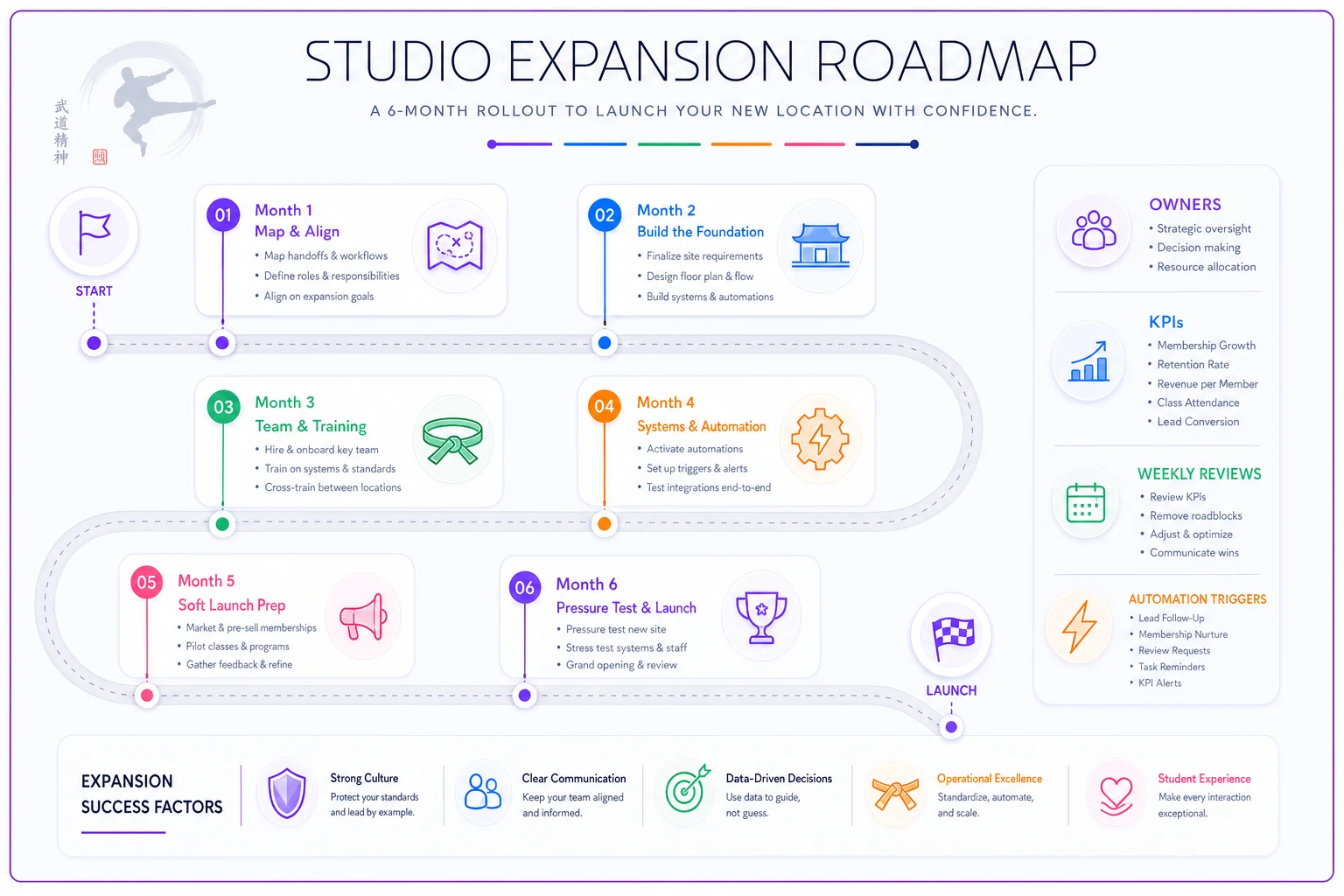
Month 1 — Map and assign
-
Diagram all five handoff seams end to end
-
Assign exactly one owner per seam
-
Write the triggering event for each handoff in plain language
-
Document how each handoff currently works (even if it's "the owner remembers")
Month 2 — Define measurement
-
Set one KPI per handoff
-
Establish a baseline number for each — even a rough one
-
Define the floor (the number that triggers action)
-
Decide where each number will live and who updates it
Month 3 — Install the cadence
-
Launch the weekly 20-minute handoff review
-
Launch the monthly strategic review
-
Run both for a full month without skipping
-
Identify your two weakest seams from real data
Month 4 — Fix and automate the weak seams
-
Rebuild the two weakest handoffs with a clearer process
-
Automate the triggers you keep forgetting manually
-
Centralize the information owners need to do their job
-
Re-baseline those two KPIs
Month 5 — Document for duplication
-
Turn each working handoff into a written SOP
-
Test each SOP by having someone else run it
-
Confirm every seam still functions when you're not in the building
-
Fix anything that only worked because you were present
Month 6 — Pressure-test for the new site
-
Run a full week with the owner deliberately hands-off
-
Review which handoffs broke without you
-
Finalize the operating manual you'll hand to new-site staff
-
Confirm capacity data supports the expansion timing
By the end of month six, you're not guessing at readiness — you have documented evidence of what holds up and what still needs work before you sign a second lease.
The system is the thing you're actually building
It's tempting to think of expansion as a marketing problem or a real estate problem. It's neither. Expansion is a coordination problem. You are taking a business that runs on your presence and converting it into one that runs on defined transfers of work.
The studios that expand successfully aren't the ones with the best ads or the flashiest facility. They're the ones where a student can move from a Facebook click to a black belt test without anyone dropping the baton — and where the owner can look at five numbers and know exactly where the friction is. Build those seams deliberately now, while you're small enough to see all of them, and the second location becomes a copy job instead of a gamble.
The studios that expand successfully aren't the ones with the best ads or the flashiest facility. They're the ones where a student can move from a Facebook click to a black belt test without anyone dropping the baton — and where the owner can look at five numbers and know exactly where the friction is. Build those seams deliberately now, while you're small enough to see all of them, and the second location becomes a copy job instead of a gamble.
Ready to elevate your dojo operations?
Join 500+ martial arts studios using Dojoyly to save time, reduce scheduling conflicts, and improve member engagement.