


Most studios treat their curriculum, billing, and retention numbers as three completely separate things. The head instructor owns the belt system. The front desk owns payments. And retention? Retention is the thing everyone worries about but nobody actually owns.
That separation causes a surprising number of problems — students who plateau and quietly disappear, belt tests that show up as billing surprises, memberships that lapse right at the moment a student was about to level up. When you map these three things onto the same timeline, something becomes obvious: a student's progression and their payment behavior are almost the same curve. They rise together. They fall together.
Good curriculum architecture for martial arts isn't just a syllabus of techniques. It's a structural map that ties skill milestones to the operational events around them — the invoices, the upgrade offers, the check-in conversations, the moments where a student is most likely to either recommit or drift. This article is about building that map so the three systems reinforce each other instead of quietly working against one another.
The real problem: progression is invisible until it breaks
A pattern that shows up over and over: a studio has a belt system on paper — white to black, ten or twelve ranks, roughly X months between each. Ask the owner how many students are currently "on track" versus "stalled," and you usually get a shrug. Nobody knows in real time. They find out at test time, when half the eligible students don't sign up.
Progression stays invisible because it lives in the instructor's head and in a stack of attendance cards. A student can go three months without meaningful advancement and nobody notices until they've already emotionally checked out. And a checked-out student is a billing risk — they're the ones who "pause" their membership over the holidays and never come back.
The insight most owners miss: skill stagnation predicts churn better than almost any billing signal. By the time a payment fails or someone asks to cancel, the retention battle is already lost. The warning sign showed up weeks earlier as a student who stopped progressing and started skipping class. If your curriculum architecture doesn't surface that stall automatically, you're always reacting too late.
Why studios keep these three systems separate
It's not laziness. The separation happens naturally because different people own different parts, and each part has its own tools.
Simplify class bookings and attendance tracking.
Dojoyly helps you schedule, confirm, and manage every class effortlessly.
- Unified class & student management
- Automated member notifications
- Instructor scheduling & availability
No credit card required
-
The curriculum lives with instructors who care about quality, not spreadsheets.
-
Billing lives with whoever handles money — often the owner or a front-desk lead — and their whole job is keeping charges clean and disputes low.
-
Retention is a lagging number on a dashboard that someone glances at monthly.
These groups rarely sit down and connect the events. So a belt promotion — which is genuinely one of the highest-emotion, highest-loyalty moments in a student's journey — passes by without anyone using it to strengthen the membership. No upgrade offer. No re-commitment conversation. No "you just earned your blue belt, here's what the next six months look like." The moment gets celebrated and then evaporates.
At small scale you can get away with this because the owner knows every student by name. What breaks is growth.
What breaks as you grow
At 60 students, the head instructor personally knows who's ready to test and who's slipping. At 200 students across multiple class times and a couple of instructors, that personal knowledge fragments. Different instructors hold different standards for the same belt. Nobody has the full picture of any single student because that student trains across three instructors' classes.
-
Assessment drift. Two instructors grade the same rank differently, so "green belt" means something different depending on who tested. Parents notice. Students who move between class times feel it.
-
Milestone blindness. No one flags that a student is eligible to test — so eligible students stall out simply because nobody invited them forward.
-
Billing collisions. Test fees, belt fees, and gear upgrades land on families as surprises, creating disputes and awkward front-desk conversations right at the milestone that should feel like a win.
-
Retention leakage. The natural drop-off points in a curriculum — the "hard middle" belts where progress slows — go unmanaged, and that's exactly where quiet cancellations cluster.
The through-line: as headcount grows, informal knowledge stops covering the gaps, and the gaps sit precisely at the seams between curriculum, billing, and retention. Fixing any one of them in isolation rarely moves the needle. The architecture is what's broken.
Building the map: milestones as trigger points
The core idea is straightforward. Every meaningful point in your curriculum becomes a trigger that fires a defined set of operational actions. A milestone isn't just "student earned a stripe." It's a moment that should automatically kick off assessment logic, a billing event if relevant, and a retention touchpoint.
-
Entry criteria — what proves the student is ready (attendance count, skill checklist, minimum time-in-rank).
-
Assessment event — the test itself, with a shared rubric.
-
Billing event — test fee, belt fee, or an upgrade opportunity, handled cleanly before test day.
-
Retention action — the conversation, the next-tier preview, the re-commitment.
Here's a simplified version of what that map looks like across the first several ranks:
| Milestone | Entry trigger | Assessment cadence | Billing event | Retention action |
|---|---|---|---|---|
| White → Yellow | ~24 classes attended, basics checklist complete | Monthly test window | Flat test fee, no surprise | "You're past the hardest part" call |
| Yellow → Orange | ~30 classes, sparring intro passed | Monthly test window | Test fee + optional gear | Preview intermediate curriculum |
| Orange → Green (the "hard middle") | ~40 classes, form + technique combo | Every 6–8 weeks | Test fee | Re-commitment offer / upgrade to unlimited |
| Green → Blue | ~50 classes, teaching-assist hours | Every 8 weeks | Test fee | Invite to leadership track |
| Advanced ranks | Instructor sign-off + time-in-rank | Quarterly | Higher test fee, bundled | Long-term goal-setting conversation |
Notice where the retention pressure is heaviest — the "hard middle." That's the green-belt zone where novelty has worn off, movements are harder, and progress feels slow. Across studios, that's where the biggest cancellation cluster sits. Your architecture should put the strongest retention action exactly there, not at the beginning when students are already excited.
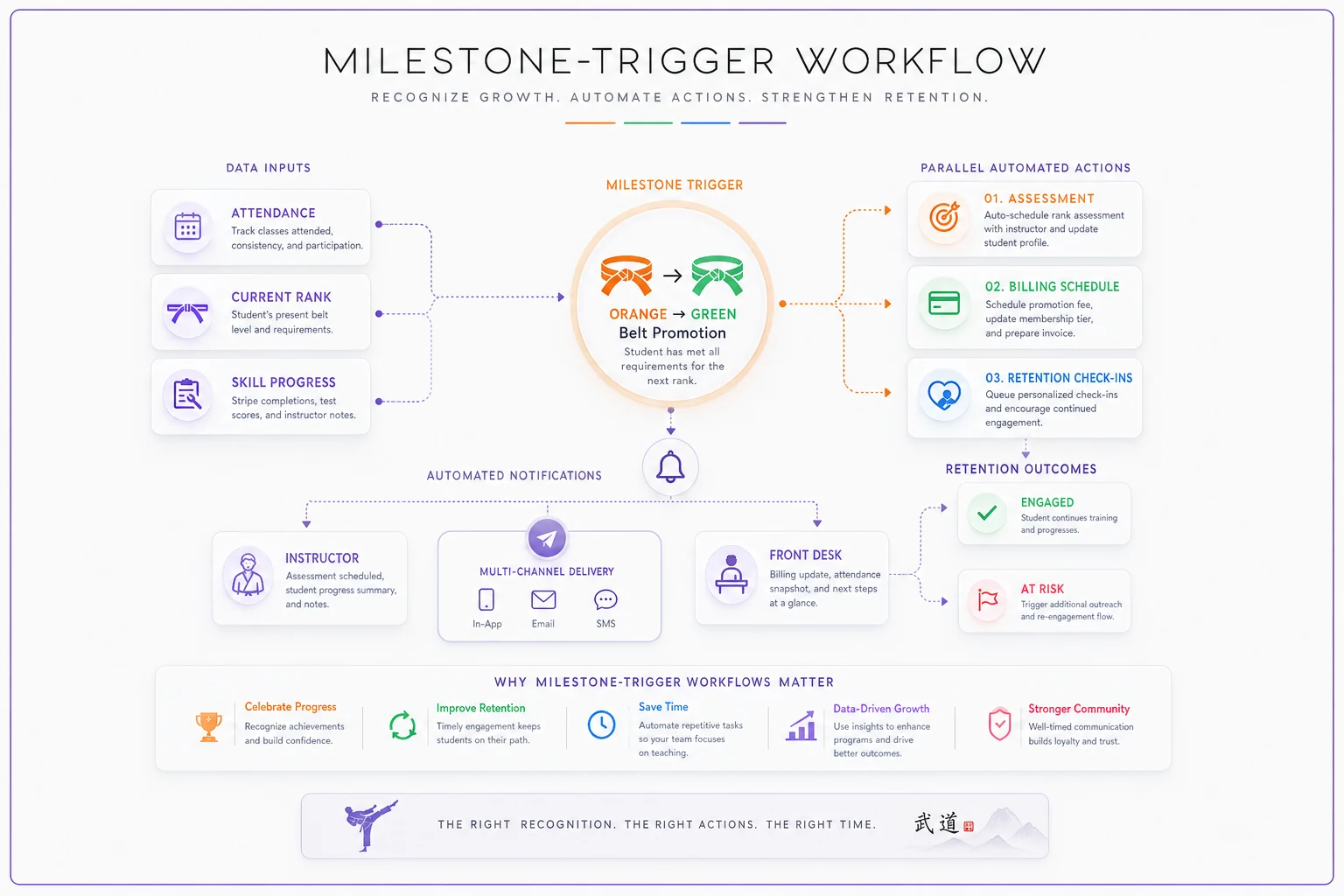
This diagram shows how a single milestone can fan out into assessment, billing, and retention actions so nothing depends on memory.
The architecture makes the milestone the moment of coordination, not a point of friction.
Assessment cadence that stays consistent
Cadence is what keeps the whole thing honest. If you test "whenever a student seems ready," you get chaos — some students wait too long and quit, others get promoted too fast and standards collapse.
-
Beginner ranks monthly test windows. Fast wins keep new students engaged.
-
Intermediate ranks every 6–8 weeks. Slower, but frequent enough to maintain momentum.
-
Advanced ranks quarterly. Depth over speed.
The exact numbers matter less than the fact that the cadence is published and predictable. Students and parents should know when the next window is without asking. Predictability is itself a retention tool — uncertainty about "when do I get to test" is a quiet frustration that compounds over time.
-
Technical execution (0–5)
is the technique mechanically correct?
-
Application (0–5)
can they use it under light pressure or in combination?
-
Consistency (0–5)
can they repeat it reliably, not just once?
-
Knowledge (0–5)
do they understand the "why" and the terminology?
Set a passing threshold per rank and require the same rubric across every instructor. This is also where curriculum ties directly into instructor development — the people running these assessments need to be calibrated against each other. If you haven't built a structured teacher development system with competency ladders and quarterly assessments, your rubrics will drift no matter how well you write them, because the graders aren't aligned.
Owner vs. instructor responsibilities
Instructor owns:
-
Applying the rubric consistently
-
Flagging students approaching entry criteria
-
Running the assessment event
-
The technical quality of every rank
Front desk / owner owns:
-
Timing billing events so they never land as a surprise on test day
-
Publishing the cadence calendar
-
Triggering retention touchpoints at the right milestones
-
Watching the "stall" report — students who've gone too long without progress
Shared:
-
Reviewing the "hard middle" cohort every month, because that's where curriculum quality and retention risk overlap most.
A mistake owners make is assuming the instructor will "handle the student side" of retention. Instructors are focused on the mat. They'll teach a brilliant class and never notice that a student hasn't paid in six weeks or hasn't tested in four months. Retention has to be an owned front-desk function that's fed by curriculum data, not left to whoever happens to notice first.
Billing and retention windows: where automation earns its keep
Once milestones are mapped to triggers, a lot of the coordination that used to depend on someone remembering can run on defined rules. This is where the three systems finally connect operationally.
-
Eligibility trigger when a student hits their attendance and time-in-rank criteria, flag them for the next test window and notify both the instructor and the front desk. No more eligible students slipping through unnoticed.
-
Billing pre-window trigger a set number of days before a test window, generate the test or belt fee as a scheduled charge — so it's cleared ahead of the emotional milestone, never as a surprise on the day.
-
Stall trigger if a student passes their expected time-in-rank without meeting entry criteria, flag them as a retention risk. This is your early-warning system — it catches drift weeks before a cancellation request.
-
Milestone-upgrade trigger right after a promotion, surface an upgrade or re-commitment offer while loyalty is peaking. A student who just passed their blue belt test is far more likely to upgrade to an unlimited plan than a random Tuesday contact.
-
Retention-window trigger for "hard middle" ranks, schedule an automatic check-in conversation before the historical drop-off point.
Platforms built as AI-assisted operational software are genuinely useful here because they connect data that normally lives in separate places — attendance, rank, payment status, last check-in — and fire the right action at the right moment without a human having to cross-reference three systems. The value isn't automation for its own sake. It's that the seams between curriculum, billing, and retention stop being where things fall through. A stalled student surfaces automatically. A test fee gets scheduled before the student even asks. The retention conversation gets queued for the exact window where it matters.
Schedule billing to trigger before the test window so families never see charges as a surprise on test day.
None of this replaces the instructor relationship. It just means the operational follow-through happens consistently at 200 students the way it used to happen naturally at 60.
A real scenario
A studio running around 180 students had a decent belt system but treated tests as ad-hoc events announced a couple weeks out. Their intermediate retention was soft — students in the green-belt range were canceling at a noticeably higher rate than beginners, and test fees were a recurring source of front-desk friction because families got hit with charges the week of testing.
They restructured around milestone triggers. Published a fixed cadence calendar. Moved test-fee billing to fire about two weeks before each window instead of the day of. Built a simple "stall" flag for any intermediate student who went 8+ weeks past their expected progress point, routing those to the front desk for a check-in. They also added a re-commitment conversation specifically at the orange-to-green transition.
The changes weren't dramatic overnight. Over roughly two quarters, the intermediate cancellation cluster shrank meaningfully — the "hard middle" stopped being a leak. Test participation rose because eligible students were actually being invited forward instead of waiting to be noticed. Billing disputes around test fees basically disappeared because nothing landed as a surprise anymore. The owner's summary: testing stopped being a scramble and became a rhythm.
When this makes sense — and when it doesn't
Worth building when:
-
You're past the point where one person knows every student's progress.
-
You have more than one instructor grading the same ranks.
-
Your intermediate retention is weaker than your beginner retention.
-
Test days feel like a scramble instead of a scheduled event.
Probably overkill when:
-
You're a solo instructor with 40 students you know by name. The overhead of formalizing triggers may cost more than it saves. Keep it simple until the informal system actually starts breaking.
Who should NOT rush this: studios whose curriculum standards aren't settled yet. If your instructors don't agree on what a green belt is, automating triggers around it just scales the inconsistency faster. Fix rubric alignment first, then wire the operational triggers on top.
Where this fits in the bigger picture
Curriculum architecture isn't a standalone project — it's one layer of how the whole studio operates. It sits directly on top of your student lifecycle work; if you've thought through how trials convert into long-term members tied to curriculum and billing, this is the natural next layer that keeps those members progressing and paying past the first plateau.
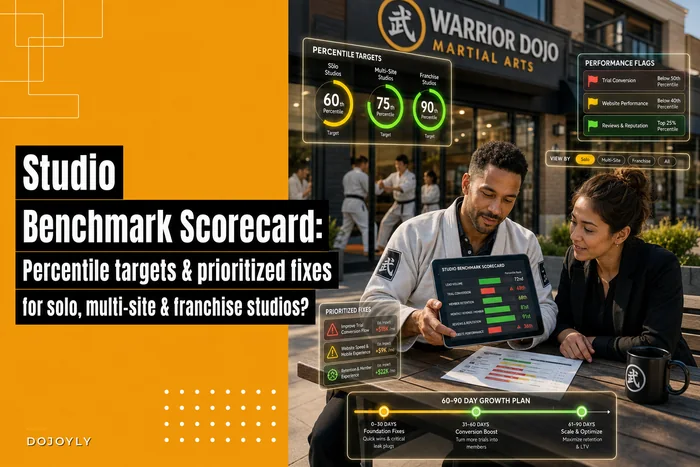
It's also worth measuring. Track intermediate vs. beginner retention as separate numbers, watch your test-participation rate against eligibility, and benchmark those against where a healthy studio your size should sit. If you're not sure what "healthy" looks like, a studio benchmark scorecard with percentile targets gives you the comparison points to know whether your hard-middle leak is normal or a genuine outlier.
Bringing it together
The studios that retain best aren't the ones with the flashiest curriculum or the cheapest membership. They're the ones where progression, billing, and retention move as one connected system — where a milestone automatically triggers the right assessment, the right billing timing, and the right conversation, every time, for every student, regardless of which instructor they train under.
Map your ranks to triggers. Fix your cadence so it's predictable. Align your rubrics so a belt means the same thing across the floor. Put your strongest retention actions in the hard middle where students actually leave. Time your billing so the money side never poisons the emotional high of a promotion. Do that, and you stop treating curriculum, billing, and retention as three separate problems — because they were always one system, just running without a map.
Map your ranks to triggers. Fix your cadence so it's predictable. Align your rubrics so a belt means the same thing across the floor. Put your strongest retention actions in the hard middle where students actually leave. Time your billing so the money side never poisons the emotional high of a promotion. Do that, and you stop treating curriculum, billing, and retention as three separate problems — because they were always one system, just running without a map.
Ready to elevate your dojo operations?
Join 500+ martial arts studios using Dojoyly to save time, reduce scheduling conflicts, and improve member engagement.