


Most studio owners who start thinking about franchising or licensing have already built something that works. One or two locations, a decent instructor team, a curriculum that converts. The problem is that "it works" and "it's repeatable by someone who isn't you" are two completely different things. The gap between them is where almost every early franchise effort falls apart.
The real question behind franchise governance martial arts isn't "how do I sell franchises." It's "what parts of my operation can survive being handed to a stranger with my logo on their wall." That's a governance problem, not a sales problem. And it comes down to three decisions you have to get right before a single license agreement goes out: what gets centralized, what each site has to document, and how you verify compliance over time without becoming a full-time inspector.
Here's how the whole system fits together, where it breaks, and what owners consistently get wrong when they rush it.
The centralize vs decentralize decision is where most of the damage starts
Before you build a single SOP or dashboard, you have to decide who owns what. This is the decision that quietly determines whether your brand feels consistent across locations or whether every site becomes its own weird little kingdom.
The mistake owners make is treating this as all-or-nothing. They either centralize everything — creating a bureaucracy that slows every franchisee down and breeds resentment — or they decentralize everything except the brand name and wake up two years later to find one site running a completely different belt system, pricing model, and refund policy.
The more useful framing: centralize anything that protects the brand or creates legal and financial risk, and decentralize anything that's genuinely local and low-stakes. Here's the split that tends to hold up across multi-location operators.
| Function | Centralize (HQ owns) | Decentralize (Site owns) | Why |
|---|---|---|---|
| Curriculum & belt standards | ✅ | Core brand promise; inconsistency destroys trust | |
| Pricing & discount rules | ✅ | Minor local promos only | Protects margins and brand positioning |
| Branding, logos, uniforms | ✅ | Non-negotiable for a franchise | |
| Instructor certification standards | ✅ | Hiring itself | Quality floor must be uniform |
| Class scheduling | Framework only | ✅ | Local demand varies a lot |
| Local marketing execution | Templates + rules | ✅ | Site knows its neighborhood |
| Billing platform & refund policy | ✅ | Legal exposure, chargebacks, reputation | |
| Incident/conduct reporting | Standard + escalation | First response | Liability travels back to the brand |
| Staffing & scheduling labor | Comp bands | ✅ | Local wages and availability differ |
| Data & member records | ✅ (ownership) | Daily operation | You need the data if a site closes or leaves |
The principle that's easy to miss: you can decentralize execution while centralizing standards. A franchisee should pick their own class times, but they shouldn't get to invent what a blue belt means. They should run their own local Facebook ads, but from approved templates with approved claims.
When owners get the layer wrong, symptoms show up fast. Decentralize pricing and you'll have one site at $89/month and another at $149 fifteen minutes away, both competing for the same Google searches. Centralize scheduling too tightly and you'll have franchisees in different time zones fighting a calendar built around your flagship's assumptions.
When heavy centralization actually makes sense
If your brand's entire value is consistency — think structured kids' programs where parents expect the exact same experience at any location — lean heavier toward central control. Same if your curriculum is your real IP. The tighter the brand promise, the more you centralize.
When tight centralization is a bad idea
If your sites serve very different demographics (a downtown adult BJJ gym versus a suburban family dojo), forcing identical operations will choke your better operators. Over-centralization also tends to attract the wrong franchisees — people who want to follow a script, not people who can actually run a business through the messy parts.
Minimum SOP artifacts: what every site must document before launch
A lot of first-time franchisors underbuild here. They hand over a 200-page operations manual that nobody reads, instead of a tight set of SOP artifacts each site actually uses day to day.
Simplify class bookings and attendance tracking.
Dojoyly helps you schedule, confirm, and manage every class effortlessly.
- Unified class & student management
- Automated member notifications
- Instructor scheduling & availability
No credit card required
The goal isn't volume. It's coverage of the moments where things reliably go wrong. Across multi-site studios, breakdowns cluster in predictable places: front desk handling, billing exceptions, incident response, instructor coverage, cleaning and safety. If your SOP set covers those with real checklists and decision trees, you've covered maybe 80% of what causes brand-damaging mistakes.
A workable minimum SOP artifact set per site:
-
Front desk playbook — inquiry response times, trial booking flow, conversion scripts, complaint escalation tree.
-
Billing & refund SOP — proration rules, failed-payment retry sequence, who can approve a refund and up to what amount.
-
Incident & conduct SOP — injury reporting, conduct escalation, parent communication scripts, what gets reported to HQ and within what window.
-
Instructor coverage SOP — substitute process, minimum certification to teach each class type, sign-off on who can run a belt test.
-
Opening/closing checklist — safety checks, mat cleaning, equipment, cash/float handling.
-
Curriculum & grading SOP — testing criteria, who administers, how results get recorded.
-
Local marketing SOP — approved templates, claims you can and can't make, brand asset usage.
-
Member data SOP — how records are entered, who has access, what happens to data if the site changes hands.
These aren't essays. Each should be a checklist or decision tree a new manager can follow on day three. If an SOP can't be executed by someone who just started, it's documentation — not an SOP.
Focus SOPs on exceptions (refunds, incidents, failed payments) rather than the routine happy-path.
The pattern worth internalizing from running multi-location operations: the SOPs that matter are the ones for exceptions, not the happy path. Anyone can take a payment. The question is what happens when a card fails three times, or a parent complains an instructor was too rough, or someone shows up injured. Those are the moments that define your brand reputation, and they're exactly the ones undertrained sites handle badly. A lot of this groundwork overlaps with what you'd build in a solid multi-site operations playbook before you ever add the franchise layer.
Audit cadence: how you verify compliance without living at each site
SOPs that nobody checks decay within months. This is the part owners skip because auditing feels adversarial — you don't want to be the person riding your franchisees. But without a cadence, standards drift silently until a bad Google review or a legal letter tells you something broke six weeks ago.
The fix is to make audits boring, scheduled, and mostly self-reported, with occasional verification layered on top. The cadence that tends to hold up:
-
Weekly self-check (site manager) quick 10-item checklist. Cleaning done, incident log current, trials followed up, billing exceptions cleared. Ten minutes, submitted to HQ.
-
Monthly operational audit (regional or HQ) review KPIs, spot-check three to five SOPs, confirm incident reports match what the data shows.
-
Quarterly deep audit on-site or thorough remote review. Curriculum consistency, instructor certification status, financial reconciliation, brand compliance.
-
Annual readiness/renewal review the full picture, tied to license renewal or expansion decisions.
A realistic audit checklist for a monthly operational review:
-
Are incident reports filed within the required window, and do they match member attendance records?
-
Are failed payments being worked through the standard retry sequence, or quietly written off?
-
Is every instructor teaching within their certification level?
-
Do current prices and active discounts match the approved pricing sheet?
-
Is member data complete and entered in the standard format?
-
Are refunds within policy limits, with approvals logged?
-
Does the published schedule match what's actually being taught?
-
Are local marketing materials using only approved claims and assets?
The thing that separates functional franchises from chaotic ones: audits should cross-check data against claims, not just ask "did you do it." A site manager will always check the box that says "incident log current." But when you compare the incident log against who was actually in class and against member complaints, gaps appear. The audit has teeth only when two sources have to agree.
This is also where centralized systems earn their keep. When member records, billing, scheduling, and incident logs all live in one platform you can see across sites, a lot of the audit becomes something you can review from a dashboard instead of a site visit. Operational software with automated flags — failed-payment counts climbing, incident reports missing, schedule not matching the approved template — lets you spend audit time on the sites that actually need attention instead of auditing everyone equally. That's the difference between an audit cadence that scales and one that collapses the moment you hit five locations.
Visualizing the cadence makes it easier to hand to a regional manager.
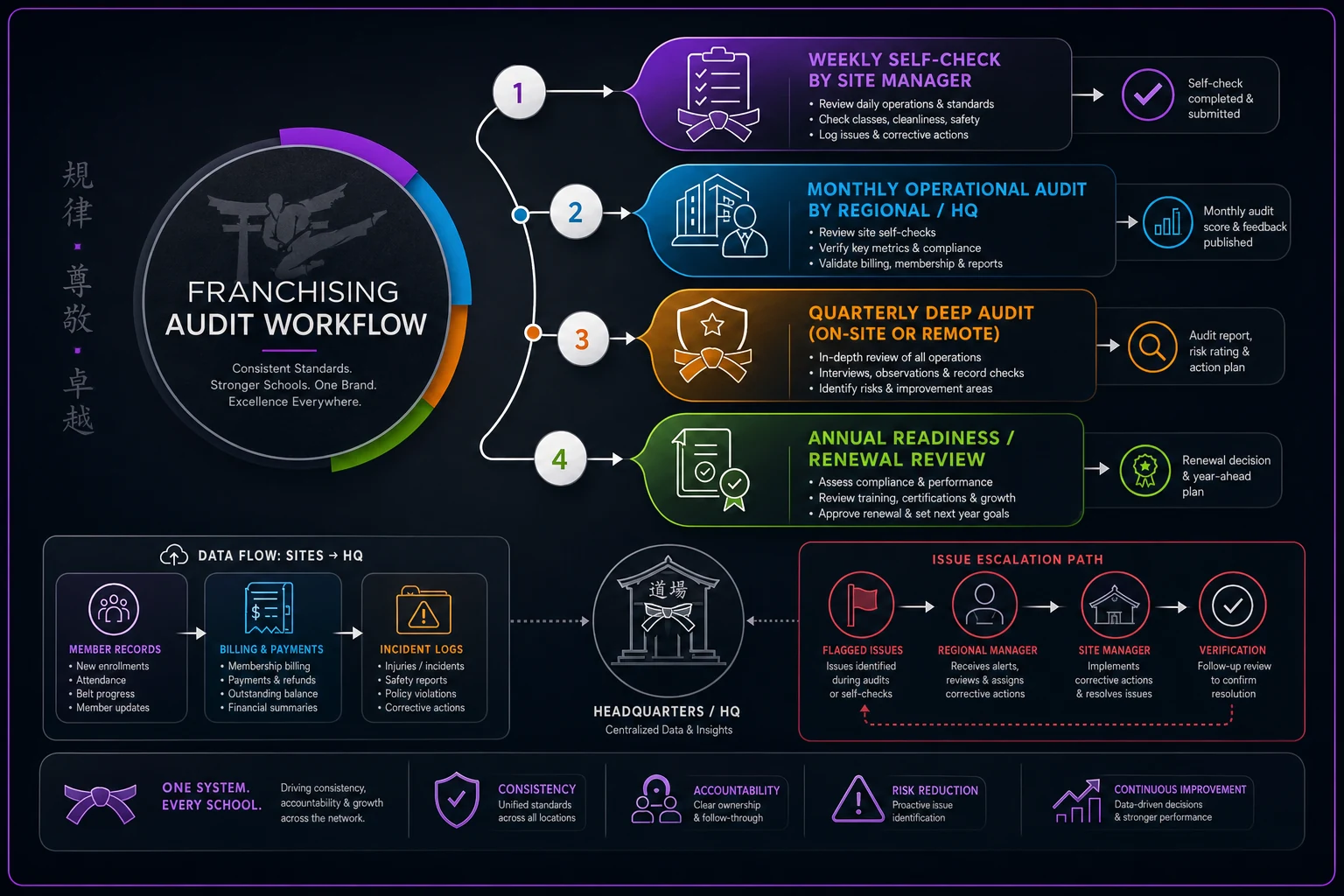
This flow shows who owns each audit step and how data moves to HQ.
HQ KPI dashboards: what you actually watch across sites
Once you're overseeing multiple locations, you stop managing individual numbers and start managing variance between sites. The question isn't "how's revenue" — it's "why is Site C converting trials at 40% while Site A is at 22%, and what's different about how they run."
A franchise-level dashboard needs fewer metrics than people think, but each one should be comparable across sites. The ones that actually tell you whether a site is healthy:
-
Trial-to-member conversion rate — the single best early signal of operational quality.
-
Member retention / churn — monthly and rolling 90-day.
-
Active member count vs capacity — are they growing or stalling.
-
Failed payment recovery rate — how much of billing is quietly leaking.
-
Incident rate and resolution time — risk and service signal.
-
Instructor-to-member ratio — understaffing hides in growth numbers.
-
Revenue per member — catches pricing drift and discount abuse.
Building a dashboard with 40 metrics nobody looks at is a common mistake. A franchise dashboard works when a regional manager can scan it in five minutes and know which three sites need a conversation this week. The point of centralized KPIs isn't surveillance — it's spotting which site needs help before the problem becomes a closure.
A useful habit: set a tolerance band for each metric and only flag sites outside it. If trial conversion across your network averages 30% and one site sits at 18%, that's a coaching conversation, not a blanket policy change. Governance is about catching outliers, not micromanaging the middle. If you haven't nailed down how metrics roll up and who's accountable for each, the thinking in turning staff chaos into scalable governance applies directly — comp bands and accountability have to line up with what your dashboard actually measures.
Readiness gates: the checklist before you license anything
This is the part that protects you legally and reputationally. A readiness gate is a hard yes/no checkpoint. If a site can't clear it, you don't license yet — no exceptions, because the exceptions are what sink early franchise systems.
Before you license or franchise, the brand itself has to clear these gates:
-
Documented, tested SOPs for every item in the minimum artifact set, each proven to work with at least one manager who isn't you running it unsupervised.
-
A functioning audit cadence already running at your own sites for several months. If you can't audit your own locations, you can't audit a franchisee's.
-
A centralized data and billing system where member records, payments, and incident logs are owned by HQ, not trapped in a franchisee's personal account.
-
Clear financial unit economics — you know what a healthy site's P&L looks like, because you can't promise a model you can't prove.
-
A certification pathway for instructors that someone else can run without your personal judgment on every test.
-
Defined escalation and legal boundaries — who handles an incident, within what window, and when HQ takes over.
For a prospective franchisee or licensee, the gate looks a little different:
-
Have they completed the required operations training?
-
Can their lead instructor meet your certification floor?
-
Do they have the capital to run at a loss through ramp-up — usually several months at minimum?
-
Will they operate on your centralized systems, not their own patched-together tools?
-
Have they signed off on audit access and data ownership terms?
The governance principle underneath all of this: a readiness gate you're willing to waive isn't a gate. The first time you let a well-funded, enthusiastic franchisee skip the training requirement because they seem competent, you've told yourself the standard is negotiable. And the sites that cause the most brand damage are almost always the ones that were allowed to skip a gate because they were charming or in a hurry.
A real scenario: what the gap costs
A two-location studio owner — roughly 300 members combined across both sites — had been fielding "can I open one in my town" requests for about a year before deciding to license to a former senior student.
The handoff happened fast. The new operator got the curriculum, the branding, and a verbal "here's how we do things." No tested SOP set, no audit cadence, no centralized billing. Within four months the problems surfaced: refunds were being handed out freely to keep people happy, trial conversion was sitting around 15% because nobody had documented the actual follow-up sequence, and a minor injury got handled with no report and an awkward parent conversation that ended up on Facebook tied to the brand name.
None of that happened because the operator was bad. They were running blind. No checklist for refunds, no script for incidents, no dashboard showing conversion was collapsing until revenue did. The owner spent the next six months retrofitting what should have come first: a minimum SOP set, a monthly audit built on shared data, and a simple KPI dashboard comparing both licensed sites against the flagship. Conversion at the struggling site climbed from the mid-teens back toward the high 20s once the follow-up SOP was actually documented and audited. Refund leakage stopped once approval limits were defined and logged. Nothing exotic — just governance that should have existed before the license was signed.
Putting the system together
The three pieces aren't separate projects — they're one system. Your centralize/decentralize decision determines what needs SOPs. Your SOPs determine what the audit checks. Your audit feeds the KPI dashboard that tells you which sites are drifting. And the readiness gates are just the bar that whole system has to clear before anyone new gets to operate under your name.
Owners who skip straight to selling licenses are essentially franchising chaos and hoping the new operator is better organized than they are. Owners who build the governance layer first are selling something repeatable — which is the only thing worth franchising in the first place. If you're still earlier in that journey, the owner-to-operator transformation roadmap is the groundwork that makes all of this possible, because you can't govern across sites while you're still the person running one.
Build the standards. Document the exceptions. Audit against real data. Watch variance, not individual numbers. Don't waive the gates. That's the whole blueprint — and it's a lot less exciting, and a lot more durable, than most people expect franchising to be.
Ready to elevate your dojo operations?
Join 500+ martial arts studios using Dojoyly to save time, reduce scheduling conflicts, and improve member engagement.