

Most studio owners don't have a growth problem. They have an "everything runs through me" problem. Enrollment is fine, retention is decent, classes are full enough — but the owner is still approving refunds at 9pm, texting instructors about sub coverage, personally writing belt test emails, and manually checking who didn't pay this month. The business works, but only because the owner never stops working.
That's the trap of the owner‑operator identity in a martial arts studio. You built the thing by doing everything yourself, and now the very habits that got you here are capping how big it can get. Making the shift from owner to operator in a martial arts studio isn't about hiring one manager and disappearing. It's a slow, deliberate transfer of decisions — not just tasks — out of your head and into systems other people can actually run.
This is a 12‑month roadmap for doing exactly that. It's built around four moving parts that most owners try to solve separately and fail: who's actually responsible for what (RACI), what gets centralized versus left to each site, how you keep an eye on the whole thing without micromanaging (governance cadence), and the specific signals that tell you when to pull payroll, marketing, and curriculum under central control instead of guessing.
Why owners stay stuck (it's rarely about talent)
The instinct is to blame the team. "I'd delegate, but nobody does it the way I do." That's real, but it's also a symptom, not the cause. What tends to happen across studios is that owners never actually defined the decision — only the task. You can hand someone the job of "handle late payments," but if you never told them the refund threshold they can approve on their own, the escalation rule for a three‑month lapse, or when to just cancel the membership, then every edge case bounces right back to you. You didn't delegate. You created a middleman.
The second thing that keeps owners stuck is that the studio's knowledge lives in the founder's memory. How you handle a parent who's upset about a belt promotion, the discount you quietly give long‑time families, why class order matters for the kids' program — none of it is written down. The moment you try to step back, quality gets weird and you get pulled in to fix it. That reinforces the belief that you're irreplaceable, and the cycle repeats.
The transformation isn't about willpower. It's about converting three things into transferable systems:
-
Decisions → written thresholds and rules people can apply without you
-
Knowledge → documented standards, not folklore
-
Oversight → a rhythm of check‑ins that catches problems early instead of you hovering
Everything below is meant to be done in order, because doing it all at once is how owners burn out and revert.
The RACI foundation: separate the doer from the decider
Before you move a single responsibility, you need a shared language for what kind of involvement someone has. RACI is old and unglamorous, but it works because it forces you to name the difference between doing the work and owning the outcome. For the uninitiated: Responsible does the work, Accountable owns the result (only one person), Consulted gets asked before, Informed gets told after.
Simplify class bookings and attendance tracking.
Dojoyly helps you schedule, confirm, and manage every class effortlessly.
- Unified class & student management
- Automated member notifications
- Instructor scheduling & availability
No credit card required
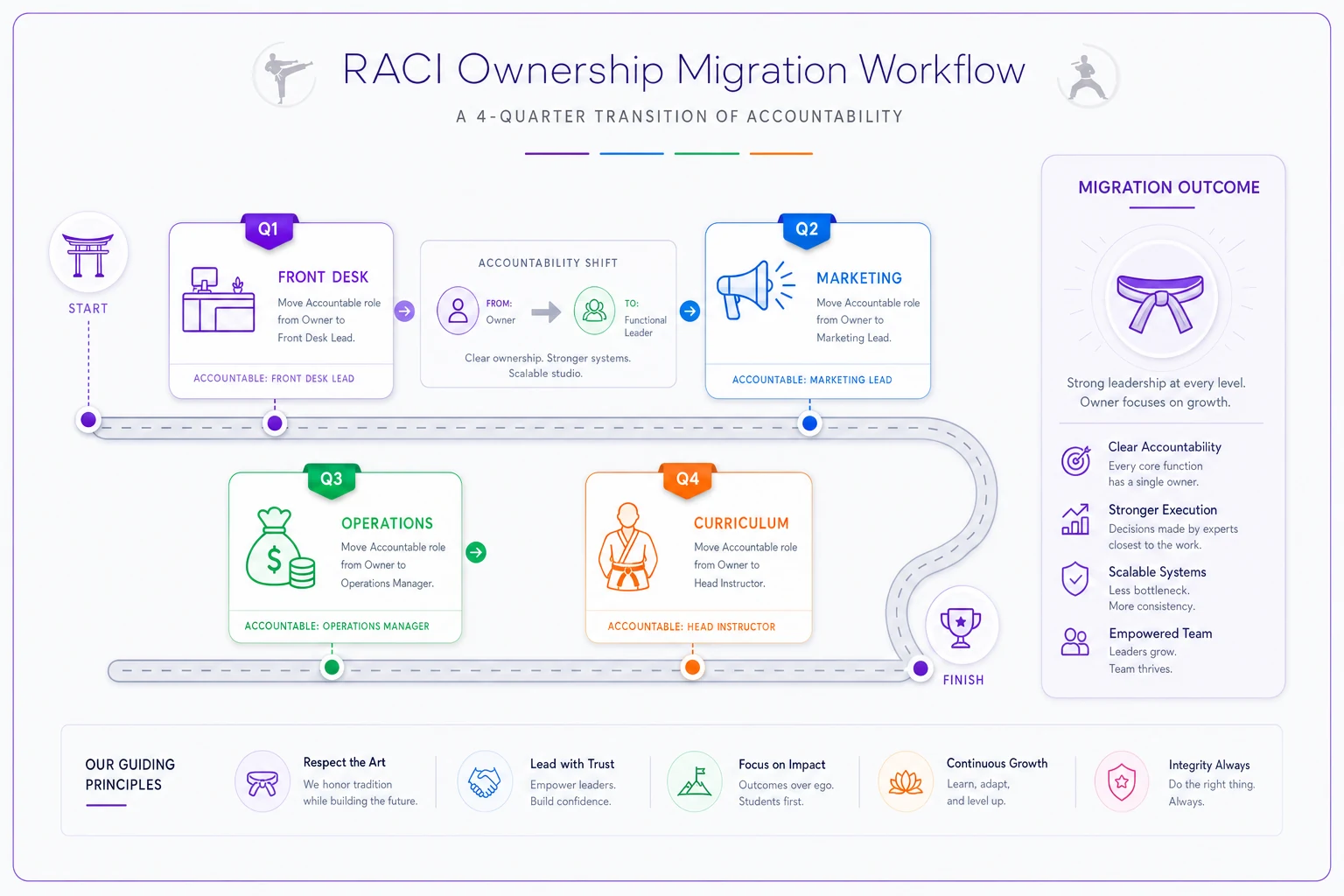
The mistake most studios make is having no "A" that isn't the owner. Everything rolls up to you. The first real move in this whole roadmap is assigning an Accountable person to each core function who isn't you — even if you're still heavily Consulted at the start.
Here's a starter map for the functions that eat the most owner time. Adjust the names to your actual roles.
| Function | Responsible | Accountable | Consulted | Informed |
|---|---|---|---|---|
| Front desk / inquiries | Front desk staff | Head instructor / manager | Owner (first 90 days) | Owner |
| Trial‑to‑member conversion | Front desk | Program manager | Owner | Owner |
| Class scheduling | Lead instructor | Program manager | Owner | All instructors |
| Sub coverage | Instructors | Program manager | — | Owner |
| Billing & failed payments | Admin | Manager | Owner (over threshold) | Owner |
| Payroll | Admin / bookkeeper | Owner (initially) | Bookkeeper | — |
| Curriculum & belt standards | Head instructor | Owner (initially) | Senior instructors | All instructors |
| Local marketing | Front desk / manager | Manager | Owner | Owner |
Notice two functions still have the owner as Accountable: payroll and curriculum. That's intentional. Those are the last things you should let go of, and there are specific triggers for when to move them — covered below. Everything else should have your name migrating out of the "A" column over the first two quarters.
If your staff structure isn't even clear enough to fill this table out, that's a signal you have a governance gap before a delegation gap. Sorting out roles, comp bands, and succession is a genuine prerequisite — worth working through properly with something like the framework in turning staff chaos into scalable governance before you start handing off decisions.
Centralization vs. local checklists: the decision most owners get backwards
Once you have more than one instructor — and definitely once you have more than one location — you hit the central question: what gets standardized across the whole operation, and what gets left to the person on the ground?
Owners tend to get this backwards in a predictable way. They centralize the stuff that should stay local (like exactly how a specific instructor warms up their Tuesday teen class) and leave local the stuff that should be standardized (like the refund policy, or belt testing criteria). The result is rigid where it should be flexible and chaotic where it should be consistent.
The rule of thumb that actually holds: centralize anything that affects money, safety, brand promise, or fairness. Leave local anything that's about in‑the-moment teaching judgment.
-
Centralize pricing, discount rules, refund thresholds, belt requirements, safety protocols, injury reporting, payroll structure, membership contract terms, the core intake flow for new students.
-
Keep local (as checklists, not scripts) lesson pacing, drill selection within a curriculum, how an instructor manages their own class energy, minor scheduling swaps between two instructors who cover each other.
The word "checklist" matters here. A checklist tells someone the non‑negotiable steps without dictating the flavor. A script tells them exactly what to say. Front desk conversion? A checklist of what must happen — log the inquiry, book the trial, send the reminder, follow up within 24 hours — works fine. Scripting every human interaction backfires and makes your staff sound like robots.
A practical test: if two instructors doing the same thing differently would create a student complaint, a legal risk, or a revenue leak, it needs to be centralized. If it just means the class feels slightly different, leave it local.
Convert front desk conversion steps into a one‑page checklist so new hires can follow the non‑negotiables without memorizing scripts.
A practical test: if two instructors doing the same thing differently would create a student complaint, a legal risk, or a revenue leak, it needs to be centralized. If it just means the class feels slightly different, leave it local.
The governance cadence: how you watch without hovering
The reason owners can't let go is usually that stepping back feels like flying blind. The fix isn't more control — it's a rhythm. When you have a predictable schedule of reviews, you stop randomly checking on things, because you know problems will surface at a known time.
-
Weekly (15–20 min, manager‑led) cash position, failed payments, trials booked vs. converted, any sub coverage gaps, one flagged student issue. This is a scan, not a strategy session.
-
Monthly (45–60 min) retention numbers, new enrollments, payroll accuracy, any complaint that escalated, progress on whatever function you're currently handing off.
-
Quarterly (half day) review the RACI map — is anything still bouncing back to the owner that shouldn't? Review comp, curriculum standards, and pricing. Decide what centralizes next quarter.
-
Annually the big one — org structure, expansion decisions, and whether you as the owner are actually operating less than you were 12 months ago.
The part most people miss: the cadence itself is the delegation tool. When your manager knows they'll be presenting weekly numbers every Monday, they start owning those numbers. Accountability isn't something you assign in a document — it gets reinforced every time someone has to report on their area out loud.
If you're building this rhythm from scratch, the handoff and KPI mapping in building a studio growth operating system pairs well with the cadence above, especially for figuring out which numbers actually belong in each review.
The three hardest handoffs: payroll, marketing, curriculum
These are the last functions owners give up, and for good reason — get them wrong and you feel it fast. So instead of vague "delegate when ready" advice, here are the actual triggers that tell you it's time.
Payroll — centralize when errors or volume force it
Payroll stays owner‑controlled the longest because a mistake here is both personal and legal. But there's a clear point where holding onto it costs more than it protects.
Trigger to centralize: you have more than around 5–6 instructors on mixed comp (hourly plus per‑class plus bonus), OR you've made two or more payroll errors in a quarter, OR payroll is eating more than a couple hours of your time each cycle. Any of those and it's time to move it to a bookkeeper or admin working off a documented comp structure — not off your memory of who gets what.
The failure pattern to avoid: owners centralize payroll processing but keep the rules in their head. That doesn't help. The comp structure — rates, bonus criteria, how substitutes get paid — has to be written down before anyone else can run it, or you've just added a person who still asks you every question.
Marketing — centralize when brand consistency starts leaking
Local marketing (a single studio posting its own events, running a local promo) is fine to leave local for a long time. It only needs to centralize when inconsistency starts hurting you.
Trigger to centralize: you open a second location, OR different staff start running promotions that undercut each other or confuse pricing, OR your offers stop being tracked so you can't tell what's working. At that point you need a central calendar, approved offer templates, and one Accountable person for the brand.
Marketing chaos is usually the first thing to break when you open a second site, well before payroll or curriculum does. Two locations quietly running different Facebook offers at different price points is how you end up with students at one site angry about what students at the other one got.
Curriculum — centralize last, and only when drift appears
Curriculum is the soul of the studio, which is why owners guard it hardest. It should be the last function to fully leave your direct oversight. But it can't stay in your head forever, because inconsistent belt standards across instructors is a slow poison for trust.
Trigger to centralize: you have multiple instructors testing students for the same rank, OR a parent questions why their kid's promotion looked different from another kid's, OR you're opening a second location and the belt standard has to travel. When requirements live only in the head instructor's judgment, you get drift — one instructor's green belt becomes another's blue belt — and eventually a credibility problem.
Centralizing curriculum means written rank requirements, a shared testing rubric, and a review cadence. Not you personally signing off on every promotion.
Who should NOT rush this
This roadmap assumes you've got a real business with enough volume and staff to actually distribute work into. If that's not you yet, forcing it will hurt.
-
Solo instructors with under roughly 60 students and no employees: don't build a RACI matrix for a team of one. Document your own processes so a future hire can pick them up, but the transformation itself is premature.
-
Studios in active crisis (cash flow underwater, retention collapsing): fix the leak first. You can't hand off a sinking function — you'll just hand off a mess.
-
Owners who actually want to teach full‑time and stay small there's nothing wrong with this. Not every studio needs to become a multi‑site operation. If you love being on the mat and the numbers work, "operator" might not be your goal, and that's a legitimate choice.
The transformation makes the most sense when you're at roughly 150+ students, have a few instructors, and you can feel that you personally are the ceiling on growth.
A real scenario: the two‑location bottleneck
A studio running two locations with around 240 total students had the classic problem. The owner taught at the main location and drove 25 minutes to the second one three times a week to "keep an eye on things." Every refund, every sub swap, every belt test question, every promo idea funneled through their phone. They were working roughly 60+ hours a week and the second location still felt shaky.
They ran this roadmap over about ten months. Front desk and scheduling got an Accountable manager at each site by month three, working off centralized checklists for intake and conversion. Marketing centralized at month four after the two sites ran conflicting summer promos — one gave a free month, the other gave 20% off, and families found out. That got consolidated into one approved offer calendar. Payroll moved to a bookkeeper at month six after a proper comp structure was written down. Curriculum — the belt rubric — got documented and centralized last, around month eight, after a parent complaint about inconsistent promotions.
By the end, the owner was down to roughly 35–40 hours, most of it on the mat and in quarterly reviews instead of putting out daily fires. Revenue didn't spike overnight — it grew maybe 15% over the year — but the more meaningful shift was that the owner could take a week off and the studios kept running. That's the actual deliverable of this whole exercise.
Pilot templates: don't roll out to everything at once
The way owners blow this up is trying to transform all functions across all sites simultaneously. Pilot instead. Pick one function, run it at one location for 30 days, fix what breaks, then roll it out.
-
Week 1 document the current process and the decision rules — write down the thresholds you've been keeping in your head
-
Week 2 hand it to the Accountable person, with you as Consulted — they run it, they check with you before big calls
-
Week 3 move yourself to Informed — they run it and just tell you what happened
-
Week 4 review what bounced back to you and why, then fix the rule or the training gap
If more than a couple of things bounced back in week 3, the rule wasn't clear enough. That's a documentation problem, not a "they're not ready" problem. Fix the doc — don't take the function back.
When you get to the second‑location version of this, having the operational groundwork from the multi‑site operations playbook in place first matters — a handoff that works at one site can quietly break the moment geography and separate teams enter the picture.
Handoff map: what "done" looks like at 12 months
By the end of the roadmap, your RACI table should have your name almost entirely out of the "Accountable" and "Responsible" columns, mostly showing up as "Consulted" on the big stuff and "Informed" on everything routine. The real tell isn't that you're doing less — it's what you're doing.
An owner still stuck in the doer role spends their week answering questions and fixing individual problems. A real operator spends their week reviewing cadence reports, deciding what centralizes next, and coaching the Accountable people to make better calls themselves. You've stopped being the person who solves the problems and become the person who makes sure the system solves them.
Where the leverage really is
The centralization decisions, the RACI table, the governance rhythm — they all point at one underlying shift. You're moving the studio from running on your memory to running on documented decisions. That's what makes everything else possible. It's why the belt rubric has to be written before curriculum can be delegated, why the comp structure has to exist before payroll can move, why the refund threshold has to be a number before front desk can stop asking you.
Tooling matters here in one specific way: when billing, scheduling, attendance, and payment data all live in one place with clear rules, every one of these handoffs gets easier. When failed payments, trial conversions, and sub coverage are visible to the Accountable person in the same system — instead of scattered across text messages and your memory — they can actually own the outcome. But the tool is downstream of the decisions. Get the RACI and the thresholds right first; software just enforces what you've already decided.
The owners who actually make this transition don't do it by working harder or finding one magical manager. They do it by treating their own indispensability as the problem to be solved — deliberately, one function at a time, on a schedule — until the studio can outrun their personal capacity. That's the whole game. Twelve months, four functions, and a real willingness to write down the things you've been carrying in your head.
The owners who actually make this transition don't do it by working harder or finding one magical manager. They do it by treating their own indispensability as the problem to be solved — deliberately, one function at a time, on a schedule — until the studio can outrun their personal capacity. That's the whole game. Twelve months, four functions, and a real willingness to write down the things you've been carrying in your head.
Ready to elevate your dojo operations?
Join 500+ martial arts studios using Dojoyly to save time, reduce scheduling conflicts, and improve member engagement.