


There's a specific moment in most martial arts studios where the informal setup breaks. You don't usually notice it happening. One day you have three instructors, everyone knows the rules because you personally trained them, and pay is whatever felt fair at the time. Then you blink and there are nine people on the mat across two locations, two of them barely remember your original standards, and you can't explain to a new hire why the senior kids' coach makes $4 more an hour than the guy who's been there longer.
That gap between "how we've always done it" and "how we actually run this" is where martial arts studio HR governance either exists or it doesn't. Most studios think governance is corporate paperwork. It isn't. It's the set of documents and cadences that let you make consistent decisions about people without reinventing the answer every single time.
This post is about building that layer: real job specs, interview scorecards that don't produce garbage hires, compensation bands you can defend out loud, quarterly review agendas that actually change behavior, and a 12‑month succession scorecard so your studio doesn't crater the week your head instructor gets injured or moves away.
Worth saying early: the goal isn't to make your studio feel like an HR department. It's to remove the emotional guesswork from staff decisions so you can spend your energy teaching and growing.
Why staff chaos is almost always a documentation problem, not a personality problem
Owners tend to describe their staffing issues as people issues. "This instructor has a bad attitude." "That coach won't follow the belt curriculum." "My front desk person keeps making pricing exceptions." Fair. But when you look at what's actually happening, the pattern is usually different.
Nobody wrote down what "good" looks like, so everyone invented their own version. When a coach freelances the curriculum, it's usually because the expectation lived in your head and never made it onto paper. When pay feels unfair, it's because raises got handed out reactively — someone threatened to quit, or you felt guilty, or it was December and you had a good month.
A common setup: a studio with four instructors where two are on $22/hr, one is on $26/hr, and one is on $19/hr. Ask the owner why, and the honest answer is some mix of hire date, negotiation confidence, and vibes. None of it maps to skill, responsibility, or student retention. That's not a compensation strategy — it's an accident that compounds.
Governance fixes this by making the standard external to you. Once the standard lives in a document instead of your memory, three things become possible: you can hold people to it, you can hire against it, and you can delegate it. Without that, every people decision routes back through the owner, and that bottleneck gets worse with every hire.
Start with job specs that describe outcomes, not vibes
Most studio job descriptions are useless because they list activities ("teach classes, help students, keep the mat clean") instead of outcomes and standards. Activities don't tell a coach whether they're doing well. Outcomes do.
Simplify class bookings and attendance tracking.
Dojoyly helps you schedule, confirm, and manage every class effortlessly.
- Unified class & student management
- Automated member notifications
- Instructor scheduling & availability
No credit card required
A usable job spec for a martial arts role has four parts:
-
Purpose — one sentence on why this role exists in the business. Example: "The Kids Program Lead is responsible for retention and skill progression of students aged 5–12."
-
Core responsibilities with standards attached — not "teach kids classes" but "run kids classes with a documented curriculum, keep class attendance logged within 24 hours, and maintain a 6‑month retention rate above the studio target."
-
Competency level required — technical rank, teaching skill, and the softer stuff like parent communication.
-
What this role does NOT own — surprisingly the most useful section. It stops turf confusion and stops people quietly dropping tasks they assumed weren't theirs.
Put the "What this role does NOT own" section into onboarding so new hires don't inherit turf assumptions.
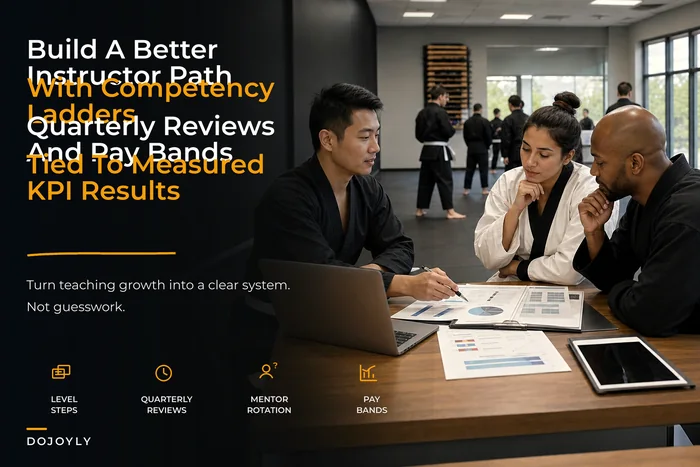
The insight most owners miss: your job specs should ladder. A junior assistant spec, a lead instructor spec, and a program head spec should read like rungs on the same climb, not three unrelated documents. That laddering is what makes promotions obvious instead of political, and it connects directly to how you structure instructor growth. If you haven't built that progression yet, the scalable teacher development system with competency ladders and pay bands feeds directly into everything here — job specs are basically competency ladders written as roles.
Interview scorecards: stop hiring on "he seemed like a good dude"
Studio hiring is notoriously gut-driven. Someone trains at your school for two years, they're a brown belt, they're around, and suddenly they're teaching. No interview, no scoring, no comparison. Sometimes that works. Often it produces a coach who's great on the mat and terrible at showing up on time or handling a frustrated parent.
An interview scorecard forces you to separate "I like this person" from "this person will do this job well." It doesn't have to be complicated. Pick 5–6 dimensions that actually predict success in the role, define what a 1, 3, and 5 look like for each, and score every candidate the same way.
For a lead instructor, those dimensions usually look like:
-
Technical demonstration — can they actually teach a technique cleanly to a beginner, not just perform it?
-
Class control — do they command a room without yelling or freezing?
-
Reliability signals — history of showing up, past commitments kept.
-
Communication with parents/adults — the thing that quietly makes or breaks kids programs.
-
Coachability — do they take a correction without ego?
-
Curriculum alignment — will they teach your system or their own?
The mistake isn't skipping interviews. It's running them with no scoring, so the last person you talked to always feels like the best candidate because they're freshest in your memory. Scorecards kill that recency bias. When two owners of a multi-instructor school both score the same candidate independently and compare notes, the disagreements are where the real conversation happens.
Compensation bands you can actually say out loud
The test for a good comp structure is simple: could you read your pay logic aloud to your entire staff in a room without anyone feeling cheated? If the answer is no, you don't have bands — you have a pile of individual deals.
Comp bands tie pay to the role and the competency level, not to the person's negotiation skills. Here's a simplified example of what a small studio's bands might look like. Numbers vary a lot by region, so treat these as structure, not gospel:
| Role | Band range (hourly) | What moves someone up the band |
|---|---|---|
| Assistant Instructor | $16 – $20 | Reliability, basic class support, rank progress |
| Lead Instructor | $22 – $28 | Running classes solo, retention results, parent handling |
| Program Head (e.g. Kids or BJJ) | $30 – $38 | Owning a program's retention + growth, mentoring others |
| Assistant Manager / Ops | $24 – $34 | Scheduling, billing oversight, sub coordination |
Each role has a range, and movement inside that range is tied to specific things — not tenure alone. A coach who's been there four years but stayed flat on skill sits at the bottom of their band. A newer coach driving strong retention climbs faster. That feels fair because it is fair, and it kills the "I've been here longer" resentment that poisons a lot of studio staff rooms.
One pattern worth calling out: studios without published bands almost always overpay for loyalty and underpay for performance. The loudest, longest-tenured person gets the raises; the quiet coach whose classes have the best retention gets nothing until they quit. Bands invert that dynamic.
When bands are a bad idea: if you genuinely have one or two instructors and no growth plans, formal bands are overkill. You can hold the logic in your head at that size. The moment you hit your fourth staff member or open a second location, though, the informal approach starts leaking money and goodwill.
Quarterly review agendas that change behavior instead of documenting it
Annual reviews are basically useless for studios. Twelve months is far too long a feedback loop for someone teaching kids four nights a week. By the time you sit down, the problems are either forgotten or fossilized.
Quarterly works because it's short enough to correct course and long enough to see real trends. But a review only changes behavior if it has a repeatable agenda. Winging it turns the meeting into empty praise or an ambush — both useless.
A quarterly review agenda that actually works:
-
Numbers first, no interpretation — attendance, retention in their classes, sub reliability, any incidents. Just facts on the table.
-
Self-assessment before your assessment — ask them how the quarter went before you say anything. You learn a lot from the gap between their read and yours.
-
One clear win, one clear focus — not a laundry list. One thing to keep doing, one thing to fix. People can't act on ten priorities.
-
Band position check — where are they in their pay band, and what specifically moves them up. This turns the review into a growth conversation instead of a judgment.
-
Owner commitments — what YOU will do to support the focus area. Reviews that are entirely one-directional breed resentment.
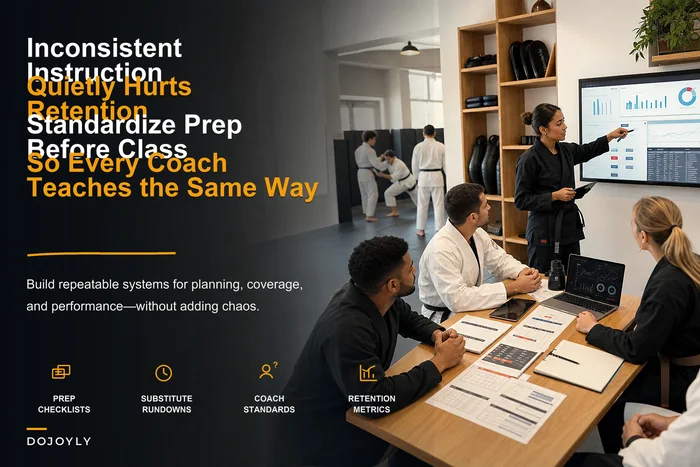
The studios that improve fastest treat the review agenda as fixed and the content as variable. Same five steps every quarter, different substance. That consistency is what makes staff trust the process instead of dreading it. It also connects directly to instruction quality — if your reviews aren't grounded in real performance data, you end up back at the problem of inconsistent instruction quietly costing you students.
The 12‑month succession readiness scorecard
This is the part almost no studio owner does, and it's the one that saves the whole business.
Succession isn't just "who takes over when I retire." For a studio, the real risk is smaller and more frequent: your head instructor tears an ACL. Your best kids coach moves cities. You want to open a second location but you're the only one who can run the first. Every one of those is a succession problem, and without a readiness plan, each one becomes a crisis that visibly damages retention.
A 12‑month succession readiness scorecard tracks how exposed your studio is and whether that exposure is improving. Score each of these 1–5 every quarter, four times over the year, and watch the trend:
-
Single points of failure — how many critical functions only one person can do? (Lower is better.)
-
Documented systems — is the curriculum, the class flow, the billing process written down, or is it in someone's head?
-
Bench depth per role — for each key role, is there at least one person who could step up within a month?
-
Cross-training progress — are people actively learning adjacent roles, or siloed?
-
Owner dependency — what percentage of daily decisions still route through you?
-
Emergency coverage readiness — can you cover a sudden absence without cancelling classes?
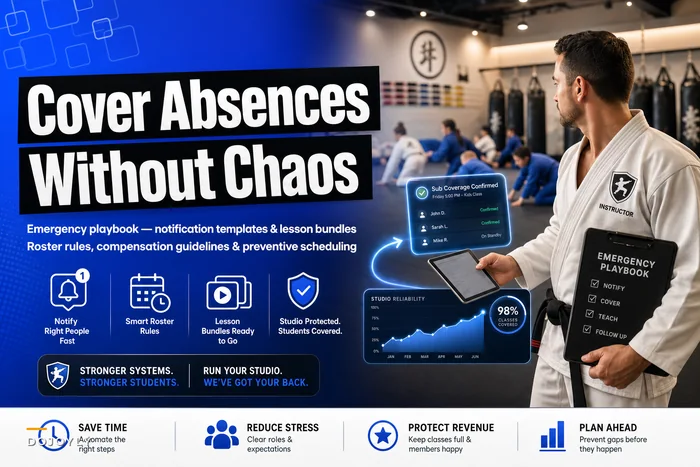
That last point is where a lot of studios discover their real fragility. If a no-notice absence forces you to cancel a class, your succession readiness is genuinely low regardless of what the other numbers say. A tight coverage system is the entry-level version of succession planning, and the substitute-instructor playbook for handling last-minute absences is basically succession readiness at the daily scale.
The point of scoring quarterly is the trend line. A studio scoring a flat 2 across four quarters is standing still and doesn't know it. A studio moving from 2 to 3.5 over the year is actively de-risking, even if it never feels dramatic day to day.
A real scenario: the studio that couldn't take a vacation
A two-location taekwondo school, roughly 260 active students split across the sites, run by an owner and his wife plus five instructors. Both locations were profitable. On paper it looked healthy.
The problem showed up when the owner tried to take his first real two-week vacation in six years. Within four days, one location had a scheduling mess because only he knew how to handle the sub swaps, a parent billing dispute escalated because nobody was authorized to make a call on it, and one instructor quietly changed the belt-testing standard because there was no written spec to point to. He came back to lower attendance at one site and a resentful staff member who felt undermined.
Nothing here was a people failure. It was a governance vacuum. Over the following year they built the boring stuff: written job specs for all five instructor roles, published pay bands, a quarterly review rhythm, and a succession scorecard they revisited every three months. Their owner-dependency score started around a 2 out of 5 — almost everything routed through him. Twelve months later it was closer to a 4. He took another vacation. Attendance held, and two staff members had grown enough to cover most of what used to be his exclusive job.
Revenue barely changed that year. That's actually the point. The value wasn't a growth spike — it was a business that could survive its owner being gone, and a staff that stopped guessing.
How these pieces connect (because they're not five separate projects)
The mistake is treating these as five documents. They're one system. Job specs define the roles. Interview scorecards hire against those specs. Comp bands price those specs and reward movement between levels. Quarterly reviews are where people get feedback on where they sit and what moves them up. The succession scorecard measures whether the whole thing is actually building depth or just spinning.
Pull any one out and the others weaken. Comp bands with no job specs are just arbitrary numbers with a nicer label. Reviews with no bands to reference become directionless chats. A succession plan with no documented systems is wishful thinking.
This is also where studios hit a real operational wall: keeping all of this current across multiple people and locations by hand. Spreadsheets for pay bands, a doc somewhere for job specs, review notes scattered across email and paper — it decays fast. Running staff governance inside a proper operational platform rather than loose files isn't about software being magic. It's because the documents only work if they're findable, current, and consistently applied. AI-assisted operational tools help here mostly by removing the manual drift — flagging when a coach hasn't had a quarterly review, surfacing who's overdue for a band re-check, keeping specs and pay logic in one place so a new hire onboards against the real standard instead of someone's memory. The value isn't the automation itself. It's that governance stops depending on the owner remembering to enforce it.
This visual shows the workflow and how each piece feeds the next.
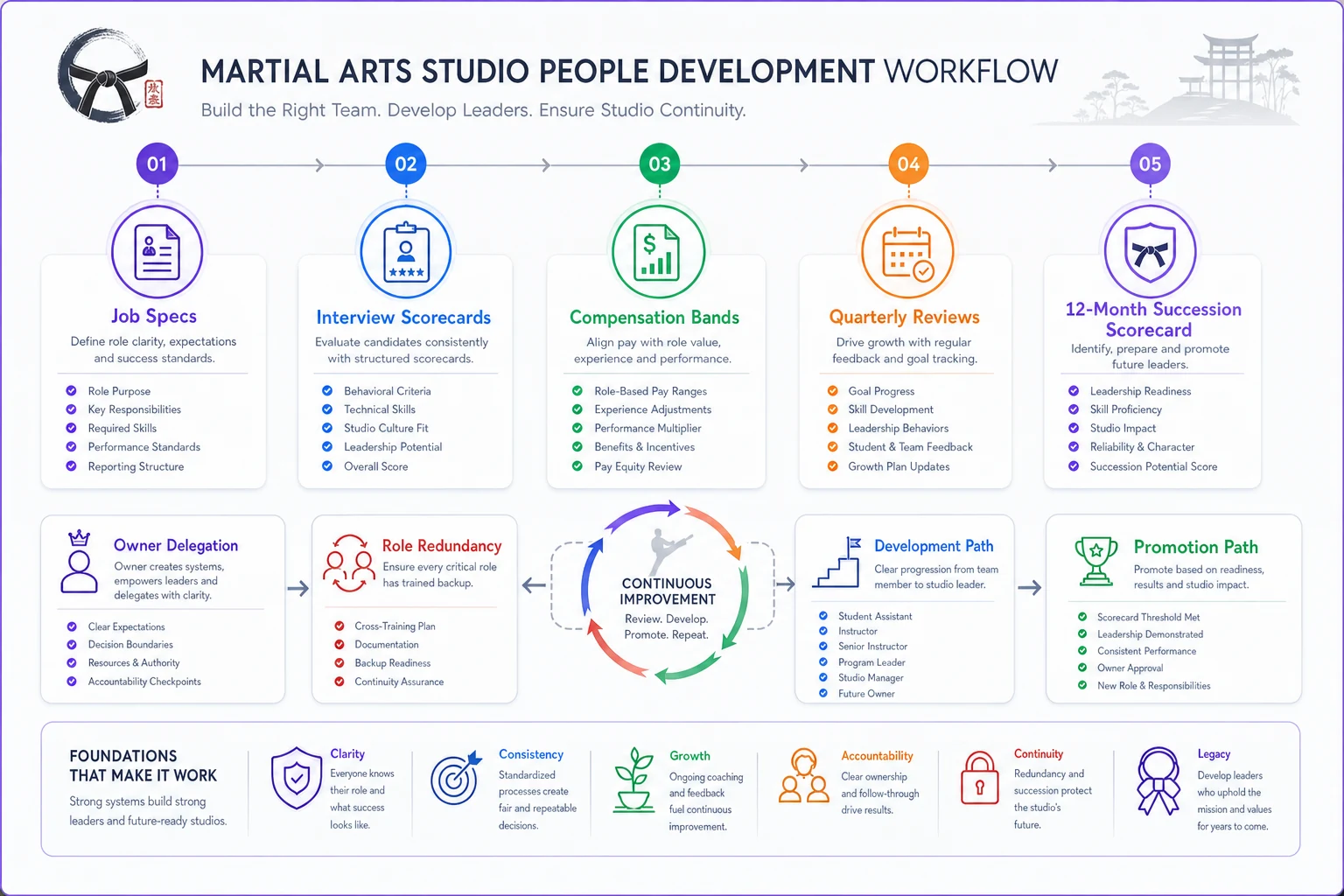
Keeping these documents in one platform stops drift and makes the system durable across people and locations.
Where to start if this feels like too much
You don't build all five at once. If I had to sequence it for a studio just starting:
-
Month 1 Write job specs for every existing role. Just describe what good looks like. Don't overthink it.
-
Month 2 Sketch rough comp bands and privately check your current pay against them. You'll find the unfair spots fast.
-
Month 3 Run your first structured quarterly review using a fixed agenda.
-
Month 4 onward Score your succession readiness, then again each quarter, and watch the trend.
Start with the specs, because everything else references them. A studio that can clearly say "here's what each role does, here's what it pays, here's how you move up, and here's who could cover it tomorrow" has already solved most of what people call "staff drama."
Governance sounds heavy. In practice it's just the difference between a studio that runs on your presence and one that runs on its systems. The first caps out at the edge of your personal attention. The second can actually grow — and let you take a vacation without your phone blowing up on day four.
Governance sounds heavy. In practice it's just the difference between a studio that runs on your presence and one that runs on its systems. The first caps out at the edge of your personal attention. The second can actually grow — and let you take a vacation without your phone blowing up on day four.
Ready to elevate your dojo operations?
Join 500+ martial arts studios using Dojoyly to save time, reduce scheduling conflicts, and improve member engagement.