


Most studio owners run their numbers backwards. They wait until a class is packed, until they're turning people away, until an instructor quits — and then they scramble to figure out whether they can afford to react. By that point the decision is emotional, rushed, and usually wrong in one direction or another. You either overhire into a demand blip or you underhire and burn out the person who's been carrying three classes a night.
A martial arts studio multi-year financial model isn't about predicting the future accurately. Nobody can do that. It's about building a structure where each major decision — raise prices, add a class, hire staff, take on a lease, borrow money — has a pre-written trigger attached to it. You decide now, calmly, what number or event flips the switch. Then when that number shows up in Q3 next year, you don't debate. You execute.
Why single-year budgeting quietly caps your studio
A one-year budget answers "can we afford this year?" It never answers "are we building toward something?"
The problem shows up in a pretty predictable pattern. A studio hits around 180–200 members and feels healthy. Cash is fine. The owner's teaching most of the schedule. Then growth flattens — not because demand dried up, but because there's no more capacity and no plan to add it. The schedule is full, the owner is tired, and every marginal new member makes the operation worse because service quality slips.
-
Pricing drifts. You don't raise rates because there's no model showing what happens to margin if you don't. Costs creep, price stays flat, per-class profit erodes.
-
Capacity gets reactive. You add classes when you're already drowning, so quality dips during the exact window new members are deciding whether to stay.
-
Capital gets expensive. You go looking for money when you need it now, which is the worst possible negotiating position with a bank or a partner.
A multi-year model fixes the sequencing. It forces you to decide the order of operations before the pressure hits.
The four levers, and how they actually connect
Owners tend to treat pricing, capacity, hiring, and capital as separate conversations. They're not. They're one machine with four inputs, and moving one changes what the others can do.
Simplify class bookings and attendance tracking.
Dojoyly helps you schedule, confirm, and manage every class effortlessly.
- Unified class & student management
- Automated member notifications
- Instructor scheduling & availability
No credit card required
Pricing sets your margin per member. Margin per member sets how much capacity you can afford to add. Capacity sets your ceiling on members. Members set your MRR. MRR sets your runway and your access to capital. Capital lets you add capacity ahead of demand instead of behind it.
Break that chain anywhere and the whole thing stalls. If your pricing is too low, you can't afford the second instructor, so you can't add capacity, so you can't grow membership, so your MRR stays flat, so you can't get a favorable loan, so you can never buy your way ahead of demand. Underpricing isn't just a margin issue — it quietly locks every other lever.
The reverse matters too. If you price well but never model capacity, you build up cash and then panic-spend it on a second location before your first one is running at a repeatable margin. Studios with strong single-location economics have torched two years of profit opening a second site that was never triggered by anything except boredom and ambition.
If you haven't nailed down which billing structure actually supports multi-year planning, that's worth settling first — the choice between recurring, class-packs, and hybrid changes how predictable your MRR line is, and predictability is the whole point of a model. There's a full breakdown in this comparison of billing models for a 200-member dojo.
Building the three templates you actually need
You don't need a 40-tab spreadsheet. You need three connected views, each covering 3–5 years by quarter.
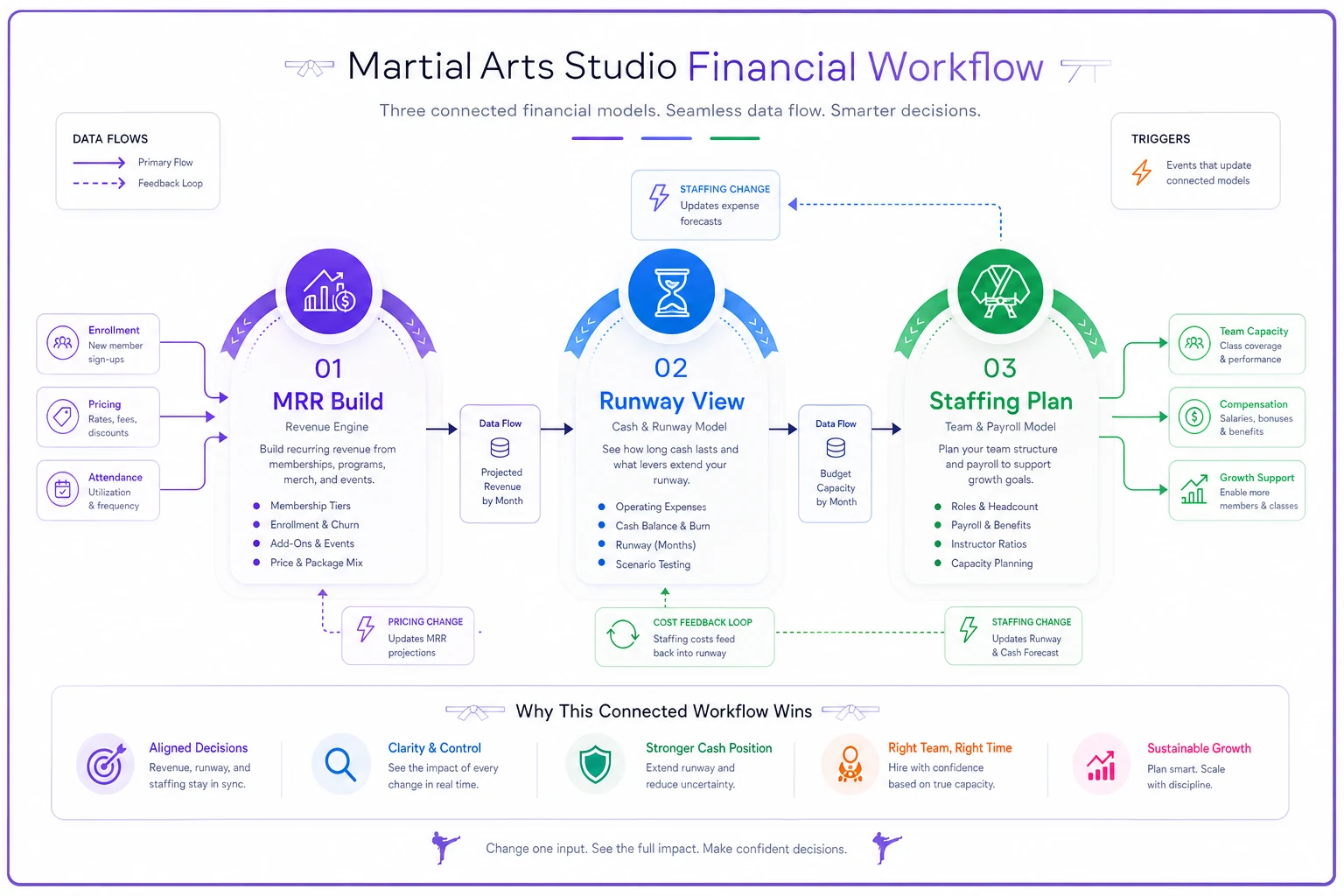
The diagram below shows how information flows between the three templates — each one feeds the next, so a change in any single input ripples through the whole model.
1. The MRR build
-
Starting count
-
Expected net adds per quarter (new signups minus churn)
-
Average price per member in that category
-
Planned price increases and when they hit
The mistake here is modeling gross adds and ignoring churn. A studio adding 12 members a month while losing 9 is not growing at 12. It's growing at 3, and the model needs to show that honestly or every downstream number is fiction.
2. The runway view
Runway is cash on hand divided by monthly burn — but for a growing studio, burn changes every time you hire or sign a lease. This template should show your cash balance projected forward, factoring in every planned hire and capital outlay from the other tabs. The number you're watching is your runway floor: the minimum months of cash you refuse to drop below. For most studios that's somewhere in the 3–4 month range of full operating cost.
3. The staffing plan
Map instructor and admin capacity against projected class demand. Every full-time hire is a big step-change in cost, so this tab is where triggers live. It should show, quarter by quarter, your class utilization and the point where you cross into needing another body.
The three tabs feed each other. Staffing costs flow into runway. MRR feeds cash into runway. Price changes in the MRR tab change how fast runway rebuilds after a hire. Change one input and you should watch the effect ripple through all three.
Comparison: reactive vs. triggered decision-making
Putting these two approaches side by side makes the difference pretty hard to ignore. The triggered column doesn't require more effort — it just moves the thinking to a calm moment instead of a crisis one.
| Decision | Reactive approach | Triggered approach |
|---|---|---|
| Price increase | Raise when panic sets in about margin | Scheduled review each Q; auto-raise if per-class profit drops below threshold |
| Adding a class | Add when current classes overflow and members complain | Add when target class hits ~85% utilization for two straight months |
| Hiring instructor | Hire when current staff is burned out or quits | Hire when projected demand crosses capacity + runway floor is safe |
| Opening a site | Open when feeling ambitious or cash looks big | Open only when site 1 hits defined margin + cash buffer + repeatable SOPs |
| Taking capital | Borrow when cash is already tight | Arrange when strong, deploy against a pre-planned capacity move |
The right column costs you nothing extra. That's the entire value of the model.
The quarterly decision triggers
This is the part owners can actually run each quarter. Sit down with the three templates, update the actuals, and check each trigger. If a condition is met, the action isn't optional — that's the whole discipline.
-
Pricing trigger. If loaded per-class profit has dropped below your floor (say, a decline of more than 8–10% from your baseline), a price increase is scheduled for next cycle. No debate.
-
Class-add trigger. If a class category has run above ~85% capacity for two consecutive months, add a slot or a section. Waiting past this point costs you trials that never convert because the room feels crowded.
-
Hiring trigger. If projected demand over the next two quarters exceeds current staff capacity and the hire keeps you above your runway floor, start recruiting now — hiring takes 60–90 days to do well.
-
Runway trigger. If projected cash dips below your floor in any of the next four quarters, freeze discretionary spend and revisit pricing before anything else.
-
Capital trigger. If you're above your cash buffer and your model shows a capacity investment paying back within your target window, that's the green light to line up financing — while you're strong, not desperate.
-
Expansion trigger. A second site only unlocks when site 1 hits its defined margin, holds it for two quarters, and runs on documented SOPs someone else could follow.
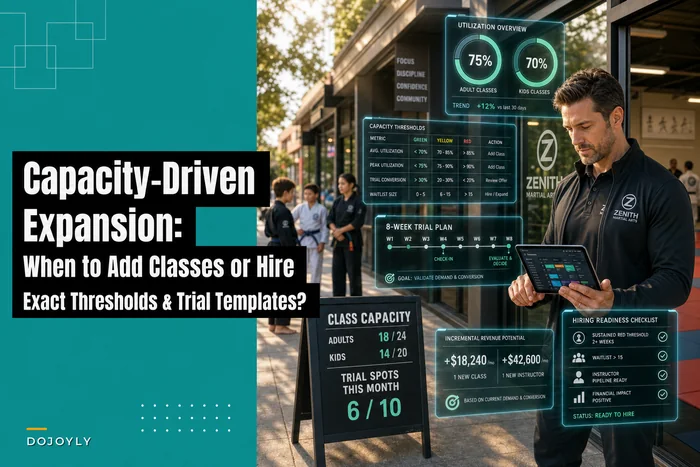
The thresholds around capacity deserve real precision — the exact utilization and cost numbers that justify each move are laid out in this deep dive on capacity-driven expansion thresholds.
Sensitivity scenarios: model the bad quarters on purpose
A model that only shows the plan going right is a fantasy. Build three versions of your projection and keep them side by side:
-
Base case your realistic expected net adds and churn.
-
Downside churn runs 30–40% higher than expected, net adds slow. What happens to runway? When would you have to pull a lever?
-
Upside demand runs hot. Do you have the capacity and cash to catch it, or would you turn people away?
The point of the downside case isn't pessimism. It's knowing your break-glass moves before you need them. When you've already decided that a 35% churn spike means you delay the second instructor by a quarter and hold your current price one cycle longer, a bad quarter becomes a plan instead of a panic.
One pattern worth flagging: studios almost always underestimate summer churn and holiday-season slowdowns. If your model uses a flat monthly net-add number, your runway projection will look smoother than reality and you'll get surprised twice a year, every year.
When this level of modeling makes sense — and when it doesn't
When it makes sense: you're past roughly 120–150 members, you've got at least one employee besides yourself, and you're seriously weighing a hire, a bigger space, or a second location in the next couple years. At that stage the cost of a wrong move is large enough that a few hours of modeling pays for itself many times over.
When it's overkill: you're a solo instructor with 40 students in a shared space. You don't need a five-year sensitivity table. You need to nail your unit economics and pricing first. A giant model at that stage is procrastination dressed up as strategy.
Who should NOT open a second site off this model: anyone whose first location still depends on the owner teaching most of the schedule. If site 1 can't run without you, site 2 will just spread you thinner across two operations that both underperform. The expansion trigger exists specifically to stop this.
A real scenario
A single-location studio running about 190 members had healthy cash but flat growth for three quarters. The owner was teaching six classes a week and assumed the plateau meant the market was tapped out.
Running the numbers told a different story. Two class slots — the 5:30pm adult and the Saturday kids — were sitting above 90% utilization for months, quietly rejecting trial students because the mat felt packed. Meanwhile the mid-morning adult class ran at maybe 40%. The model showed that adding one part-time instructor to open a second evening section, funded by a modest price adjustment on new signups, kept the runway floor intact and projected roughly 25–30 net new members over the following year.
The owner set the hiring trigger, hit it the next quarter, and made the move. Within about eight months membership was in the low 220s and — more importantly — the owner had dropped two of their own teaching slots. The plateau was never a demand ceiling. It was a capacity decision that had no trigger attached, so it never got made. Keeping the underlying per-class economics honest through all of this leaned heavily on the discipline in this studio financial operations playbook.
Governance: the checklist for partners and investors
If you have a business partner, silent investor, or even a spouse with money in the studio, the model becomes a shared language instead of a source of arguments. Run these checks before any major decision:
-
Does the move keep us above the agreed runway floor in the base and downside case?
-
Which pre-set trigger authorized this? (If none did, why are we doing it?)
-
What's the payback window, and does it fit our target?
-
What's the exit plan if the downside case plays out for two straight quarters?
-
Who has authority to pull each lever without a full partner meeting, and where's the line?
-
Are the three templates updated with actuals through last quarter before we decide?
The value of writing these down isn't bureaucracy. Disagreements get settled against numbers and pre-agreed rules instead of against whoever's more stubborn that week. Partnerships rarely blow up over a bad decision — they blow up over an unauthorized one that felt fine to one person and reckless to another.
Keeping the model alive instead of letting it die in a folder
The single biggest failure with multi-year models isn't building a bad one. It's building a good one, admiring it, and never opening it again. A model that isn't updated with real actuals every quarter drifts into fiction fast, and a fictional model is worse than none because it gives false confidence.
The quarterly cadence is what keeps it honest. Update actuals, re-run the three cases, check every trigger, decide, move on. Ninety minutes a quarter. This is where studio management software earns its place — not as a magic forecasting engine, but as the thing that keeps your MRR, churn, utilization, and cash numbers accurate and one click away, so updating the model isn't an archaeology project through six spreadsheets and a shoebox of receipts. When the actuals flow in cleanly, the discipline sticks. When you have to manually rebuild the data every quarter, the model quietly dies by March.
Set a recurring 90-minute quarterly meeting to update actuals and check triggers.
Build the structure once. Attach a trigger to every big lever. Check them every quarter against real numbers. That's the whole system — and it turns the scariest decisions in your business into ones you already made, calmly, a year before the pressure ever arrived.
Build the structure once. Attach a trigger to every big lever. Check them every quarter against real numbers. That's the whole system — and it turns the scariest decisions in your business into ones you already made, calmly, a year before the pressure ever arrived.
Ready to elevate your dojo operations?
Join 500+ martial arts studios using Dojoyly to save time, reduce scheduling conflicts, and improve member engagement.