


Most studios don't have a marketing problem. They have a marketing operations problem. The ads run, the leads come in, and then everything downstream turns into a mess of missed calls, half-filled CRM fields, trial bookings nobody confirmed, and new students who vanish after week two. The spend looks fine. The pipeline looks broken.
The difference between a studio that grows predictably and one that limps from promo to promo usually isn't the quality of the campaign. It's whether marketing is wired into operations as a repeatable system—with owners, service levels, and numbers attached to every stage. That's what a studio marketing operating system actually is. Not a funnel diagram. The operational plumbing that moves a stranger from "clicked an ad" to "paying member" without anyone dropping the ball.
This post is about the mechanics. Not messaging, not hooks, not which platform to run ads on. The boring stuff that actually determines whether your ad money turns into members.
Why marketing leaks happen between the ad and the mat
The reason pipelines leak is almost always structural. A lead doesn't vanish because your front desk person is lazy. It vanishes because nobody defined who owns the lead in the first ten minutes, what "owns" actually means, or what happens if that person is teaching a class when the lead comes in.
In real operations, this breaks down at the seams—the handoffs. A lead fills out a form at 6:40pm during peak class time. The front desk is on the floor. The lead gets a text back at 9:15pm when the studio's already closed. By then they've booked a trial somewhere else, or the impulse is just gone. Nothing in that sequence was a marketing failure. It was an operational one: no response time standard, no fallback owner, no automated acknowledgment to hold the lead's attention while the team was busy.
A few patterns show up over and over:
-
Leads with no owner. Everyone assumes someone else is handling follow-up.
-
No defined response window. "We call them back when we can" is not a system.
-
Trial booked, never confirmed. The person books online and then gets radio silence until the day of, so half don't show.
-
Trial day with no script. The instructor teaches a great class but nobody asks for the sale, so the lead walks out "thinking about it."
-
No 30-day tracking. The new member joins and then falls off the radar because onboarding isn't owned by anyone specific.
Each of these is a gap between stages. And gaps compound. A studio converting trials at 40% that closes two of these handoff problems can hit 55% without spending another dollar on ads.
The four-stage map: lead → trial → trial-day → 30d
If you want marketing to behave like an operation, you need one shared map with stage names everyone actually uses consistently. Not "warm lead" and "hot prospect"—those mean different things to different people. Use concrete, observable states.
Simplify class bookings and attendance tracking.
Dojoyly helps you schedule, confirm, and manage every class effortlessly.
- Unified class & student management
- Automated member notifications
- Instructor scheduling & availability
No credit card required
Here's the backbone most studios should run:
| Stage | Definition (what has to be true) | Owner | Target SLA / conversion |
|---|---|---|---|
| Lead | Form submitted, call logged, or walk-in captured with contact info | Front desk | First touch within 10 min (business hrs), auto-ack instantly |
| Trial booked | Specific class date/time on the calendar, confirmed by lead | Front desk | 60–70% of leads booked |
| Trial-day | Lead physically attends the trial class | Instructor + desk | 70–80% of booked trials show |
| 30-day member | Enrolled and still attending at day 30 | Onboarding owner | 45–60% of trial attendees enroll |
The numbers in that last column are rough targets, not laws. A kids-heavy program behaves differently than an adult BJJ gym. What matters more than hitting a specific percentage is that you measure each stage separately so you know exactly where the leak is.
This is the single biggest shift. Most owners track one number—"we signed 12 people this month"—with no idea whether the problem is lead volume, booking rate, show rate, or close rate. Those are four completely different problems with four completely different fixes. If your show rate is 50% but your close rate on people who actually show is 80%, putting more money into ads is the wrong move. You have a confirmation problem, not a traffic problem.
The insight most people miss
Trial-day is where studios overspend attention and underspend systems. Owners obsess over delivering a great first class—which matters—but the data usually shows the bigger leak is between booking and showing up, not on the mat. A booked trial with no confirmation sequence shows up at maybe 55%. The same trial with a confirmation text, a reminder the night before, and a "what to bring / where to park" message shows up closer to 80%. Same class. Same instructor. Purely operational difference.
SLA handoffs: where the baton gets dropped
An SLA is just a promise with a clock on it. Marketing leaks almost always trace back to a handoff that had no clock.
Two handoffs matter most, and both deserve written rules.
Handoff 1: Lead → Front desk. When a lead comes in, the clock starts. The rule should be specific: acknowledged instantly (automated is fine), human first-touch within 10 minutes during business hours, and a defined fallback if the primary owner is teaching. Speed matters a lot here. The drop-off between a 5-minute response and a 60-minute response is significant—the lead's attention has moved on, they've opened other tabs, and the window is gone.
Handoff 2: Front desk → Onboarding. This one gets ignored constantly. The trial converts, the desk celebrates, and then the new member enters a vacuum. Who schedules their next three classes? Who introduces them to a regular? Who checks in at day 7 and day 21? If the answer is "whoever remembers," you'll lose a predictable slice of people in weeks two and three—right when the newness wears off and life gets in the way.
The whole machine lives or dies on the front desk. If you don't already have documented response standards and escalation rules, that's the first thing to build—the front-desk operations manual with inquiry SLAs and conversion scripts covers the scripts and escalation trees that keep this handoff from collapsing. The back half—what happens once someone enrolls—is its own discipline. The first-30-days onboarding workflow breaks down exactly who owns what after the sale.
A simple handoff workflow in plain text
Here's how a clean lead-to-trial flow actually runs, start to finish:
-
Lead submits form → automated acknowledgment fires within seconds ("Got it, someone will call you shortly").
-
Lead drops into a queue visible to the front desk with a 10-minute timer.
-
Front desk calls/texts, books a specific trial class, logs the date.
-
Automated confirmation goes out immediately after booking.
-
Reminder sequence
24 hours before + 2 hours before, with logistics (what to wear, where to park, arrive 10 min early).
-
Trial day
instructor flagged that a trial is attending, desk greets by name.
-
Post-class
desk runs the enrollment conversation same-day (not "think about it and let us know").
-
On enrollment → lead handed to onboarding owner, who schedules the next three classes before the member leaves.
-
Day 7, day 21 check-ins logged and owned.
Visualized below is the same handoff workflow so you can see owners and timing at a glance.
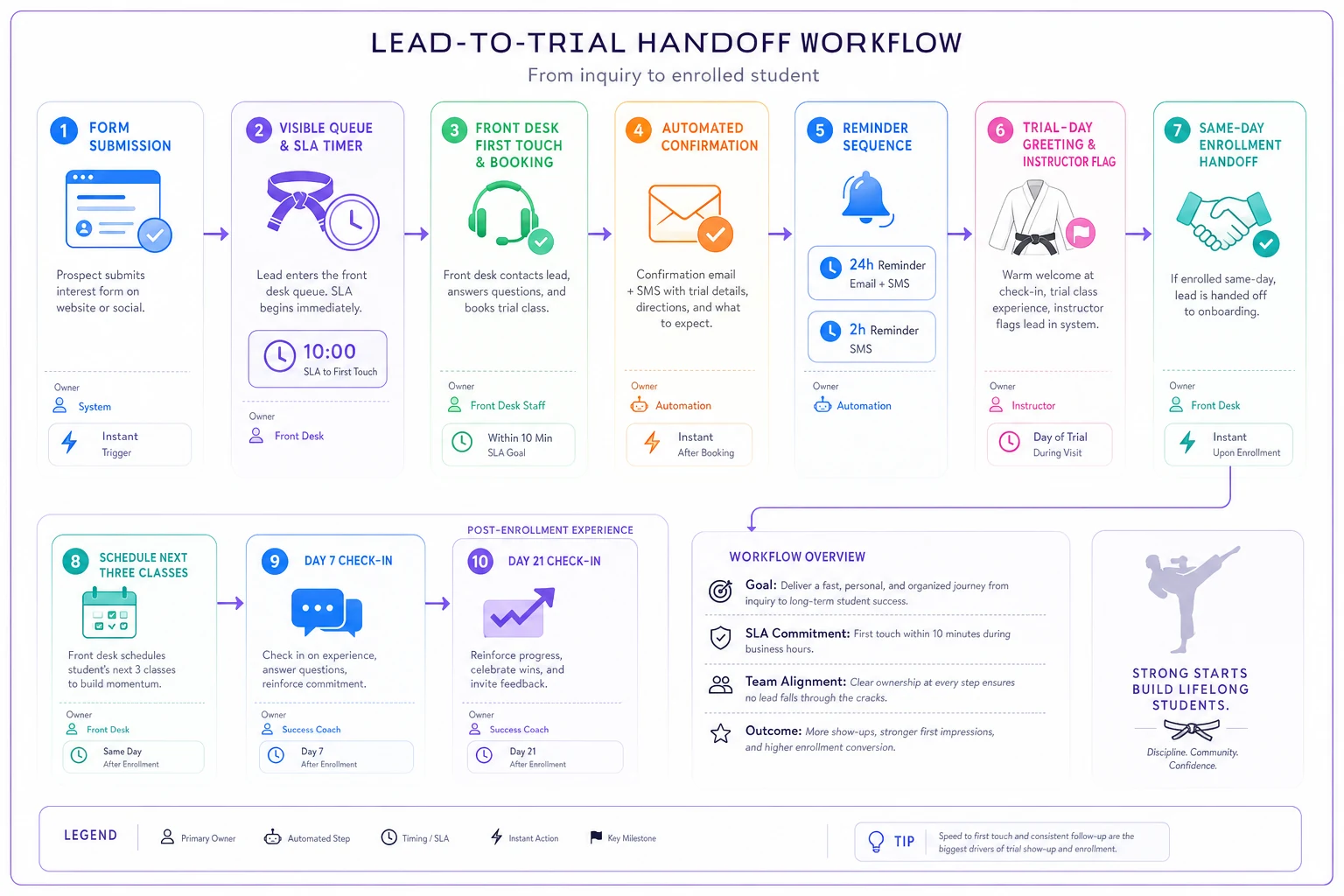
Notice how much of this is just making sure the next step is owned and timed. There's very little cleverness involved. It's reliability. The studios that struggle with this aren't failing because of bad staff—they're failing because the sequence lives in people's heads instead of on paper.
LTV-driven acquisition budgets (so you stop guessing)
Most studios set their ad budget by feel—"let's try $800 this month"—and then judge it by how many signups seemed to come in. That's backwards. Your acquisition budget should be a function of what a member is actually worth over their lifetime.
The logic is straightforward once you have the LTV number. If a member stays an average of 14 months at roughly $150/month, that's about $2,100 in gross revenue per member. Subtract your rough cost to deliver (instructor time, space, overhead) and you land on a contribution margin—somewhere around $1,200–$1,400 per member in this example. That margin is the ceiling that tells you how much you can spend to acquire one.
Here's a basic template to work it backward:
| Input | Example value |
|---|---|
| Avg member lifetime | ~14 months |
| Avg monthly revenue | ~$150 |
| Gross lifetime revenue | ~$2,100 |
| Contribution margin per member | ~$1,300 |
| Max allowable CAC (acquisition cost) | target 20–30% of margin → ~$260–$390 |
| Lead → member conversion (full funnel) | ~15% |
| Max cost per lead | CAC × conversion → ~$40–$58 per lead |
Now your budget has a foundation. If you want 10 new members and your full-funnel conversion is 15%, you need roughly 67 leads. At your max cost-per-lead, you know the ceiling before acquisition stops making sense.
The exact math isn't the point—your numbers will differ. What matters is that the budget is downstream of LTV and conversion, not a number picked out of the air. And the part most people don't think about: improving your downstream conversion (the SLA stuff above) lowers your cost per member without touching ad spend at all. A studio that lifts full-funnel conversion from 15% to 20% just cut its effective acquisition cost by a quarter. That's usually cheaper and faster than trying to optimize the ads themselves.
When spending more on ads is the wrong move
-
When your show rate is below 65%—fix confirmation first.
-
When your close rate on trials who attend is below 60%—fix the trial-day conversation first.
-
When day-30 retention is weak—you're putting new members into a leaky bucket and just paying to replace churn.
Ad spend should be the last lever you pull once the pipeline is actually holding water. Scaling traffic into a broken funnel is how studios burn cash and conclude that marketing doesn't work for them.
The weekly ops cadence that keeps it running
A map and a budget are useless without a rhythm to review them. Studios that stay predictable run a short, boring weekly meeting on the pipeline. Thirty minutes, same day every week, same metrics every time.
Weekly (30 min, pick a fixed day):
-
Review last week's stage numbers
leads in, trials booked, trials shown, enrolled.
-
Flag any stage that dropped below its SLA or target.
-
Review every lead older than 48 hours with no contact logged—these are your live leaks.
-
Confirm the week ahead's booked trials are all confirmed.
-
One action item per leak. Not ten. One.
Monthly:
-
Recalculate cost per lead and cost per member against your LTV ceiling.
-
Review the 30-day retention cohort from last month.
-
Adjust budget up or down based on whether CAC is under your max allowable.
Quarterly:
-
Revisit LTV assumptions (has average tenure or pricing shifted?).
-
Review which lead sources produce members who actually stick, not just members who sign.
One action item per leak. Not ten. One.
That last quarterly point is underrated. Two lead sources can look identical at signup and wildly different at month six. Cheap leads that churn fast are more expensive than pricier leads that stay. You only see that if you track lead source all the way through to 30-day retention and beyond.
Don't forget the back end of the lifecycle feeds the front. Members who leave on good terms are a lead source too—alumni re-engagement programs are often the cheapest "new" members you'll ever get, because the trust is already built.
A real scenario
A single-location studio running mixed kids and adult programs was spending around $1,100/month on ads and generating roughly 55–60 leads. They were signing about 6 new members a month and couldn't figure out why it felt like so much money for so little result.
When they broke the funnel into stages, the problem was obvious. Leads to booked was fine—around 60%. But booked to showed was sitting at about 50%, and nobody was confirming trials beyond the initial booking. Trials who actually showed were closing at nearly 80%. The instructors were great. The leak was almost entirely in the gap between booking and actually showing up.
They didn't change the ads at all. They added a two-step reminder sequence, assigned the front desk a 10-minute response SLA with a fallback owner during class times, and moved the enrollment conversation to same-day instead of "let us know whenever." Show rate climbed into the mid-70s over about two months. Same ad spend, same leads—monthly signups moved from around 6 to roughly 9–10. Effective cost per member dropped by close to a third, purely from closing operational gaps.
The lesson they took away: they'd been treating a confirmation problem like a traffic problem for almost a year.
Who this system is overkill for
If you're a brand-new studio doing a handful of leads a month, don't build an elaborate SLA machine yet. You can manage it in your head, and the overhead of tracking will cost more than it saves. The system earns its keep once you're past roughly 30–40 leads a month, when things genuinely start slipping through cracks and "I'll remember to follow up" stops being true.
It also doesn't help if you're not willing to actually look at the numbers weekly. A beautiful pipeline map that nobody reviews is just a document. The cadence is what makes it work, and the cadence requires discipline more than it requires tools.
Where software fits (and where it doesn't)
Most of what makes this work is discipline, not software. But a few pieces genuinely benefit from automation—specifically the parts humans forget or physically can't do fast enough. Instant lead acknowledgment, confirmation and reminder sequences, SLA timers that flag an aging lead before it goes cold, and clean stage-by-stage reporting so your weekly meeting isn't someone manually counting spreadsheet rows.
AI-assisted operational platforms handle the drudge layer well here: auto-acknowledging leads the second they arrive, triggering the reminder cadence without anyone remembering to do it, nudging the front desk when a lead crosses its SLA window, and rolling up lead-source-to-30-day data so you can actually see which sources produce members who stay. That frees your team to focus on the parts that genuinely need a human—the trial-day conversation and the relationship itself.
The real win isn't the automation anyway. It's the shift in how you think about marketing: it stops being something you spend money on and hope works, and becomes a measured operation with owned handoffs, timed responses, and a weekly rhythm. Once the pipeline is wired that way, growth stops feeling random—and you know, every single week, exactly where to push.
Ready to elevate your dojo operations?
Join 500+ martial arts studios using Dojoyly to save time, reduce scheduling conflicts, and improve member engagement.